What Are AI Real Estate Title Search Tools? (And Why They Matter)
An AI real estate title search tool is software that uses artificial intelligence to automatically scan public records, identify ownership history, and flag potential title issues on a property in a fraction of the time it takes a human to do the same work manually. If you are buying property, refinancing, or working as a real estate professional, this technology directly affects how fast and how safely a deal gets done.
I want to start with the honest truth here. Most buyers never think about title searches until something goes wrong. But a clean title is the foundation of every safe real estate transaction and AI is now completely changing how that foundation gets built.

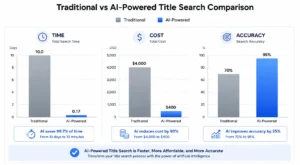
days required for traditional manual searches.
The Traditional Title Search Problem: Hours of Work, Errors and Expense
Title search software powered by artificial intelligence exists largely because the traditional process was genuinely painful. Before AI tools entered the picture, performing a real estate title search meant sending someone to physically dig through courthouse records, county clerk files, and public databases to build a complete property ownership timeline from scratch.
Avi Hacker put it clearly in his real estate education work: professionals traditionally spent hours manually combing through public records to check for liens, easements, and potential issues one document at a time. That meant starting over on essentially every search.
The manual process typically takes three or more business days to complete. Costs range from around five hundred dollars on the lower end to well over two thousand dollars depending on the property’s complexity and location. And human review of that many pages across that many days naturally introduces errors.
The real danger is not just the time or money. A missed lien or an overlooked ownership gap can create serious legal complications after a property closes. In real estate due diligence, a single overlooked document can unravel an entire transaction.
Traditional title searches also created a closing bottleneck. When a title search takes three to five days, every deal waits on that result. Real estate technology solutions built around AI now compress that timeline dramatically.
Why Title Searches Matter (Even If You Did Not Know)
A title search is the process of reviewing a property’s legal history to confirm who actually owns it and whether any outstanding claims or obligations are attached to it. Most buyers focus on the property itself and overlook this step entirely until their closing agent brings it up.
Chain of title search records establish an unbroken line of ownership from the very first recorded owner to the current seller. If that chain has gaps, disputes, or missing transfers, the buyer could inherit legal problems they never anticipated.
Title defect identification protects buyers from inheriting unpaid taxes, contractor liens, court judgments, and other financial obligations tied to the land itself rather than to any individual person. Property title verification also guards against fraud where a seller might attempt to transfer ownership of a property they do not fully or legally own.
When a title search is thorough and accurate, a clean transfer of ownership happens. When title defects go undetected, buyers can face costly legal battles long after moving in.
The 82% Shift: Why AI Title Search Matters in 2026
Consumer behavior in real estate has shifted faster than most industry professionals expected. Research shared by real estate educator Lisa shows that 82% of consumers now use ChatGPT or another AI tool when searching for real estate decisions. That number reflects a fundamental change in how modern buyers discover, evaluate, and act on property information.
AI powered real estate tools are no longer a niche innovation for tech forward firms. They have become part of how buyers expect the process to feel: faster, clearer, and more transparent from start to finish.
Real estate technology solutions that incorporate AI into the title search process directly address what buyers now want. Buyers in 2026 expect faster closings and fewer delays. When a traditional title search takes days and an AI driven search takes hours, the competitive advantage for professionals using AI becomes obvious.
As Badal Gupta observed in his analysis of AI’s impact on the property sector, AI has heavily transformed the real estate industry by enabling professionals to streamline document creation and analysis across multiple formats. Title search is one of the most meaningful areas where that transformation is already producing measurable results.
For real estate professionals who have not yet adopted AI title search tools, the risk is not just inefficiency. The risk is falling behind clients and competitors who now expect and receive a faster and more accurate standard of service. Understanding how AI systems discover and recommend professionals helps you position yourself to win in this AI-powered marketplace.
How AI Real Estate Title Search Tools Actually Work (Step by Step)
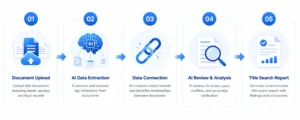
Understanding how to use AI for title search becomes much easier once you see the actual workflow. The process is not as complicated as most people assume. At its core an AI real estate title search tool takes documents that previously required hours of careful human reading and processes them in minutes by following a clear and logical sequence from document input all the way through to a finished professional report.
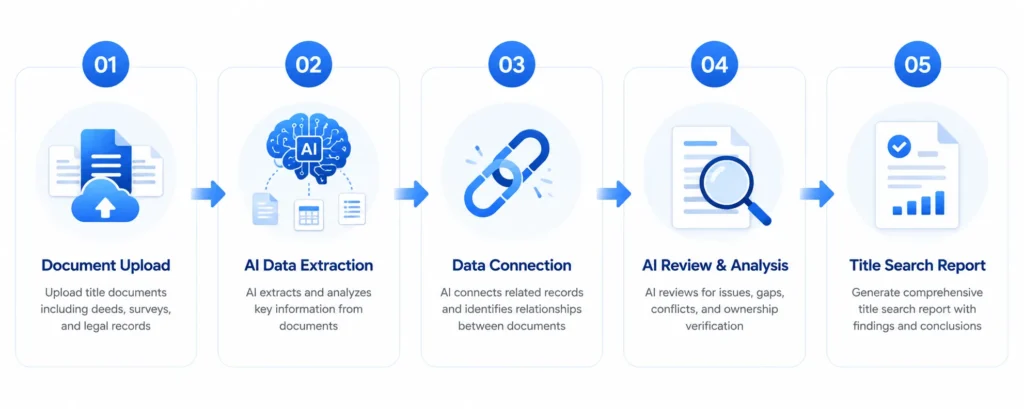
document upload to finished report.
I find the best way to understand this technology is to walk through each stage the way you would actually experience it when using one of these platforms yourself.
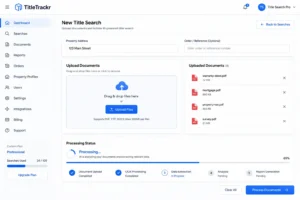
Step 1: Uploading Documents (The Input)
The first thing you do with any AI title search platform is feed it the source documents. Most modern tools accept a wide variety of file formats including scanned PDFs, image files, and digitally created documents. You simply drag and drop your files into the upload interface or select them from your local storage.
What makes this stage genuinely impressive is the flexibility. You can upload warranty deeds, quit claim deeds, mortgage documents, surveys, court judgments, power of attorney documents, and tax records all in one batch. The property records database that the AI works from grows richer with every document you add to the session.
Deed analysis automation begins the moment your files land in the system. You do not need to label each document or tell the AI what type of file it is receiving. The platform identifies document categories on its own as part of the processing stage that follows.
Step 2: AI Reads and Extracts Data (The Processing)
This is the stage where the real intelligence shows up. Once your documents are uploaded the AI uses optical character recognition technology to read every word on every page including handwritten notes, old typewritten text, and low quality scans that a human would struggle to read quickly.
Document analysis OCR technology converts those scanned images into readable structured text that the AI can then analyze at a deeper level. After reading the raw text the system begins categorizing what it has found. A warranty deed gets recognized as a warranty deed. A quit claim deed gets categorized separately. A power of attorney document gets flagged as a third distinct category.
The AI then extracts the critical data points from each document. Legal description extraction pulls the exact property boundaries and identifiers from the legal text. The system also captures grantor and grantee names, transaction dates, dollar amounts, and book and page reference numbers that title professionals rely on to verify records in public archives.
What used to require a trained abstractor reading every line with careful attention now happens automatically and with consistent accuracy across every document in the batch.
Step 3: Chain of Title Validation (The Linking)
Once the AI has extracted data from every document it begins connecting the information across all records to build a complete ownership timeline. Chain of title search automation is where AI genuinely separates itself from manual processes because a human can miss a subtle discrepancy while an AI cross references every detail simultaneously.
The AI traces property ownership history from the earliest available record forward through each subsequent transfer. If a deed from 1987 lists a different legal description than a deed from 2003 for the same property the system catches that mismatch and flags it for review.
As Avi Hacker demonstrated in his real estate title workflow, after a simple instruction to analyze documents the AI instantly isolates the current owner, traces the chain of title, flags potential issues, identifies discrepancies, and highlights problems without requiring the user to manually compare documents side by side.
Title defect identification at this stage is particularly valuable. Gaps in ownership history where a property transferred without a clearly recorded deed create serious legal risk. The AI surfaces those gaps immediately rather than letting them hide inside a stack of documents. Real estate title examination that once took trained professionals multiple days now produces preliminary findings in a fraction of that time.
Step 4: Lien and Encumbrance Identification (The Detection)
After validating the ownership chain the AI moves into one of the most legally significant parts of the entire title search process. Encumbrance search automation means the system actively scans for every financial claim or legal obligation attached to the property itself.
Mortgage and lien identification covers outstanding home loans, unpaid contractor bills, federal and state tax obligations, homeowner association assessments, and court ordered judgments. These are the items that can transfer to a new buyer if they go undetected during the purchase process.
Property lien search results from an AI tool are particularly thorough because the system searches across all uploaded documents simultaneously rather than checking one record at a time. Easements that grant neighboring landowners or utility companies specific rights over the property also get captured and flagged during this detection stage.
Avi Hacker’s demonstration showed the AI clearly highlighting tax liens and other encumbrances as distinct findings within seconds of processing the document set. That speed matters enormously in active real estate markets where deals move quickly.
Step 5: Report Generation (The Output)
The final stage transforms everything the AI found into a professional document that real estate attorneys, title insurance underwriters, and closing agents can actually use. Title report generation pulls all extracted data, chain of title findings, flagged defects, and identified encumbrances into a single organized abstract.
The TitleTrackr platform workflow demonstrates this clearly. The finished output is an attorney ready abstract file that users can export directly to PDF or Word format depending on what the recipient needs. Legal grade title reports produced by AI tools follow the same structured format that professionals expect from traditionally prepared abstracts.
The turnaround difference is significant. A manually prepared title abstract typically requires three or more business days to complete. An AI generated title report covering the same property and the same document set can be ready within the same working session. For professionals managing multiple transactions simultaneously that time savings compounds into a meaningful competitive advantage across an entire business operation.
Why Switch to AI Title Search: Speed, Accuracy and Cost Benefits
The business case for AI title search automation is honestly one of the clearest I have seen in any area of real estate technology. When a single tool can reduce the time spent on a critical process from several days down to a few minutes while simultaneously cutting costs and improving accuracy, the question shifts from “should I consider this?” to “why haven’t I made the switch yet?”
Let me walk through the five most meaningful benefits that real estate professionals and title companies are experiencing right now with AI powered title search tools.
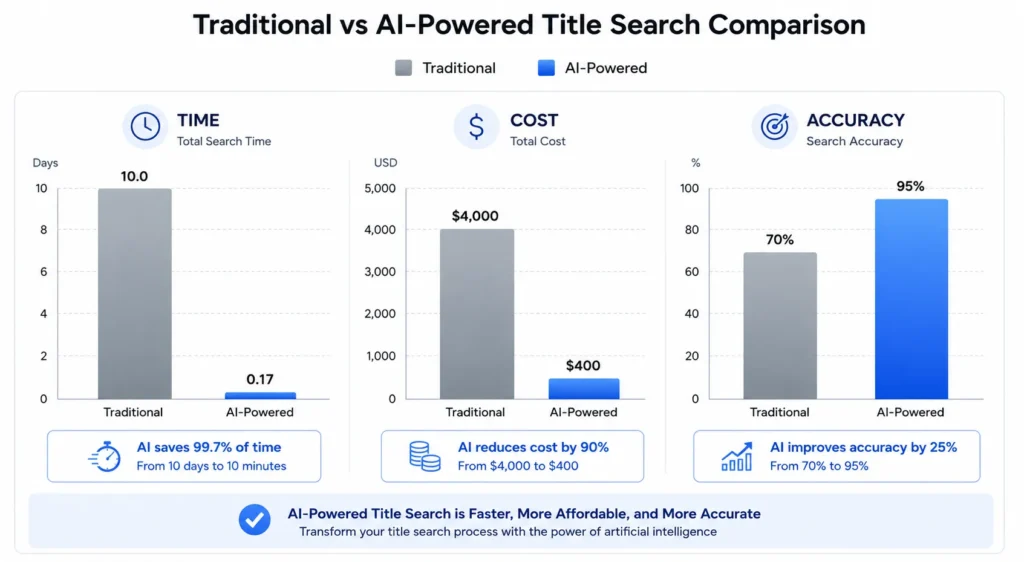
99% compared to traditional manual searches.
Benefit 1: Speed From Days to Minutes
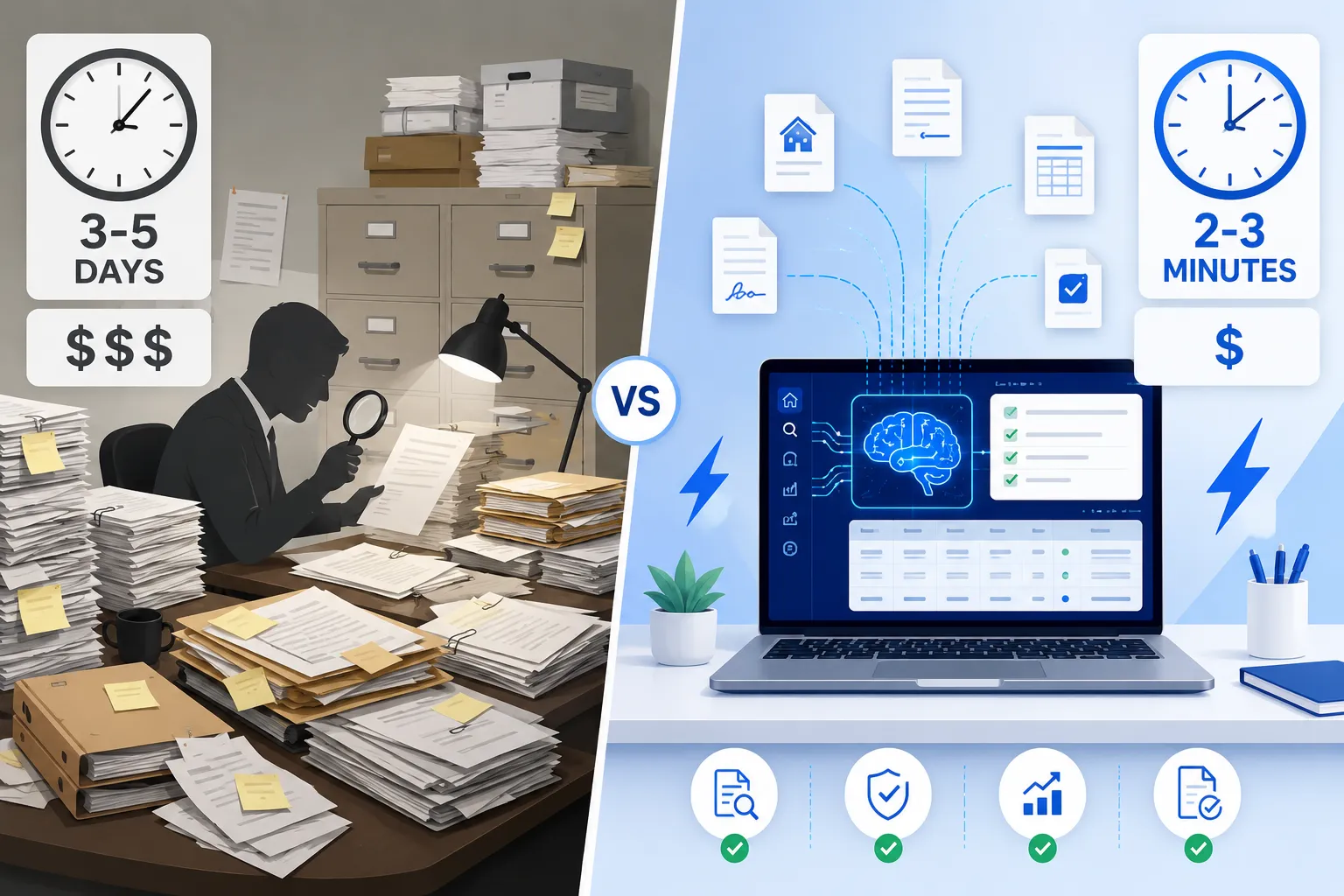
The most immediately obvious advantage of AI title search is the dramatic reduction in turnaround time. A traditional manual title search typically takes three to five business days to complete depending on the complexity of the property’s ownership history and the accessibility of local public records.
AI title search tools process the same volume of documents in roughly two to three minutes. That is not a small improvement. That is a complete transformation of what the closing timeline looks like for everyone involved in the transaction.
Avi Hacker demonstrated this clearly in his real estate workflow, noting that instead of wasting hours sorting through documents manually, AI tools allow professionals to immediately spot red flags without the lengthy research process that used to consume entire workdays.
Title search time savings of this magnitude have a ripple effect across the entire transaction. Buyers experience less waiting and less anxiety. Sellers move to closing faster. Agents can manage more transactions simultaneously without sacrificing quality. Closing timeline acceleration becomes a natural outcome rather than something that requires extraordinary effort from the team.
In competitive real estate markets where multiple offers arrive on the same property within days, the ability to complete due diligence faster gives buyers and their representatives a genuine structural advantage that slower traditional processes simply cannot match.
Benefit 2: Cost Savings of 75 to 87 Percent
Cost reduction is where AI title search tools make the strongest impression on business owners and decision makers. A manually conducted title search typically costs between five hundred and two thousand dollars per property depending on the market, the complexity of the search, and the professional performing the work.
AI title search platforms generally price individual searches between fifty and three hundred dollars depending on the tool and the depth of analysis required. That pricing difference represents a cost reduction of approximately 75 to 87 percent per search compared to traditional methods.
To put that in real business terms: a title company processing one thousand searches per year at an average manual cost of one thousand dollars per search spends one million dollars annually on title search labor and vendor fees. Switching to an AI platform at an average cost of one hundred fifty dollars per search brings that annual expense down to one hundred fifty thousand dollars. The savings in that scenario exceed eight hundred fifty thousand dollars in a single year.
Title underwriting automation delivers these savings not by cutting corners but by eliminating the labor intensive manual steps that made the traditional process expensive in the first place. Most businesses that make this transition report recovering their software investment well within the first six to twelve months of adoption.
Benefit 3: Accuracy and Fewer Human Errors
Manual title examination is skilled work but skilled humans still make mistakes especially when working under time pressure across multiple files simultaneously. A missed lien, a misread date, or an overlooked ownership gap can create serious legal and financial consequences after a transaction closes.
AI title search tools apply the same consistent criteria to every single document in every single search regardless of how many searches happen in a single day. Title search accuracy improvement through AI comes specifically from this consistency. The system does not get tired, does not rush because of a deadline, and does not skip steps because a document looks similar to one processed earlier.
Title defect identification becomes more reliable because the AI cross references all uploaded documents against each other simultaneously rather than relying on a single reviewer’s memory and attention span across a long working session.
For title companies, lenders, and real estate attorneys, improved accuracy means fewer post closing disputes, fewer title insurance claims, and stronger professional reputations built on consistently thorough work.
Benefit 4: Risk Mitigation Through Earlier Problem Detection
One of the most valuable things an AI title search tool does is surface problems earlier in the transaction process. Title risk assessment happens at the beginning of due diligence rather than at the closing table when fixing a problem becomes dramatically more expensive and disruptive.
AI powered title analysis flags outstanding litigation, unresolved tax obligations, competing ownership claims, and other title defects as soon as the documents are processed. Real estate professionals who identify these issues early can address them, negotiate around them, or advise clients to walk away before significant time and money have been committed to a flawed transaction.
This early warning capability protects everyone in the deal. Buyers avoid inheriting financial obligations they did not know existed. Lenders avoid funding transactions where collateral has unclear ownership. Title insurance companies face fewer claims because the problems that generate claims get caught before the policy is ever issued.
Benefit 5: Competitive Advantage in a Market Where Speed Wins
The competitive pressure driving AI adoption in real estate title search is not subtle anymore. Research from real estate educator Lisa shows that 82 percent of consumers now use ChatGPT or another AI tool when making real estate decisions. That level of market adoption means buyer expectations around speed and transparency have fundamentally shifted.
When your competitors can deliver a completed title search and a clear to close status two full days before your firm can, those competitors win deals that your firm loses. AI powered real estate workflows are no longer a forward thinking innovation reserved for early adopters. Real estate technology solutions built on AI have become the baseline that competitive firms are measured against.
The professionals and companies who treated AI title search as optional in 2023 are discovering in 2026 that the market has moved past them. Adopting AI title search tools now is not about getting ahead of the curve. For many firms it is about catching up to where the industry already is.
The Technology Behind AI Title Search: How the Magic Actually Works
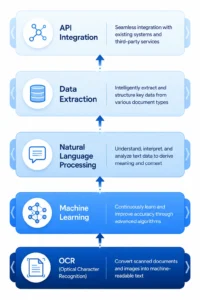
Most people who start using AI title search tools are genuinely surprised by how capable the technology feels from the very first search. What looks like magic from the outside is actually a layered combination of five distinct technologies working together in sequence. Understanding what sits under the hood helps you use these tools more effectively and helps you explain the value to colleagues or clients who are skeptical about adopting automated title search with AI technology.
I want to break this down in plain language because the technical concepts are genuinely approachable once someone removes the jargon.
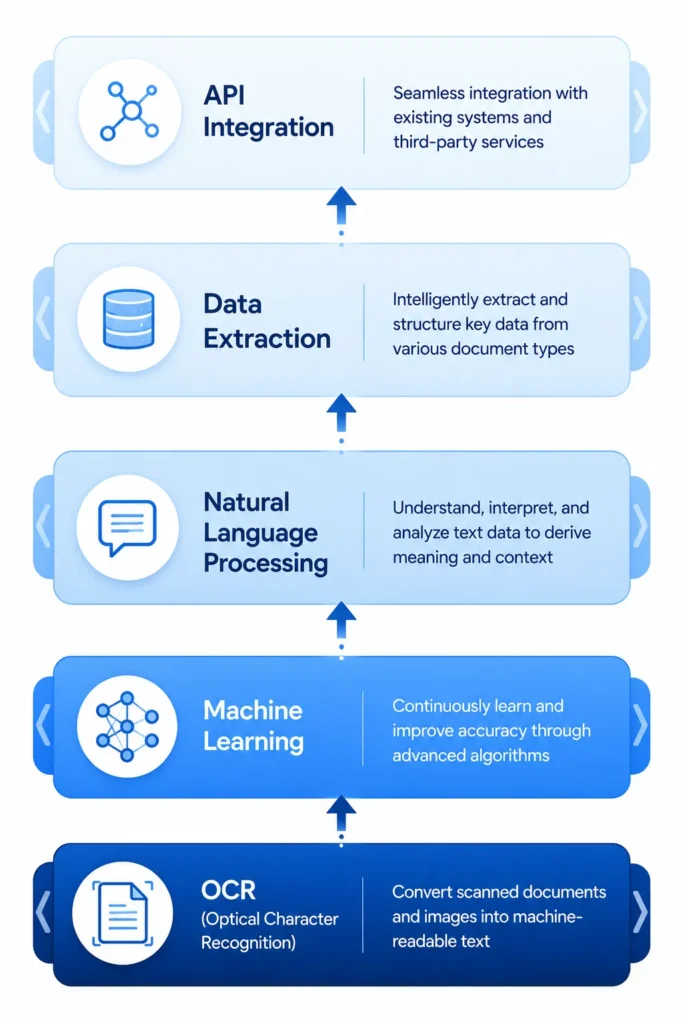
to automate document analysis and title examination.
OCR (Optical Character Recognition): Reading the Unreadable
The first challenge any AI title search system faces is a surprisingly basic one. Most property records are not clean digital text files. They are scanned images of paper documents, some of which are decades old, faded, handwritten, or reproduced at poor quality through repeated photocopying over many years.
Optical character recognition is the technology that solves this problem. Document analysis OCR works by analyzing the visual patterns in a scanned image and converting what it sees into machine readable text that the AI can then process and understand. Think of it as the AI learning to read the way a human would, except the AI reads thousands of pages without losing focus or accuracy.
What impressed me about platforms like TitleTrackr is that their proprietary AI successfully reads scanned PDFs and extracts data automatically even when document quality is inconsistent. The system recognizes warranty deeds, quit claim deeds, and power of attorney documents correctly even when the source scans are far from perfect.
Legal description extraction depends entirely on OCR quality because legal property descriptions are often lengthy, precise, and embedded deep within older document formats. When OCR performs accurately, the AI captures those descriptions correctly. When OCR struggles with document quality, modern platforms have secondary validation layers that catch potential misreads before they affect the final output.
Machine Learning: Getting Smarter Over Time
Once the AI has converted documents into readable text the machine learning layer takes over. Machine learning in the context of AI title search means the system has been trained on enormous volumes of historical property records and deed analysis automation patterns so that it already understands what typical deed structures look like before it ever sees your specific documents.
Property records analysis through machine learning works because most title documents follow recognizable patterns. A warranty deed from 1978 and a warranty deed from 2019 look different on the surface but share the same underlying structure of grantor, grantee, legal description, consideration amount, and notary acknowledgment. The machine learning model has seen thousands of variations of that structure and knows where to look for each data point regardless of formatting differences.
Kadel Labs has highlighted the machine learning feedback loop as one of the key reasons AI title tools improve over time. As more documents pass through the system the model refines its understanding of edge cases, unusual formatting, and regional variations in how records are prepared across different counties and states. The result is a tool that genuinely gets more reliable the more professionals use it.
Natural Language Processing: Understanding What You Actually Mean
Natural language processing is the technology that makes AI title search feel conversational rather than rigid. Traditional property database searches required users to input exact field values using specific syntax. If you typed something in the wrong format the system returned nothing useful.
Natural language processing allows users to express their search intent in plain everyday language and receive accurate results. Automated title search with AI technology powered by natural language processing means a user can type a descriptive request in their own words and the system correctly interprets the underlying data query that request represents.
Demonstrations from platforms including Kadel Labs and others show users typing conversational search requests and receiving structured results that match the intent behind the question rather than just the literal words. AI powered real estate tools that incorporate natural language processing remove the technical barrier that previously required specialized training to use property research databases effectively.
Data Extraction and Structuring: From Messy to Clean
Raw property documents are what data professionals call unstructured information. Pages of legal text contain critical data points scattered throughout paragraphs, tables, signature blocks, and margin notations with no consistent formatting that a computer can easily parse.
AI title search tools solve this through intelligent data extraction that identifies and pulls specific information from its surrounding context. The system locates grantor and grantee names, transaction dates, recorded dollar amounts, book and page reference numbers, and legal property descriptions and then organizes all of that information into clean structured tables within the property records database.
Legal description extraction and data structuring together transform what was previously a document reading exercise into a searchable organized dataset. Title report generation becomes significantly faster when the underlying data is already structured because the system assembles the report from organized fields rather than re reading raw documents. TitleTrackr’s workflow demonstrates this clearly with data table outputs that show extracted information in immediately usable structured format.
Integration Architecture: How AI Title Search Connects to Your Existing Systems
A common concern I hear from title company owners and real estate technology managers is whether an AI title search platform will work alongside their existing software or require everyone to learn a completely separate system. The answer for most modern platforms is that integration is built into the architecture from the start.
API driven platforms like HomesageAI use application programming interfaces to create direct connections between the AI title search engine and existing loan origination systems, title management platforms, and custom internal workflows. An API connection means data flows automatically between systems without requiring manual export and import steps that create delays and introduce transcription errors.
Title plant integration through API architecture means a firm can adopt AI title search capabilities without abandoning the workflow tools their team already knows. The AI engine handles document processing and analysis in the background while results appear inside the familiar interfaces professionals already use every day. This automation workflow approach dramatically lowers the adoption barrier for firms that want the benefits of AI title search without the disruption of a complete platform migration.
What AI Title Search Cannot Do (And When You Still Need Humans)
I want to be completely honest with you here because I think this section is actually the most important one in this entire guide. Every tool has limits and AI title search tools are no exception. Any article that tells you AI can fully replace human expertise in real estate title examination is not giving you the complete picture.
The most accurate way to think about AI title search is as a highly capable first responder that handles the routine heavy lifting so that human experts can focus their energy where human judgment genuinely matters. Understanding where that boundary sits helps you use AI title search tools responsibly and get the best possible outcomes for your clients and your business.
Limitation 1: AI Cannot Interpret Complex Legal Situations
For the vast majority of title searches, AI performs remarkably well. Standard ownership transfers, common lien types, and straightforward chain of title gaps are exactly the kind of clear pattern based problems that AI handles confidently and quickly.
But real estate due diligence occasionally surfaces situations that fall well outside standard patterns. Contested ownership claims involving multiple heirs, property held inside complex family trust structures, boundary disputes that require survey interpretation, and title defects created by decades old court orders all require a level of contextual legal reasoning that current AI systems cannot reliably provide.
As Avi Hacker noted directly in his real estate workflow demonstration, an AI generated title summary serves as a rapid first draft rather than a replacement for a professional official title report. Title defect resolution in complex situations requires a trained human examiner who understands not just what the documents say but what the legal implications are within the specific jurisdiction and circumstances of the transaction.
Chain of title problems that involve unusual recording practices, missing intermediate deeds, or competing claims from unresolved estate proceedings need experienced human eyes to interpret correctly. AI flags the anomaly. A qualified professional determines what the anomaly actually means and what steps are needed to resolve it.
Limitation 2: AI Depends Entirely on Data Quality
This is perhaps the most important practical limitation to understand before relying on any AI title search tool for real estate due diligence. The quality of what an AI produces is directly determined by the quality of the information it receives to work with.
Badal Gupta addressed this limitation explicitly in his analysis of AI in real estate, noting that AI is entirely dependent on the information it receives and that feeding an AI system outdated data will yield inaccurate results. This principle applies directly to title search work where property records databases can contain incomplete entries, missing pages from old scans, recording gaps from periods before digital systems existed, and local recording practices that vary significantly between counties.
When source documents are incomplete or when a county’s public records have not been digitized fully, the AI works with an incomplete picture. Title defect identification under those conditions may miss issues that an experienced human abstractor would catch by knowing the specific local records landscape and knowing where to look beyond the digital database alone.
The practical takeaway is that AI title search tools perform best in markets with well maintained and comprehensive digital records. In areas with older or less complete records, human oversight becomes even more essential.
Limitation 3: AI Cannot Provide Human Judgment or Relationship Context
Real estate transactions are not just legal and financial exercises. They involve real people making significant decisions under pressure with unique personal circumstances affecting every choice along the way.
Badal Gupta captured this limitation clearly when he stated that AI cannot provide genuine human touch or human emotions and that high value clients specifically demand personalized solutions that reflect their individual situations. Title defect interpretation in the context of a real transaction requires understanding whether a buyer has the flexibility to wait for a resolution, whether the seller will negotiate a price reduction to account for a discovered issue, and whether the timeline pressures of a specific deal make certain risks more or less acceptable.
These are judgment calls that draw on experience, relationship knowledge, and an understanding of human motivation that no current AI system can replicate. Real estate due diligence at its best combines data precision with human wisdom and AI title search tools currently provide the data precision side of that partnership.
The Solution: AI and Human Expertise Working Together
The best practice that experienced real estate and title professionals are landing on is not AI alone or human expertise alone. The most effective approach combines both in a deliberate structure where each handles what it does best.
In this hybrid model AI powered title search handles approximately 80 percent of routine searches automatically. The AI processes documents, builds the chain of title, identifies standard encumbrances, and produces a structured first draft report in minutes. A qualified human examiner then reviews the AI output, interprets any flagged anomalies, applies professional judgment to complex findings, and finalizes the report with the authority that only a credentialed professional can provide.
Automated title examination through AI handles the volume and speed challenge. Human expertise handles the complexity and judgment challenge. Together the two produce results that are faster than a purely manual process and more reliable than a purely automated one. This AI and human hybrid approach represents the current best practice in professional title search operations and the direction the entire industry is moving toward as AI title search tools continue to mature.
How to Use AI Title Search: Step-by-Step Beginner Tutorial
Learning how to use AI for title search is genuinely easier than most people expect. Whether you are a real estate agent doing your own preliminary research, a title professional looking to speed up your workflow, or a developer building property tools into a larger system, there is an approach that fits your situation and your budget.
I want to walk you through three distinct approaches so you can choose the one that makes the most sense for where you are right now. Each approach delivers deed analysis automation and faster results compared to traditional manual research. The difference between them is mostly about how much technical setup you want to do and how much you want to spend.
Approach 1: Using a Commercial Platform (TitleTrackr Example)
A dedicated AI title search platform like TitleTrackr is the most straightforward option for professionals who want reliable results without any technical setup. The entire workflow happens inside a clean interface that feels intuitive from the very first session.
Here is exactly how the process works from start to finish:
Step 1: Create a New Abstract
Log into your TitleTrackr account and click the button to create a new abstract or start a new project. The platform prompts you to name the file and associate it with a specific property address so your searches stay organized.
Step 2: Upload Your Documents
Drag and drop your PDF files directly into the upload area. You can add warranty deeds, quit claim deeds, mortgage documents, survey records, and tax filings all in one batch. The platform accepts scanned PDFs and digital documents without requiring any special formatting from you.
Step 3: Wait for AI Processing
This is the part that genuinely impresses first time users. The AI begins processing your uploaded documents immediately. For a typical document set the processing stage takes between one and five minutes. During this time the system reads every document, identifies each document type, and begins extracting structured data automatically through deed analysis automation.
Step 4: Review the Extracted Data Table
Once processing completes you see a structured data table displaying all extracted information. Grantor and grantee names, transaction dates, recorded amounts, book and page numbers, and legal description extraction results all appear in organized rows that are easy to read and review.
Step 5: Check Flagged Issues
The platform highlights any gaps in the ownership chain, identified liens, or inconsistencies between documents. These flags appear clearly so you can focus your review time on the items that actually need attention rather than re reading every page.
Step 6: Export and Share
Click the export button to download your completed title report as a PDF or Word document. Title report generation produces an attorney ready abstract that you can share directly with your client, legal counsel, or title insurance underwriter without additional formatting work.
The entire process from upload to finished report typically takes under ten minutes for a standard residential property with a complete document set.
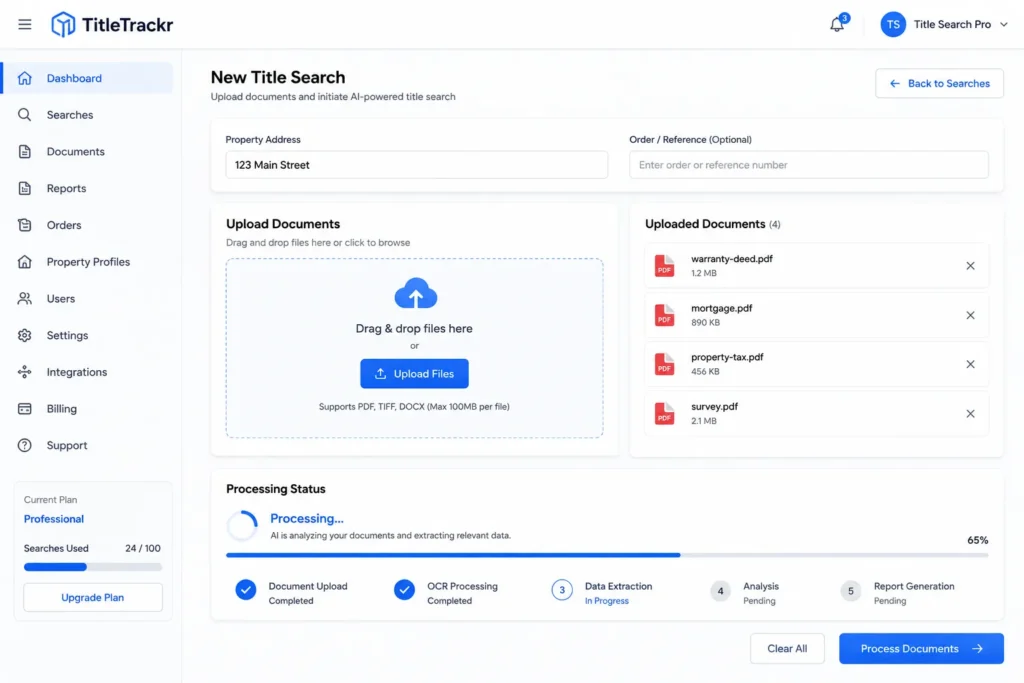
interfaces that require no technical expertise to use.
Approach 2: DIY Using ChatGPT or Claude (Budget Option)
This approach is something most of my competitors never mention and I think that is a real gap in the information available to smaller operators. Solo real estate agents, independent investors, and freelance researchers can build a highly capable automated title search with AI technology using tools they may already have access to.
Avi Hacker demonstrated this workflow clearly using Claude and the results are genuinely impressive for preliminary research purposes. Understanding Claude’s capabilities for document analysis helps explain why it’s particularly effective for this title search use case.
Here is how to set it up:
Step 1: Open Claude Projects or ChatGPT
Log into your Claude or ChatGPT account and create a new Project or custom GPT. Projects allow you to save instructions that persist across all conversations so you do not need to re explain your requirements every time.
Step 2: Write a System Prompt
In the project instructions write a clear description of the role you want the AI to play. Something like: “You are an experienced real estate title analyst. When I upload property documents analyze the ownership history, identify all parties, extract key dates and amounts, flag any liens or gaps in the chain of title, and present your findings in a structured table format.”
Step 3: Upload Your Property Documents
Attach your scanned deeds, mortgage records, or public records downloads directly to your conversation. Claude and ChatGPT both accept PDF uploads and can read document content to perform deed analysis automation at a basic level.
Step 4: Request Your Analysis
Type a simple instruction such as “Please analyze this property’s title history and flag any potential issues.” The AI processes your uploaded documents and returns a structured analysis covering ownership history, identified encumbrances, and any discrepancies it detects.
Step 5: Export Your Results
Copy the structured output into a Word document or ask the AI to format the results as a clean report you can save and share.
This DIY approach works well for preliminary research and first pass screening. Remember that results from this method should always be reviewed by a qualified professional before being used in a formal transaction context.
Approach 3: API Integration for Developers (Technical)
For technology firms and title companies wanting to embed AI title search capabilities directly into existing systems, an API driven approach offers the most seamless long term solution. Platforms like HomesageAI provide direct API access that connects AI title search analysis to loan origination systems, title management platforms, and custom property research applications.
The basic workflow involves obtaining an API key from your chosen platform, writing code that sends property addresses or document files to the API endpoint, and receiving a structured JSON response containing property condition details, ownership status, and identified title issues. That response data then flows automatically into whatever system your team already uses for transaction management.
This automation workflow approach eliminates manual steps entirely for firms processing high volumes of searches. The property records database query, document analysis, and results delivery all happen programmatically in seconds per property rather than requiring any manual interface interaction.
Timeline: What Speed to Expect From Each Approach
One of the most meaningful improvements AI title search delivers over traditional methods is the dramatic reduction in turnaround time. Here is what you can realistically expect:
- Commercial platforms like TitleTrackr: Two to three minutes per property for a standard document set
- DIY Claude or ChatGPT approach: One to five minutes depending on document volume and complexity
- API integration: Results return in seconds per query for automated batch processing
All three approaches produce results significantly faster than the three to five business day timeline that traditional manual title searches require. Title search time savings of this magnitude translate directly into closing timeline acceleration that buyers, sellers, and lenders all benefit from throughout the transaction process.
Best AI Title Search Platforms: Complete 2026 Comparison
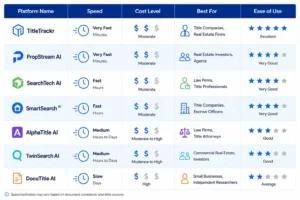
Choosing the right AI title search platform genuinely depends on who you are and what you need the tool to do for your specific workflow. A solo real estate agent researching a single property needs something completely different from a large title company processing hundreds of searches every month. I have gone deep into each of the leading platforms available in 2026 so you can make an informed decision rather than just picking whatever comes up first in a search.
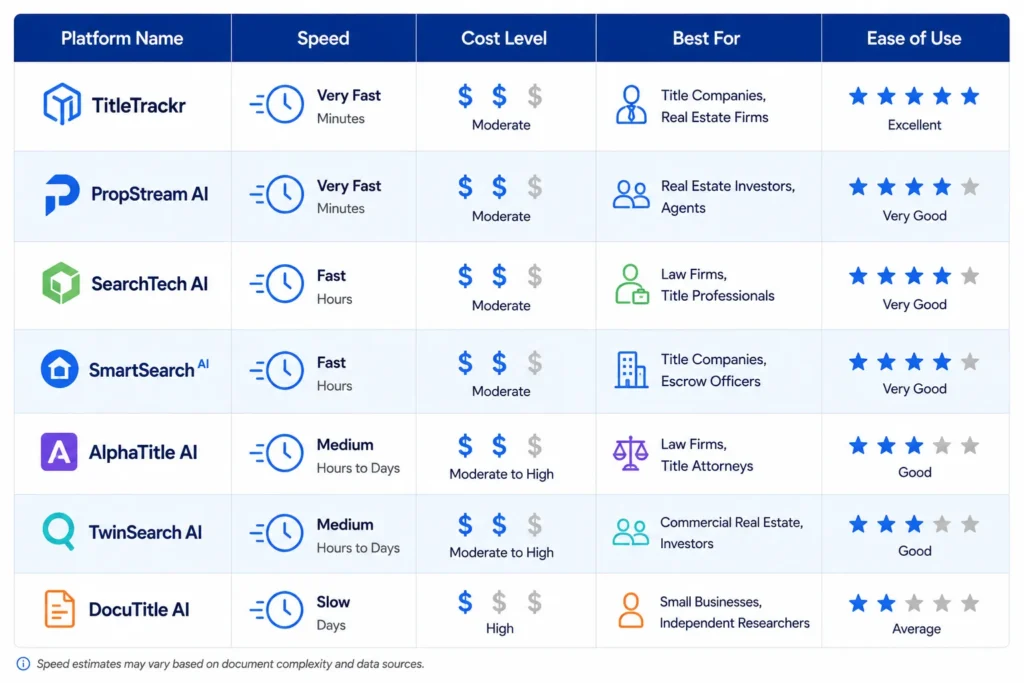
search platforms available in 2026.
Let me walk you through each platform honestly including what each one does well and where each one has limitations.
Platform 1: TitleReport.ai
TitleReport.ai positions itself as one of the fastest options for producing legal grade title reports in a professional format. The platform delivers attorney ready title reports in approximately three minutes making it one of the strongest options for law firms, title companies, and escrow officers who need polished output they can hand directly to a client or legal team without additional formatting work.
The pricing structure starts at around ninety nine dollars per report which puts TitleReport.ai in the mid range for commercial platforms. The platform also offers a first report free which gives new users a genuine opportunity to evaluate output quality before committing financially.
Best for: Title companies, real estate attorneys, and escrow professionals who prioritize report quality and output format over raw speed or volume pricing.
Key strength: The attorney ready document format means the output goes straight into professional workflows without manual reformatting.
Consider this: Per report pricing works well for lower volumes but can become expensive for firms processing large numbers of searches every month.
Platform 2: DataTrace TitleIQ
DataTrace TitleIQ is built specifically for enterprise level title operations that need deep integration with existing loan origination systems and title management platforms. DataTrace TitleIQ pulls from a database of more than 1800 title plants across the United States giving it one of the broadest real time property records coverage networks in the industry.
The platform automates chain of title construction, document tagging, and title search compilation within a loan origination system native environment. For large title companies and lenders processing high volumes of residential and commercial transactions this level of integration eliminates the manual handoffs that slow down traditional workflows.
Best for: Large title companies, national lenders, and enterprise operations that need seamless LOS integration and broad geographic coverage.
Key strength: Real time data access from over 1800 title plants is a significant competitive differentiator for accuracy and coverage depth.
Consider this: DataTrace TitleIQ is an enterprise product and the pricing and implementation complexity reflect that focus making it less suitable for smaller independent operations.
Platform 3: V7 Go (AI Deed Analysis Agent)
V7 Go approaches AI title search from a document intelligence angle rather than a traditional title plant database model. The platform uses advanced optical character recognition combined with machine learning to extract legal descriptions, chain of title data, and encumbrance information directly from uploaded deed documents.
V7 Go’s strength lies in document categorization accuracy. The system reliably distinguishes between different deed types and legal instruments even when document quality is inconsistent. Finance and enterprise real estate teams that work with large document collections find V7 Go particularly effective for batch processing and deed analysis automation at scale.
Best for: Enterprise real estate teams, finance professionals, and organizations that work primarily with document heavy workflows rather than database driven searches.
Key strength: Strong document categorization and legal description extraction even from lower quality scans.
Consider this: V7 Go is more of a document intelligence tool than a complete end to end title search platform so users may need additional tools for full title report generation.
Platform 4: LegiScore
LegiScore takes a distinctive approach to title risk assessment by producing a scored rating for each property rather than just a narrative report. The LegiScore system assigns a title integrity rating on a scale from AAA through C similar in concept to a credit rating, reflecting the overall risk level associated with a specific property’s title condition.
LegiScore reports cover title integrity, outstanding litigation risk, and regulatory compliance factors. The platform targets banks, real estate lawyers, and institutional title buyers who need a fast quantitative signal about title risk before committing resources to deeper due diligence. Reports generate in approximately fifteen minutes.
Best for: Banks, institutional investors, real estate lawyers, and any professional who needs a fast risk signal rather than a full title abstract.
Key strength: The AAA to C rating system gives decision makers an immediately actionable risk signal without requiring them to read through a full document set.
Consider this: The scored rating works well as a screening tool but complex transactions still benefit from full title examination alongside the LegiScore output.
Platform 5: Pippin Title
Pippin Title focuses specifically on the commercial title search market and serves title professionals who work primarily through desktop based interfaces integrated with their existing business workflows. Pippin Title’s AI powered search capabilities connect with professional title production systems rather than operating as a standalone web application.
The platform handles complex commercial property searches where document volumes are high and chain of title histories often span many decades. Pippin Title’s integration approach means title professionals can adopt AI search acceleration without fundamentally changing the tools and interfaces their teams already know.
Best for: Commercial title professionals and title production teams that need AI capabilities embedded within their existing desktop workflow environment.
Key strength: Purpose built for commercial title complexity with strong workflow integration rather than consumer facing simplicity.
Consider this: Pippin Title’s desktop integration focus makes it less accessible for users who prefer browser based platforms or mobile friendly interfaces.
Platform 6: Landeed AI Title Reports
Landeed operates primarily in the Indian real estate market and provides AI powered lawyer ready title reports covering deed history, litigation records, and revenue department records. Landeed claims a processing speed approximately ten times faster than traditional manual title research for the property types and record systems it covers.
Landeed’s coverage includes the comprehensive document review that Indian property transactions require including revenue records and encumbrance certificates alongside traditional deed chain analysis. For real estate professionals operating in the Indian market Landeed addresses a genuine gap where manual title research has historically been particularly time consuming.
Best for: Real estate professionals, property buyers, and legal practitioners working within the Indian real estate market.
Key strength: Pan India coverage with a lawyer ready output format specifically designed for Indian property transaction requirements.
Consider this: Landeed’s geographic focus means it is not a relevant option for professionals working in other markets.
Platform 7: TalosTitle
TalosTitle is built by people who came from within the title industry itself which shows in how the platform addresses the specific friction points that title professionals actually experience. TalosTitle claims to reduce manual work in title operations by approximately 70 percent through intelligent automation of the document review and data extraction stages.
The platform operates on a pay per use pricing model with no minimum volume commitments making TalosTitle accessible to independent title agents and smaller title companies that cannot justify enterprise software contracts. This pricing flexibility is a meaningful differentiator in a market where many AI title platforms target only large volume operations.
Best for: Independent title agents, small to mid size title companies, and real estate professionals who want AI title search capabilities without long term volume commitments.
Key strength: Pay per use pricing with no minimums removes the financial barrier that prevents smaller operations from accessing professional AI title search tools.
Consider this: As a newer platform TalosTitle has a shorter track record than established enterprise competitors though the industry native team behind the product is a positive credibility signal.
Comparison Scorecard: How to Choose the Right Platform
Rather than recommending a single platform for everyone I find it more useful to match platforms to the specific situations where each one genuinely shines.
| Platform | Best Speed | Cost Level | Best For | Ease of Use |
|---|---|---|---|---|
| TitleReport.ai | 3 minutes | Mid range | Law firms and escrow | Very easy |
| DataTrace TitleIQ | Real time | Enterprise | Large title companies | Moderate |
| V7 Go | Fast batch | Enterprise | Document heavy workflows | Moderate |
| LegiScore | 15 minutes | Mid range | Banks and investors | Very easy |
| Pippin Title | Fast | Professional | Commercial title teams | Moderate |
| Landeed | Very fast | Accessible | Indian market professionals | Easy |
| TalosTitle | Fast | Pay per use | Independent agents | Easy |
When evaluating any AI title search platform for your specific situation I recommend asking three questions before making a decision. First, how many searches do you run per month because volume determines whether per report pricing or subscription pricing makes more financial sense. Second, do you need the output to integrate automatically with other systems because API capability matters enormously for firms with existing technology stacks. Third, what document types and geographic markets do you primarily work in because platform coverage and specialization vary significantly across these tools.
Title risk assessment needs and title integrity rating requirements also vary by transaction type. A residential buyer needs different output than an institutional lender evaluating a commercial portfolio. Matching the platform to your actual use case produces far better results than choosing based on marketing claims alone.
AI Title Search for Different Professionals: Custom Solutions
One thing I notice consistently when reading about AI title search tools is that most content assumes every reader works at a large title company with an enterprise software budget. That assumption leaves out a huge portion of the real estate community. Solo agents, small law firms, independent escrow officers, and individual investors all have legitimate needs for AI title search capabilities but they face completely different constraints around budget, technical complexity, and workflow requirements.
The right AI title search solution depends entirely on who you are and what problem you most need to solve. Let me break this down by professional type so you can find the path that actually fits your situation.
For Title Companies: Speed Wins Deals
Title company automation through AI is where the business case becomes almost impossible to argue against. Title companies compete directly on turnaround time and the firm that delivers a clear to close status first often wins the relationship with the agent and the buyer that goes with it.
A traditional manual title search takes three to five business days. AI title search tools compress that same process to approximately three minutes per property. That speed differential means a title company can process ten times the volume with the same number of staff members without sacrificing accuracy or quality on individual files.
Title search time savings at this scale create a genuine structural advantage over competitors who still rely on manual research. A title company processing fifty searches per week manually might manage the same workload with one or two dedicated abstractors. With AI title search automation that same team capacity can handle five hundred searches per week. The revenue growth potential from that capacity increase is significant and the competitive positioning improvement is immediate.
For title companies evaluating platforms I recommend prioritizing tools with strong LOS integration and high volume pricing structures. DataTrace TitleIQ and TalosTitle both address the needs of professional title operations though at different price points and scale requirements.
For Law Firms and Attorneys: Accuracy and Risk Mitigation
AI title examination tools for law firms need to meet a higher standard than tools used for preliminary research because attorneys carry professional liability for their title opinions. A missed lien or an undetected chain of title gap in a legal context is not just an inconvenience. It can become a malpractice issue.
The right way for law firms to use AI title search tools is as a first pass analysis layer that surfaces all potential issues for attorney review rather than as a replacement for that review. Legal grade title reports generated by AI give attorneys a comprehensive structured starting point that is far more thorough than what a single reviewer working manually can produce in the same time window.
Title risk assessment through AI helps attorneys prioritize their review time by highlighting the specific findings that require legal interpretation and flagging documents with discrepancies that need closer examination. The AI handles the volume and consistency challenge while the attorney applies professional judgment to what the AI finds.
For law firms I specifically recommend TitleReport.ai for its attorney ready output format and DataTrace TitleIQ for practices that handle high volumes of residential transactions requiring deep property records database access. Both platforms produce output that integrates naturally into legal workflows without requiring attorneys to translate or reformat findings before using them in formal opinions.
For Real Estate Agents and Solo Investors: Budget Friendly Options
This is the audience I feel most strongly about because the gap between what large enterprise platforms offer and what individual professionals can actually afford is genuinely frustrating. The good news is that automated title search with AI technology is accessible at almost any budget level if you know where to look.
Solo agents and individual investors who cannot justify spending hundreds of dollars per search can build a capable preliminary research tool using Claude Projects or ChatGPT at a cost ranging from free up to twenty dollars per month for a premium subscription. As I described in the tutorial section earlier in this guide, the DIY approach using a properly configured AI assistant with a clear system prompt delivers deed analysis automation results that are genuinely useful for early stage property screening.
The trade off with the DIY approach is that setup requires a small time investment upfront and the output is less polished than a dedicated platform. For someone screening ten properties a month to find one worth pursuing further that trade off makes complete sense. The cost savings compared to commercial platform pricing are substantial and the quality of preliminary analysis is more than adequate for making informed decisions about which properties deserve full professional title examination.
For Escrow Offices: Coordination and Compliance
Escrow office automation through AI title search addresses a specific pain point that people outside the escrow world often underestimate. Escrow officers coordinate enormous amounts of documentation across multiple parties and a surprise title issue discovered on the day of closing creates problems for everyone involved in the transaction.
AI title search gives escrow offices a proactive tool for identifying potential complications early in the escrow period rather than discovering them at the worst possible moment. Title report generation through AI produces a clean organized abstract that escrow officers can review alongside their other closing documents, giving them a complete picture of the property’s title status well before the closing date arrives.
When escrow officers have access to AI generated title summaries that clearly flag outstanding liens, ownership questions, and document discrepancies they can coordinate resolution of those issues during the escrow period rather than scrambling to address them at the closing table. The practical result is smoother closings, fewer last minute delays, and a noticeably better experience for buyers and sellers who are already managing the stress of a major financial transaction.
For escrow offices I recommend platforms with clean exportable output formats that integrate easily into existing escrow management software. TitleReport.ai’s PDF and Word export capabilities and TalosTitle’s flexible workflow tools both serve escrow coordination needs effectively without requiring extensive technical setup.
Common Mistakes When Using AI Title Search (And How to Avoid Them)
I want to be upfront about something. The mistakes I am covering in this section are not theoretical. These are real patterns that show up repeatedly when professionals and individuals first start using AI title search tools without fully understanding where the technology excels and where it needs human support.
Most articles about AI title search skip this section entirely because discussing mistakes feels less exciting than promoting benefits. I think that is a disservice to readers. Knowing what can go wrong before it goes wrong is genuinely valuable and understanding these pitfalls is part of using AI title search tools responsibly and effectively.
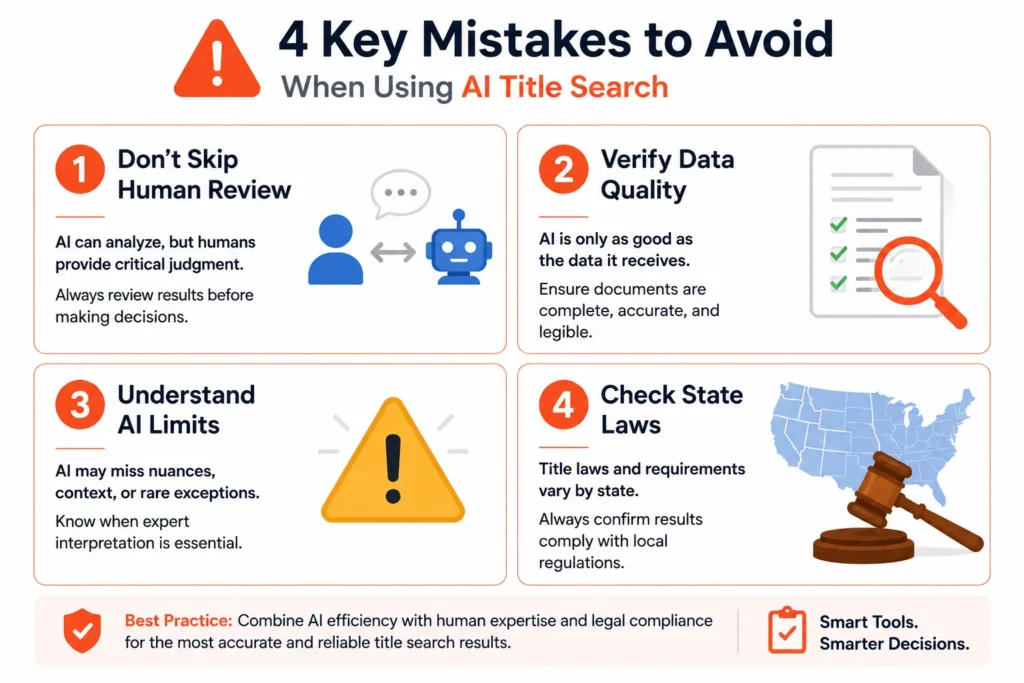
reliable results for your real estate transactions.
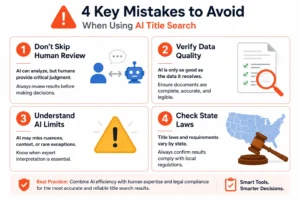
Mistake 1: Trusting AI Output Without Human Review
The single most common mistake I see is treating AI generated title analysis as a finished product rather than a highly capable first draft. A real estate professional uploads documents, receives a clean structured report, and assumes the AI caught everything. That assumption creates real risk.
Avi Hacker addressed this directly in his real estate workflow demonstration by stating clearly that an AI title summary is not a replacement for a professional official title report. Title defect resolution in any formal transaction context requires a qualified human reviewer to examine what the AI produced and apply professional judgment to the findings.
AI title search tools are exceptionally good at processing large volumes of documents quickly and consistently. What AI tools cannot reliably do is interpret unusual findings within the specific legal and factual context of a particular transaction. A missed chain of title gap or an ambiguous lien that requires legal interpretation needs human expertise to resolve correctly.
The solution is straightforward. Treat every AI generated title report as a first draft that a qualified professional reviews before any formal reliance on the findings. This hybrid approach gives you the speed benefit of AI without the risk of acting on incomplete analysis.
Mistake 2: Feeding Incomplete or Outdated Data Into AI Systems
Badal Gupta captured this principle precisely when he noted that AI is entirely dependent on the information it receives and that feeding an AI system outdated data yields inaccurate results. In practical terms this is the garbage in garbage out problem applied directly to property records analysis.
When the documents uploaded to an AI title search tool have missing pages, when county records have not been updated to reflect recent transactions, or when scanned copies are too degraded for accurate optical character recognition, the AI produces analysis based on incomplete information. The output looks clean and structured but the underlying foundation is flawed.
I always recommend verifying the completeness of your source documents before uploading them for AI analysis. Check that scanned PDFs are fully legible, confirm that your property records are current, and be especially careful with older properties where historical documents may have gaps that existed long before any AI tool touched them.
Cross checking AI output against known property details is also a smart practice. If the AI identifies a current owner that does not match what you know from other sources, that discrepancy signals a data quality issue worth investigating before proceeding.
Mistake 3: Expecting AI to Handle Complex Judgment Calls
AI title search tools perform extremely well on routine cases that follow standard patterns. A straightforward residential property with a clean chain of title and a few clearly recorded mortgages is exactly the kind of task where AI delivers its fastest and most reliable results.
But real estate title examination occasionally surfaces situations that fall entirely outside standard patterns. Complex family trust structures holding title across multiple generations, contested ownership situations involving multiple claimants, boundary disputes requiring survey interpretation, and unusual easement arrangements all require the kind of contextual reasoning that current AI systems genuinely cannot provide.
Badal Gupta noted explicitly that AI cannot provide genuine human touch or human emotions and that situations requiring personalized judgment demand professional human involvement. Chain of title situations involving active legal disputes or non standard ownership arrangements belong in the hands of experienced title examiners and real estate attorneys regardless of how sophisticated the AI platform being used happens to be.
The practical guideline I follow is letting AI handle the approximately 80 percent of cases that fit standard patterns and routing complex or unusual findings immediately to qualified human reviewers for title defect resolution.
Mistake 4: Ignoring State Specific Title Law Variations
This mistake catches people who understand AI title search tools well but underestimate how significantly title law varies from one state to another. Real estate title examination rules, recording requirements, encumbrance disclosure obligations, and chain of title standards all differ meaningfully across state lines and sometimes across county lines within the same state.
An AI title search tool trained on general property records data may not reflect the specific recording practices of the county where your property sits. Some counties have unusual indexing systems for older documents. Some states have specific encumbrance types that appear rarely in national training datasets. Some jurisdictions have unique rules about how certain ownership transfers must be recorded to be legally effective.
The solution here involves two parallel steps. First, understand the title law requirements of the specific state and county where your property is located before relying on AI output for that jurisdiction. Second, have a local real estate attorney or experienced local title examiner review AI generated findings for any property in a jurisdiction with recording practices you are not personally familiar with.
AI title search tools are powerful precisely because they process information consistently and quickly. But consistent processing of information that does not account for local legal variations can produce confidently presented output that misses jurisdiction specific issues. Local expertise remains essential for real estate title examination in markets where recording practices or title law creates scenarios outside standard national patterns.
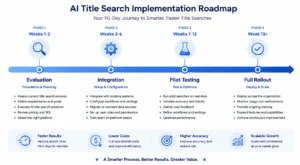
Getting Started: Your 30-60-90 Day AI Title Search Implementation Roadmap
Adopting AI title search does not have to feel overwhelming and in my experience the professionals who struggle most with implementation are the ones who try to change everything at once rather than following a structured phase by phase approach. The good news is that most AI title search platforms are designed for relatively fast onboarding and you can realistically go from evaluation to full operation within ninety days.
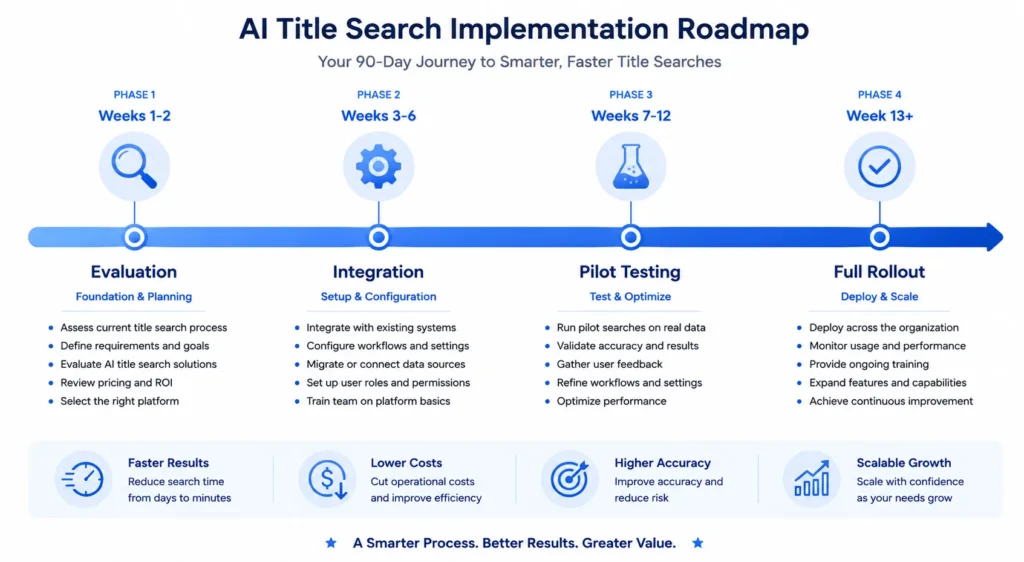
90 days using this four-phase approach.
Jerad Larkin’s 90 day sprint concept resonates strongly with how I think about technology adoption in real estate operations. Ninety days is long enough to evaluate properly and train thoroughly but short enough to maintain momentum and see genuine results before interest fades. Let me walk you through exactly what each phase looks like in practice.
Phase 1: Evaluation and Selection (Weeks 1 and 2)
The first two weeks of your AI title search implementation should focus entirely on finding the right platform for your specific situation before committing to any single tool. Rushing this stage is one of the most common implementation mistakes I see and it often leads to switching costs and lost time later.
Start by identifying two or three platforms from the best AI title search platforms available that align with your professional role and budget. Request free trials from each one. Most reputable platforms offer trial access because they know their product performs well under real conditions.
During your trial period test each platform using actual documents from your existing work rather than sample files the platform provides. Real documents reveal real performance. Evaluate each platform across five specific criteria:
- Processing speed on your typical document volumes
- Accuracy of data extraction on deed types you commonly handle
- Ease of use for the team members who will use it daily
- Pricing structure relative to your monthly search volume
- Quality and responsiveness of customer support
Make your platform selection by the end of week two. Spending more than two weeks in evaluation mode typically signals indecision rather than thoroughness and delays the real value you are trying to capture.
Phase 2: Integration and Training (Weeks 3 Through 6)
Once you select your platform the next four weeks focus on getting the tool properly connected to your existing systems and getting your team genuinely comfortable using it. Title plant integration and system connectivity happen first because having the AI tool operate in isolation from your existing workflow creates friction that undermines adoption.
Most modern AI title search platforms complete their technical onboarding process in one to two business days for standard configurations. If you are pursuing deeper automation workflow integration with a loan origination system or title management platform the technical integration timeline extends to approximately one week depending on your existing infrastructure.
Team training deserves more attention than most implementation guides suggest. I recommend structured training sessions of two to three hours rather than simply sharing login credentials and expecting staff to figure things out independently. Cover these specific areas in your training:
- How to upload and organize documents correctly
- How to interpret flagged findings and what action each flag type requires
- How to export and share completed reports in the formats your clients and partners expect
- When to escalate findings to human expert review rather than relying solely on AI output
Plan for a second shorter training session at the end of week six to address questions that emerged from initial use. Real usage always generates questions that no initial training session fully anticipates.
Phase 3: Pilot Testing and Optimization (Weeks 7 Through 12)
The pilot phase is where your AI title search implementation gets refined into a reliable operational process. During weeks seven through twelve I recommend running AI title search tools in parallel with your existing manual process on a selected sample of properties rather than switching over entirely.
Running parallel processes on the same properties lets you directly compare AI output against manually produced results. This comparison reveals any gaps in automated title examination accuracy for your specific document types and geographic markets. Parallel testing also builds team confidence because staff can see firsthand how the AI output compares to what they would produce manually.
During the pilot phase pay particular attention to title defect identification accuracy on more complex properties. Standard residential properties with clean ownership histories will perform well on almost any platform. The meaningful test of platform quality shows up on properties with longer ownership histories, multiple encumbrance types, or unusual recording situations.
Document every edge case you discover during the pilot phase and use those cases to create internal guidelines for your team. These guidelines become the foundation of your quality control process after full rollout.
Phase 4: Full Rollout (Week 13 and Beyond)
By week thirteen your team understands the platform, your integration with existing systems is stable, and your pilot testing has given you confidence in the output quality for your specific use cases. Full rollout means transitioning your entire operation to AI title search as the primary method for title research and retiring the purely manual process that preceded it.
Title company automation at full scale produces the dramatic title search time savings that make the implementation investment worthwhile. Expect your team to reach full productivity with the new workflow by the end of month four as the new process becomes second nature rather than something that still requires conscious attention.
After full rollout establish a monthly quality review practice where you randomly audit a sample of completed AI generated reports against manual verification. This ongoing quality monitoring protects accuracy standards over time and catches any platform performance changes before they affect client outcomes.
The ninety day implementation roadmap works because it respects the reality that meaningful operational change requires time for evaluation, learning, adjustment, and confidence building. Teams that rush through these phases often struggle with adoption. Teams that follow a structured phase by phase approach consistently report smoother transitions and faster realization of the speed and cost benefits that make AI title search worth adopting in the first place.
How AI Title Search Fits Into Your Marketing and Visibility Strategy
Most real estate professionals think about AI title search purely as an operational tool. They adopt it to work faster and spend less time on manual research. That thinking is correct but it stops short of the full picture. AI title search adoption also creates a genuine marketing advantage that most professionals never think to communicate to their clients and that most competitors are completely missing.
The connection between technology adoption and business visibility is something I find consistently undervalued in real estate. Let me show you how to turn your AI title search capability into a client facing differentiator that actually helps you win more business.
How 82% of Buyers Actually Search: The Three Ps Framework
Understanding how modern buyers find real estate professionals is the foundation of any effective visibility strategy. Real estate educator Lisa shared a framework that I find genuinely useful for thinking about this: buyers searching in AI powered real estate environments are essentially looking for three distinct categories of information.
The Three Ps framework identifies Properties, Process, and Professionals as the three content categories that buyers search for when making real estate decisions. Properties covers specific listings and property details. Process covers how things work including how title search works, how closings happen, and what due diligence involves. Professionals covers who to hire and why a specific person or firm is trustworthy and capable.
AI systems synthesize answers from all three categories simultaneously when responding to buyer queries. A professional who publishes helpful content across all three categories becomes far more visible to AI recommendations than one who only maintains a basic listings profile. If your online presence only addresses one or two of these categories, AI systems have an incomplete picture of your expertise and your recommendations suffer as a result.
Getting Discovered by AI Systems: Your Visibility Strategy
AI powered search tools including Google AI Overview, ChatGPT, Claude, and Perplexity all evaluate real estate professionals using a similar set of credibility signals before recommending them to users. Jerad Larkin’s work on AI visibility strategy identifies the specific trust markers these systems prioritize and the practical steps professionals can take to improve their discoverability.
Real estate technology solutions that demonstrate your professional capabilities need to be visible and consistent across every platform where your name appears. Here are the four most impactful visibility actions I recommend:
Optimize your professional biography with specific measurable metrics. Generic bios that describe someone as experienced or dedicated do not give AI systems the concrete signals they need to recommend you confidently. A bio that mentions specific transaction volumes, years of specialization, and verifiable professional credentials gives AI systems something meaningful to work with.
Create detailed process content on your website. How to guides, explainer articles, and FAQ content that walks buyers through real estate processes positions you as a knowledgeable resource rather than just a service provider. This type of content directly addresses the Process category of the Three Ps framework.
Ensure complete consistency across all platforms. Your name, business name, address, and phone number should match exactly across your website, Google Business Profile, industry directories, and social profiles. AI systems use cross platform consistency as a trust signal and inconsistencies reduce your credibility in automated recommendations.
Build and maintain genuine client reviews. Reviews on Google and industry specific platforms provide AI systems with social proof that your services deliver real results. Quantity matters but specific detailed reviews that mention outcomes carry more weight than generic positive feedback. Learning about tools that help you become more visible to AI-powered discovery systems helps you implement these visibility strategies more effectively.
Using AI Title Search as a Client Winning Marketing Angle
Here is the marketing opportunity that almost nobody in the real estate industry is taking advantage of right now. Your adoption of AI powered title search is a genuinely compelling differentiator that speed focused buyers and efficiency minded sellers respond to strongly.
Think about what your clients actually worry about during a transaction. Delays frustrate them. Surprises at the closing table stress them. Uncertainty about whether the title is clean creates anxiety throughout the process. AI title search directly addresses all three of those pain points and you can say so clearly in your marketing.
A straightforward message like “I use AI powered title search to identify potential issues faster and help closings happen on schedule” communicates real client benefit without technical jargon. Automated title examination capabilities translate directly into faster closing timelines and that outcome matters enormously to buyers and sellers who are coordinating moves, leases, and major financial decisions around a specific closing date.
Include your AI title search capability in your professional biography, your website services description, and your initial client conversations. When clients ask what makes your process different, the ability to point to a specific technology that produces faster and more thorough results gives them a concrete reason to choose you over a competitor who cannot articulate the same advantage.
The professionals who win in AI powered real estate markets are the ones who adopt better tools and then communicate the client benefits of those tools clearly and confidently. Your AI title search capability is a genuine competitive advantage. Make sure your potential clients actually know you have it.\
The Future of AI Title Search: Emerging Trends and What Is Coming
The AI title search tools available today are genuinely impressive compared to what existed just three years ago. But what is coming in the next five to ten years has the potential to transform property ownership verification even more fundamentally than current AI tools already have. I think every real estate professional who is serious about staying competitive needs at least a basic awareness of where this technology is heading.
Let me walk through the three developments I find most significant and most likely to shape how title search works in the years ahead.
Blockchain Integration: Immutable Title Records
Blockchain title verification represents one of the most compelling long term possibilities for the title search industry. Blockchain is essentially a digital record keeping system where every entry is permanently recorded and cannot be altered after the fact without every participant in the network knowing about the change.
Applied to property ownership records, blockchain title verification would create a continuous and tamper resistant chain of title where every transfer, every lien, and every encumbrance gets recorded permanently and transparently. Companies including Cotality have already begun exploring how blockchain technology could integrate with existing title verification processes to create more reliable and fraud resistant ownership records.
The practical impact of widespread blockchain adoption in title records would be significant. Title defects caused by fraudulent ownership transfers or deliberately concealed liens would become dramatically harder to execute because the permanent record would expose inconsistencies immediately. For AI title search tools, blockchain integrated property records would provide cleaner and more reliable data to work from, improving output accuracy across the board.
Widespread blockchain title record adoption is realistically five to ten years away from becoming standard practice. Legal frameworks, government recording systems, and industry infrastructure all need to align before blockchain becomes a routine part of how property ownership transfers are recorded. But the direction is clear and professionals who understand where the industry is heading will be better positioned when blockchain title verification becomes mainstream.
Advancing AI Models: More Sophisticated Legal Analysis
Current AI title search tools excel at the tasks they were designed for: reading documents, extracting structured data, identifying standard encumbrances, and building chain of title timelines. The next generation of AI models will expand those capabilities into territory that currently requires human legal expertise.
More advanced AI models will be better equipped to interpret unusual legal language, recognize jurisdiction specific recording exceptions, and analyze complex ownership structures involving trusts, partnerships, and corporate entities. Title defect resolution for non standard situations that currently requires mandatory human review may become something that advanced AI models handle reliably as their legal reasoning capabilities improve.
Automated title examination for complex cases will likely improve substantially as AI models develop deeper understanding of state specific title law variations and edge case ownership scenarios. This does not mean human experts disappear from the process. It means the percentage of cases requiring human intervention decreases as AI capability expands into more nuanced analytical territory.
Near Full Automation: What Is Realistically Possible
Could AI eventually handle the vast majority of title searches without meaningful human review? From a pure technology capability standpoint the answer is probably yes for routine residential cases within the next decade. The more interesting question is whether the industry will actually operate that way even when the technology makes it possible.
Real estate due diligence carries legal liability. Title insurance companies, attorneys, and lenders all face financial and professional consequences when title issues slip through undetected. That liability environment creates a strong institutional incentive to keep qualified human reviewers in the process even when AI accuracy rates reach levels that might technically justify removing human oversight.
Client expectations also play a role. Many buyers and lenders will likely continue to want human professional confirmation on significant ownership decisions regardless of how capable automated title examination becomes. The reassurance that a qualified professional has reviewed the findings carries value beyond pure accuracy that technology alone does not fully replace.
My honest assessment is that the AI and human hybrid model is probably the permanent operating standard for professional title search rather than a transitional phase on the way to full automation. The ratio will shift as AI capabilities improve but the combination of speed from AI and judgment from experienced professionals is likely to remain the most trusted and most defensible approach to title search for the foreseeable future.
Your Next Steps: Start Your AI Title Search Journey Today
If you have read through this entire guide you already know more about AI real estate title search tools than the majority of professionals currently working in the industry. That knowledge is genuinely valuable but only if you act on it. Understanding the technology matters far less than actually putting it to work in your practice.
Let me give you a clear and honest summary of where things stand and exactly what to do next.
What You Now Know (The Core Takeaways)
AI real estate title search tools are not future technology waiting to arrive. These tools exist today, work reliably for the majority of standard title search cases, and are already being used by forward thinking professionals across every segment of the real estate industry.
With 82 percent of buyers now using AI tools when making real estate decisions, the market has already shifted around professionals who are still relying entirely on manual processes. The question for most real estate professionals in 2026 is not whether to adopt AI title search but how quickly to make the transition without disrupting active operations.
Title search time savings of 75 to 87 percent compared to traditional manual research translate directly into faster closings, lower operational costs, and the capacity to handle significantly more transactions with the same team. Those are competitive advantages that compound over time the earlier you capture them.
Your Practical Action Plan
I want to make this feel achievable because it genuinely is. Here is what I recommend doing in each phase of your adoption journey:
This week: Go back to the platform comparison section of this guide and identify two or three of the best AI title search platforms that match your professional role and budget. Request free trials from each one. Run test searches using actual documents from your existing files so you can evaluate real performance rather than polished demo conditions.
Over the next two weeks: Compare your trial results across the criteria that matter most for your specific situation. Speed matters for high volume operations. Output format matters for firms producing attorney ready documents. Pricing structure matters for solo professionals and smaller teams. Make your platform selection and negotiate your terms before the trial period ends.
During month one: Complete your onboarding and integrate your chosen platform with the existing systems your team already uses. Run your first real property searches through the AI tool and begin building team familiarity with the new workflow. This is the phase where the initial learning curve appears and disappears quickly with consistent use.
During months two and three: Run your pilot phase where AI title search and manual verification happen in parallel on selected properties. Use this period to identify any edge cases specific to your market and document your internal guidelines for when AI output requires additional human review.
From month four onward: Transition to full AI title search operation with appropriate human review checkpoints in place. Monitor output quality through regular audits and continue refining your process as your team becomes fully comfortable with the new workflow.
The Straightforward Truth About Timing
The professionals and firms who adopt AI real estate title search tools now are building a workflow advantage that will be increasingly difficult for late adopters to close. Every month of faster closing timelines, lower search costs, and higher transaction capacity compounds into a meaningful business difference over a full year of operation.
Whether you choose a commercial platform like TitleReport.ai, DataTrace TitleIQ, or TalosTitle or you start with the budget friendly DIY approach using Claude or ChatGPT, the most important step is simply beginning. The technology is accessible, the learning curve is manageable, and the results are real.
Your AI title search journey starts with one free trial and one test search. Everything else follows from there.
Frequently Asked Questions About AI Title Search
These are the questions I get asked most often about AI title search tools. I have answered each one as directly and honestly as I can because I think straightforward answers serve you better than vague reassurances.
Is AI Title Analysis a Replacement for a Professional Title Report?
No. AI title analysis is not a replacement for a professional title report and any platform that suggests otherwise is overstating what the technology currently delivers. AI title search produces a rapid and thorough first draft that surfaces ownership history, flags potential liens, and identifies chain of title issues faster than any manual process can.
But a formal title insurance commitment, a legal title opinion, and a professionally certified abstract all require a qualified human examiner to review and take professional responsibility for the findings. Avi Hacker stated this clearly in his real estate workflow demonstration: an AI generated title summary serves as a rapid first draft rather than a finished professional report.
The right way to think about AI title analysis is as a powerful preliminary research tool that makes the human expert’s review faster, more focused, and more thorough. AI handles the volume and consistency challenge. The human professional handles the liability and judgment challenge. Both are necessary for a complete and legally reliable title search outcome.
How Long Does an AI Title Search Actually Take?
A complete AI generated title abstract typically takes between two and three minutes for a standard residential property with a full document set. That timeline compares directly to the three to five business days a traditional manual title search requires for the same property.
Processing time varies depending on the number of documents uploaded, the complexity of the ownership history, and the specific platform being used. Larger document sets with many decades of ownership records take slightly longer to process than recent transactions with fewer total documents. Even at the longer end of the processing range, AI title search tools complete their analysis in minutes rather than days.
For professionals managing active real estate transactions where closing timelines are tight, the difference between a three minute turnaround and a three day turnaround is operationally significant. Title search time savings of this magnitude change what is possible within a compressed closing schedule.
How Much Does AI Title Search Cost Compared to Traditional Methods?
AI title search costs between 75 and 87 percent less than traditional manual title search in most cases. A traditional title search typically costs between five hundred and two thousand dollars per property depending on complexity and market location. AI title search platforms generally charge between fifty and three hundred dollars per search depending on the platform and the depth of analysis required.
For professionals who want the most budget friendly entry point, the DIY approach using Claude or ChatGPT costs practically nothing beyond a standard subscription fee of around twenty dollars per month. This option works well for preliminary research and property screening even though the output polish does not match dedicated commercial platforms.
For title companies and professional operations processing significant monthly volumes, dedicated AI title search platforms deliver substantially lower per search costs than manual methods while producing more consistent and more thoroughly documented results.
What Happens If the Property Records Are Incomplete or Outdated?
When property records are incomplete or outdated AI title search tools produce output that reflects those gaps rather than filling them in. This is the principle that Badal Gupta described precisely when he noted that AI is entirely dependent on the information it receives and that feeding an AI system outdated or incomplete data produces inaccurate results.
Incomplete county records, missing pages in scanned historical documents, transactions recorded before digital systems existed, and data entry errors in public databases all affect the reliability of AI title search output in predictable ways. The AI processes what it receives and cannot independently verify whether the source records are complete.
The practical safeguards I recommend are straightforward. Verify that your source documents are complete before uploading them for AI analysis. Check that scanned pages are fully legible and that multi page documents have not lost pages during scanning or transmission. Cross reference AI output against known property details from other reliable sources when processing older properties with longer ownership histories. And for any AI generated finding that seems inconsistent with what you know about the property, treat that inconsistency as a signal to verify the underlying source records before drawing any conclusions from the AI output.