Why Your Brand Is Invisible to ChatGPT (And Why That’s Costing You Sales)
I need to share something that might make you uncomfortable: right now, while you’re reading this, potential customers are asking ChatGPT and Perplexity about products in your industry. And there’s a good chance your brand isn’t even part of the conversation.
Let me paint a picture. Someone types into ChatGPT: “What’s the best project management software for small teams?” The AI responds with a detailed comparison of five tools. Your product does exactly what they need, but your name never appears. That customer just made a buying decision, and you weren’t even considered.
This isn’t a hypothetical problem anymore. According to a 2026 consumer behavior study, 37% of people now start their product searches using AI tools instead of traditional search engines. Even more striking: 47% are using AI platforms to make actual purchase decisions. Think about that for a moment. Nearly half of your potential customers are letting ChatGPT, Perplexity, or Google’s AI guide their buying choices.
Here’s what really caught my attention when I first discovered this data: 60% of users feel AI delivers clearer, more useful answers than scrolling through traditional search results. And 80% believe the information AI provides is unbiased and trustworthy. Whether that’s actually true doesn’t matter as much as the fact that your customers believe it.
The financial impact is real. Research shows that visitors who arrive from AI-powered search tools convert at roughly 8 times the rate of traditional SEO traffic. These aren’t casual browsers clicking through ten different tabs. They’re qualified buyers who asked a specific question and received your brand as the answer.
But here’s the problem: if you’re not tracking how AI platforms perceive your brand, you’re essentially invisible to this entire channel. As one AI visibility expert put it, brands that ignore this shift will become “ghosts” in the new search landscape. No mentions. No clicks. No sales.
The trend is accelerating faster than most people realize. Industry analysts predict that traffic from AI tools will actually overtake traditional search engine traffic by 2028. That’s less than two years away. The brands positioning themselves now will own the AI visibility advantage. The ones waiting will be playing catch up while their competitors capture market share.
I started researching this topic after noticing a disturbing pattern in my own analytics. My website traffic from Google was stable, but I wasn’t seeing growth. When I manually tested my brand across ChatGPT, Perplexity, and Google’s AI Mode, I discovered I was mentioned in only 2 out of 15 relevant commercial queries. My competitors were appearing 7 to 10 times for the same searches.
That’s when I realized I needed the best AI visibility tools to understand what was happening and fix it. These platforms do exactly what traditional SEO tools can’t: they show you how your brand appears in AI generated answers, track sentiment, identify which sources AI platforms trust, and measure your share of voice across the queries that matter to your business.
In this guide, I’m going to walk you through everything I learned while testing 11 different AI visibility tools. You’ll discover which platforms are worth your money, which features actually matter, how to avoid expensive mistakes, and most importantly, how to choose the right tool for your specific situation and budget.
Whether you’re a startup founder working with limited resources, an agency managing multiple clients, or an enterprise team with serious budget, there’s a solution that fits. But first, you need to understand what these tools actually do and why the traditional digital marketing tools in your stack can’t handle AI-driven discovery on their own.
Let’s start with the fundamentals.
What Are AI Visibility Tools (And Why Your Brand Needs Them)
When I first heard the term “AI visibility tools,” I’ll admit I had no idea what people were talking about. It sounded like another piece of marketing jargon designed to sell me something I didn’t need. But once I understood what these platforms actually do, everything clicked.
Think of AI visibility tools as your eyes and ears in the world of AI search engines. They’re platforms that track exactly how your brand appears, or more importantly, doesn’t appear in the responses generated by ChatGPT, Perplexity, Google AI Overviews, Gemini, and other large language models.
Here’s the simplest way I can explain it: you know how Google Search Console shows you which keywords you rank for and where you appear in traditional search results? AI visibility tools do the same thing, but for generative engine optimization. They’re essentially Search Console for the AI era.
These platforms go by several names, and I’ve seen all of them used interchangeably. Some people call them GEO tools, which stands for Generative Engine Optimization. Others refer to them as LLM tracking platforms because they monitor Large Language Models. You might also hear the term AEO tools, meaning Answer Engine Optimization. They all describe the same category of software.
The core function is straightforward: these AI monitoring platforms continuously test how AI search engines respond when users ask questions related to your industry, products, or services. Then they show you whether your brand gets mentioned, where you rank compared to competitors, and what the AI actually says about you.
What really opened my eyes was learning that some of these platforms work with databases containing over 3 million real AI prompts. That means they already know what questions people are actually asking in their specific industries. Instead of guessing which queries matter, you can see real data about what your potential customers are searching for right now.
But here’s what makes these tools genuinely valuable: they help you understand if AI models view your brand as trustworthy and authoritative. They track your competitors to show you where they’re winning mentions that you’re missing. And critically, they identify sentiment and potential misinformation risks before they damage your reputation.
I learned this the hard way when I discovered an AI platform was confidently stating incorrect information about one of my product features. Without an AI visibility tool, I would never have known that thousands of people were receiving wrong answers about what my product could do.
The reason you need these tools now, not later, comes down to timing. Traditional search is shifting to AI powered answers faster than most businesses realize. When someone asks ChatGPT or Perplexity a question, they’re not clicking through to ten different websites anymore. They’re reading one synthesized answer and making a decision based on that response.
If your brand isn’t part of that answer, you’ve lost the sale before the customer even knew you existed. The old rules of SEO still matter, but they’re no longer sufficient on their own.
What Gets Tracked by AI Visibility Tools
When I started evaluating different platforms, I realized they all track similar core metrics. Understanding what gets measured helps you know what to look for when choosing a tool.
Here’s what the best AI visibility tools monitor:
Brand Mentions: The most basic metric. Does your brand name appear when AI platforms answer relevant questions? How often? For which types of queries? This is your starting point for understanding visibility.
Ranking Position: When your brand does get mentioned, where does it appear in the response? Being listed first carries significantly more weight than being mentioned fifth or sixth. Position matters just as much in AI answers as it does in traditional search results.
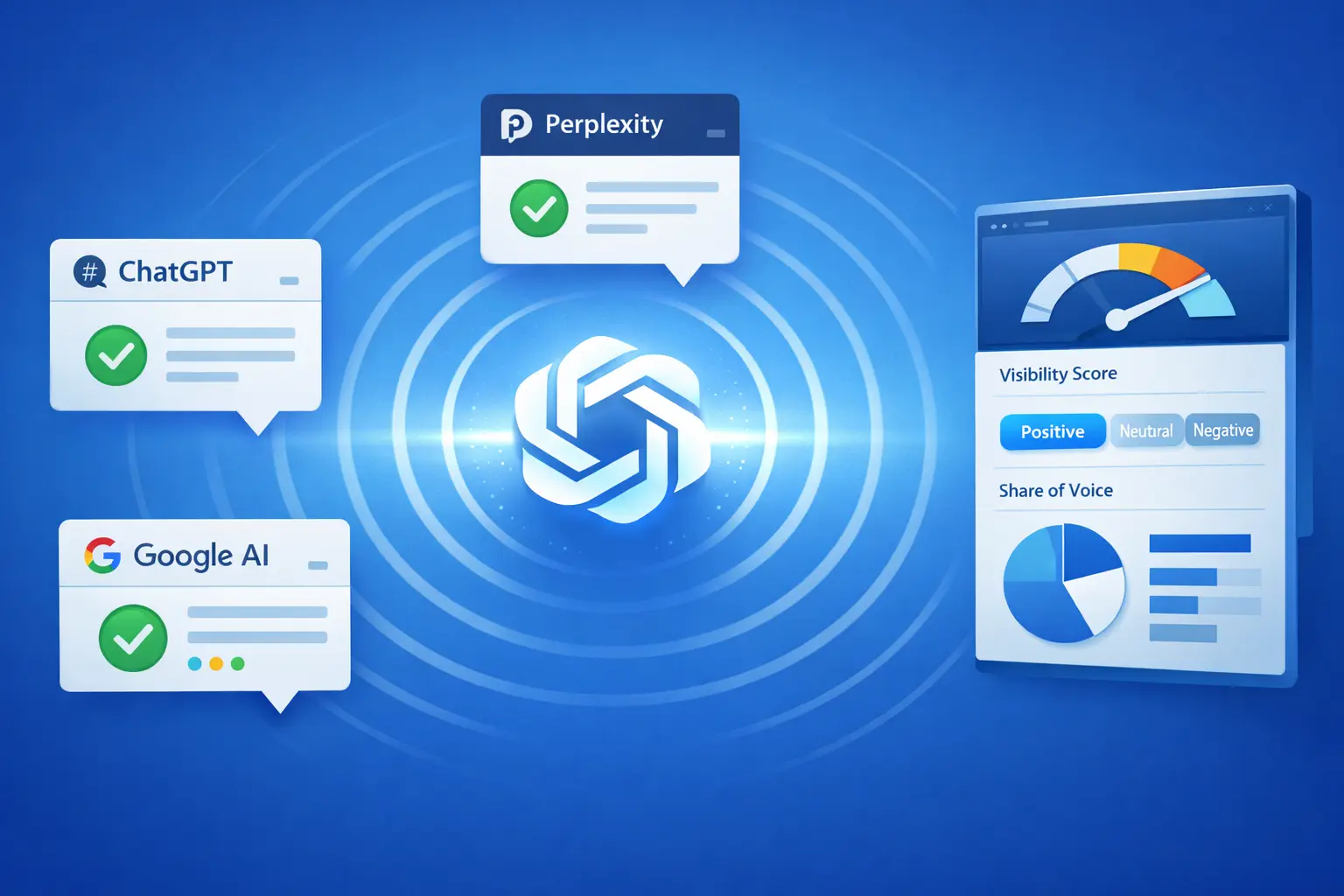
Sentiment and Tone: This surprised me at first, but it’s actually one of the most important metrics. The tools analyze whether the AI talks about your brand positively, negatively, or neutrally. A mention isn’t valuable if the AI is highlighting your weaknesses instead of your strengths.
Citation Sources: AI platforms pull information from specific websites and articles. These tools identify which sources the AI trusts and cites when discussing your industry. Knowing this lets you focus your efforts on getting mentioned by the sources that actually influence AI responses.
Competitor Comparisons: You can track how often competitors get mentioned compared to your brand. This competitive visibility analysis shows you exactly where you’re losing ground and where you’re ahead.
Share of Voice: Instead of tracking individual keywords, these platforms measure your overall presence across dozens or even hundreds of related queries. This gives you a percentage that represents your share of the conversation in your industry.
Trust Factors: Some advanced platforms track how often AI associates your brand with specific features, benefits, or characteristics. This shows you what the AI “thinks” your brand stands for based on the information it has access to.
The combination of all these data points creates a complete picture of your AI search presence. Without tracking these metrics, you’re essentially flying blind while your competitors gather intelligence and optimize their strategies.
I spent weeks manually checking my brand across different AI platforms before I invested in proper tracking tools. Looking back, that was time I’ll never get back. The right platform automates all of this and gives you insights you simply cannot gather manually at scale.
AI Search vs Traditional SEO: What’s Actually Different
One of the biggest misconceptions I encounter is that AI search is replacing traditional SEO. That’s not quite right. The relationship between SEO and GEO is more like foundation and building. You need both, but they serve different purposes.
Let me explain what I mean by walking through what actually happens behind the scenes when someone uses an AI answer engine versus typing a query into Google.
When you search on Google, the engine scans its index and shows you a ranked list of web pages. You see ten blue links, maybe some featured snippets, and you click through to read the actual content on those sites. Google’s job ends when it shows you the list. Your job as a searcher is to evaluate which result looks most helpful and click through.
AI search works completely differently. When you ask ChatGPT or Perplexity a question, you don’t get a list of links. You get a synthesized answer written in natural language, as if a knowledgeable person is explaining the topic to you directly. The large language models behind these platforms are generating unique responses in real time, not just retrieving stored pages.
This fundamental difference is why your traditional SEO tools can’t track AI visibility. Ahrefs and Semrush are built to monitor rankings in a list. But there is no ranked list in generative AI search. There’s just an answer that either mentions your brand or doesn’t.
Here’s where it gets technically interesting, and this is something I only understood after diving deep into how these systems work.
The “Query Fanout” Process Explained
When you type a complex question into an AI platform, something fascinating happens under the hood that most people never see. The AI doesn’t just respond based on what it already knows. For current information or nuanced topics, it performs what’s called query fanout.
Let me give you a real example. Say someone asks ChatGPT: “What’s the best email marketing platform for small ecommerce businesses in 2025?”
The AI breaks this single question down into multiple smaller, more specific search queries. It might generate five to ten different searches like “email marketing platforms 2025,” “ecommerce email tools,” “small business email software reviews,” and “affordable email marketing services.”
Then it performs actual web searches using traditional search engines like Google or Bing to fetch current information for each of those sub queries. This process is called Retrieval Augmented Generation, or RAG for short. The AI retrieves fresh data from the web and uses it to augment what it generates in its response.
What really surprised me when I learned this was something called drift. Drift is the difference between what the user actually typed and what the AI searches for behind the scenes. The AI often adds terms like “2025” or “best rated” or “comparison” to make the searches more specific and useful, even if the user didn’t include those terms.
This is why prompt-based monitoring matters so much. You need to understand not just what users are asking, but what queries the AI is actually performing to generate answers. Those underlying searches determine which websites get cited and which brands get mentioned in AI search results.
The practical implication hit me hard when I realized my content was optimized for the questions users ask, but not for the more specific queries the AI actually searches for. I was missing visibility because I didn’t understand this technical process.
Why You Still Need Traditional SEO
Here’s the part that confused me initially, and I see it confusing a lot of other people too. If AI search is so different, why does traditional SEO still matter?
The answer is simple but critical: AI platforms rely on traditional search engines for retrieval. When ChatGPT performs those query fanout searches I mentioned, it’s searching Google and Bing. When Perplexity needs current information, it’s pulling from search engine results.
This means that if your content doesn’t rank well in traditional search, it won’t be in the pool of sources that AI platforms can retrieve and cite. SEO is the foundation. Content optimization for search engines gets you into the game. AI search optimization helps you win once you’re in.
I tested this myself by improving a blog post’s Google ranking from position 12 to position 4. Within two days, that same article started getting cited in Perplexity responses. The AI had access to it the whole time, but it prioritized higher ranking sources. Once my ranking improved, my visibility in AI responses improved almost immediately.
Research backs this up too. Studies analyzing millions of AI generated answers found that sources ranking in Google’s top 10 positions get cited far more frequently than content buried on page two or three. Your traditional search visibility directly influences your AI visibility.
But here’s the twist that makes this complicated: you can’t just rely on SEO alone anymore. Even if you rank well in Google, there’s no guarantee an AI platform will cite you. Different AI assistants have different preferences for sources.
According to research covering thousands of brands, approximately 86% of sources cited are unique to specific AI assistants. That means ChatGPT prefers different types of sources than Perplexity, which prefers different sources than Google’s AI Overviews. A source that works well for one platform might be ignored by another.
This is why the SEO vs GEO conversation misses the point. It’s not one versus the other. Traditional SEO gets your content into the retrieval pool. Generative AI search optimization helps ensure AI platforms actually choose to cite and mention your content when generating answers.
I now split my optimization efforts roughly 70% on traditional SEO and 30% on AI specific optimization. The SEO work builds the foundation by improving rankings and domain authority. The AI work focuses on getting cited by the right sources, optimizing for natural language queries, and ensuring my brand appears in synthesized answers.
Both strategies feed each other. Better traditional rankings lead to more AI citations. More AI visibility often leads to increased brand searches, which improves traditional SEO. They’re two parts of the same visibility strategy, not competing approaches.
How to Track Your Brand in AI Search Platforms (Free & Paid Methods)
Before you spend a single dollar on the best tools for tracking brand visibility in AI search platforms, I want to show you how to do this manually. Not only will this save you money if you’re just getting started, but it also helps you understand exactly what paid tools are doing behind the scenes.
I started tracking my own brand visibility this way, and honestly, it taught me more about AI search than any tutorial could. The process is straightforward, though I’ll warn you upfront that it becomes tedious once you scale beyond a handful of queries.
The Manual Tracking Method (Free)
Here’s the exact process I used before investing in paid tools. You can start doing this today with nothing more than a Google Sheet and about 30 minutes of time each week.
Step 1: Create accounts on the major AI platforms. At minimum, you need free accounts on ChatGPT, Perplexity, and access to Google’s AI mode. If you want to be thorough, add Gemini and Claude to your list. These five platforms cover the vast majority of AI search activity.
Step 2: Build your query list. This is the most important step, and where most people go wrong. You need to create 10 to 20 commercial intent queries that your ideal customers would actually ask. Don’t just search for your brand name. That’s not useful data.
Instead, think about the questions people ask when they’re ready to buy or seriously evaluating options. For example, if you sell project management software, your queries might include “best project management tools for remote teams,” “how to choose project management software,” or “affordable alternatives to popular PM tools.”
I spent about an hour brainstorming my initial list. I put myself in my customer’s shoes and wrote down every question I would ask if I were researching solutions in my industry. The goal is to capture the queries where you want your brand to appear.
Step 3: Run your searches weekly. Pick one day each week, set a 30 minute timer, and systematically run every query on your list across each AI platform. I do this every Monday morning before I check email.
As you run each search, note three things in your tracking sheet: whether your brand gets mentioned at all, what position your brand appears in if mentioned, and which competitors are mentioned alongside you or instead of you.
Step 4: Log everything in a Google Sheet. I set up a simple spreadsheet with columns for the date, platform name, query text, whether I was mentioned, my position if mentioned, and which competitors appeared. This gives you the raw data you need to spot trends.
The key brand visibility metrics to track are mention frequency, average position when mentioned, and your share of total mentions compared to competitors. If you run 20 queries and your brand appears in 8 responses, that’s a 40% mention rate. Track how this changes week over week.
Step 5: Visualize trends over time. After you have four to six weeks of data, feed your Google Sheet into Looker Studio or any data visualization tool you prefer. Create simple charts showing your mention rate over time, position trends, and competitor comparison.
This visual representation makes patterns obvious. I discovered my mention rate was declining on ChatGPT while improving on Perplexity. That insight changed where I focused my optimization efforts.
The beauty of this manual approach is that it costs nothing except your time. It gives you real baseline data about your current AI visibility. And it helps you understand the landscape before you invest in ai search visibility monitoring tools.
I ran this process manually for about two months. It was eye opening but also frustrating. Copying and pasting queries, switching between platforms, and manually logging results felt repetitive and error prone. I knew there had to be a better way once I validated that AI visibility actually mattered for my business.
When to Upgrade to Paid Tools
The manual method works perfectly for getting started, but there comes a point where it stops making sense. I hit that point when I realized I was spending nearly three hours every week on search visibility tracking that a tool could do automatically in minutes.
Here are the clear signals that told me it was time to invest in a proper platform.
You’re tracking more than 50 queries. Once your query list grows beyond 50, the manual process becomes unsustainable. Running 50 queries across five platforms means executing 250 individual searches every week. That’s not a productive use of your time.
You need competitor intelligence. Manual tracking shows you when competitors appear, but it doesn’t give you deeper insights. Paid tools track competitor mention frequency, sentiment, position trends, and which sources AI platforms cite when mentioning them. This competitive context is nearly impossible to gather manually.
You want historical trend data. With manual tracking, you only have data from the point you started collecting it. Most paid tools have been monitoring AI platforms for months or even years. They can show you historical trends and benchmark your performance against your industry.
You need sentiment analysis. Knowing your brand was mentioned is helpful. Knowing whether that mention was positive, neutral, or negative is essential. I discovered through paid tools that one AI platform was consistently mentioning my brand in a negative context when discussing pricing. I never would have caught that nuance with manual tracking.
Your tracking takes more than two hours per week. This is my personal threshold. If I’m spending more than two hours on any repetitive task that could be automated, it’s time to find a tool. Your time is worth more than that, and those hours are better spent actually improving your content and visibility.
One thing I learned from testing multiple platforms is that tools are not strategy. Having expensive AI visibility analytics software doesn’t automatically improve your results. You still need to understand what the data means and take action based on what you discover.
The manual tracking method I described teaches you that foundation. You learn what queries matter, how AI platforms behave differently, and what good visibility actually looks like. Then when you do invest in a paid tool, you know exactly what to look for and how to interpret the data.
If you’re just starting out or have a limited budget, begin with manual tracking. Give it at least four weeks to build baseline data. Then evaluate whether the time investment justifies moving to a paid solution. For most businesses tracking their brand seriously, the answer will be yes. But starting manually ensures you’re making an informed decision based on real experience, not just marketing promises.
5 Key Metrics That Actually Matter (Not Vanity Metrics)
When I first started evaluating AI visibility tools, I made the mistake of focusing on the wrong numbers. I got excited when a tool told me my brand was mentioned 47 times across various AI platforms. That sounds impressive, right? It felt like progress.
Then I dug deeper and realized that most of those mentions were in responses to questions nobody was actually asking, or they were buried at position eight or nine where users would never see them. I was tracking vanity metrics that made me feel good but didn’t move the business forward.
Let me save you from making the same mistake. Here are the five brand visibility metrics that actually predict whether your AI visibility efforts will generate real results.
1. Share of Voice Across Prompt Buckets
This is the single most important metric, and it’s what separates beginners from people who understand AI search strategy. Share of voice means the percentage of relevant queries where your brand gets mentioned compared to the total number of queries in that category.
Here’s why it matters: tracking individual keywords or prompts gives you fragmented data. One day ChatGPT mentions you for “best email marketing tools,” but that’s just one data point. It doesn’t tell you if you’re winning or losing the overall conversation in your industry.
Instead, you need to group related queries into buckets of 15 to 50 commercial intent prompts. For example, if you’re in the email marketing space, your bucket might include “best email marketing platforms,” “affordable email tools for small business,” “email marketing software comparison,” and 20 other variations that all represent the same buying intent.
Then you calculate what percentage of those 20 to 50 queries mention your brand. If your brand appears in 15 out of 30 relevant queries, you have a 50% share of voice. Track this number over time, and you’ll see whether your visibility is actually improving or if you’re just celebrating random wins.
I learned this approach from an SEO expert who’s been tracking AI search for years, and it completely changed how I measured success. My share of voice was only 22% when I started. Six months later, it’s up to 41%. That’s meaningful progress I can actually measure and report.
2. Position Within AI Responses
Getting mentioned is step one. Where you get mentioned is step two, and it matters more than most people realize. Being listed first in an AI generated answer provides significantly more visibility and credibility than being mentioned fifth or eighth.
Think about your own behavior when you read an AI response. You pay the most attention to the first option mentioned. By the time you get to the fourth or fifth brand listed, you’re already forming opinions based on the earlier mentions. Position matters enormously.
The AI search rankings within responses work similarly to traditional Google rankings. Position one gets the most clicks and consideration. Position two gets substantially less. By position five or six, you’re mostly invisible even though you were technically mentioned.
I track my average position across all mentions, not just whether I was mentioned at all. When my average position improved from 4.2 to 2.1, I saw a noticeable increase in demo requests and branded search volume. Better position equals better business results.
3. Sentiment and Trust Factors
This metric shocked me when I first understood its importance. It’s not enough to be mentioned. You need to know what the AI is actually saying about you when it includes your brand.
Trust factors measure how often AI platforms associate your brand with specific features, benefits, or characteristics. When someone asks about project management tools, does the AI describe your product as “affordable” or “expensive”? As “easy to use” or “complex”? As “best for small teams” or “enterprise focused”?
I discovered through sentiment tracking that one AI platform consistently described my pricing as “higher than competitors” even though our pricing is actually mid range. That negative framing was costing me conversions. Without tracking sentiment, I never would have known to address that perception problem.
The best tools break down sentiment into positive, neutral, and negative categories. They show you the specific language AI platforms use when describing your brand. This gives you actionable intelligence about how your brand is perceived and where you need to improve your messaging or source content.
4. Citation Source Diversity
Here’s a metric most people ignore completely, but it’s critical for sustainable visibility. You need to know which websites and sources AI platforms are citing when they mention your brand or your industry.
If all your mentions come from citations to your own website, that’s a weak signal. AI platforms tend to trust diverse sources more than single sources. You want a mix of your own content, industry publications, review sites, news articles, and authoritative third party sources all contributing to your visibility.
I track the number of unique domains that AI platforms cite when mentioning my brand. When I started, 80% of my citations came from my own website. After six months of building presence on industry blogs, review platforms, and news sites, that’s down to 35%. My overall mention frequency increased because AI platforms now have multiple trusted sources confirming my brand’s relevance.
Source diversity also protects you from volatility. If one source stops being cited or changes its content, you don’t lose all your visibility overnight. Diversification matters in AI visibility just like it matters in investment portfolios.
5. Platform Coverage Breadth
The final key metric is understanding your visibility score across different AI platforms, not just one. Your brand might perform well on ChatGPT but be completely invisible on Perplexity. Or you might dominate Google AI Overviews while barely appearing in Gemini responses.
Different platforms have different user bases and different preferences for sources. I learned this the hard way when I optimized heavily for ChatGPT and then discovered my target customers were mostly using Perplexity for research. I was winning on the wrong battlefield.
Track your performance across at minimum ChatGPT, Perplexity, and Google AI Overviews. These three platforms cover the vast majority of AI search activity. If you have the budget and tools, add Gemini and Claude for complete coverage.
Your goal should be consistent visibility across platforms, not dominance on one and absence on others. Balanced platform coverage ensures you’re visible no matter which AI tool your potential customers prefer.
The visibility score that many tools provide is just an aggregate of these underlying metrics. Don’t get distracted by a single number. Dig into the components and understand which specific metrics are improving or declining. That’s where you’ll find the insights that actually help you make better decisions and allocate resources effectively.
The Best AI Visibility Tools: Detailed Reviews & Honest Comparisons
I’ve spent the past several months testing and evaluating the best AI visibility tools on the market. I didn’t just sign up for free trials and skim through dashboards. I ran real queries, tracked actual data, compared results across platforms, and talked to other SEO professionals who’ve been using these tools in production environments.
What I discovered is that not all AI visibility tools are created equal. Some excel at accuracy but cost a fortune. Others are affordable but missing critical features. A few claim to do everything but actually do nothing particularly well.
The reviews below represent my honest assessment based on hands-on experience, feedback from industry experts who’ve tested these platforms extensively, and real world use cases. I’m including both the strengths and the genuine limitations of each tool because I want you to make an informed decision, not just pick the one with the best marketing.
Before we dive into individual reviews, here’s what I tested for: accuracy of brand mention detection, platform coverage breadth, ease of setup and use, quality of the visibility dashboard, pricing transparency, depth of competitive analysis, sentiment tracking capabilities, and whether the insights actually help you take action or just give you vanity metrics.
Let’s start with the enterprise grade options and work our way down to budget friendly alternatives.
1. Profound: Best for Enterprise Teams Who Need Proven Accuracy
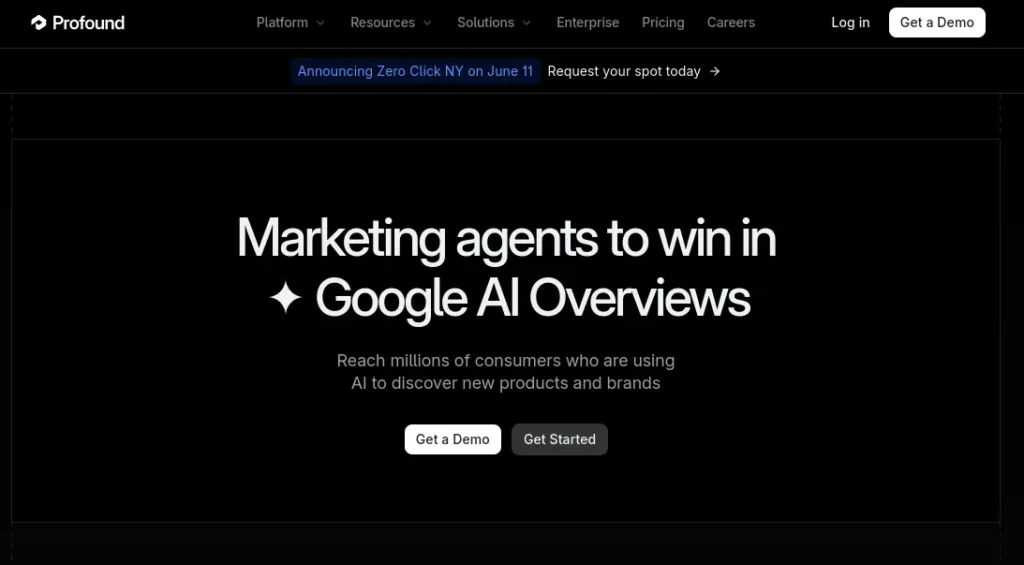
Profound is the AI monitoring platform I keep hearing about from enterprise SEO teams who need the most accurate data available. After researching how it works, I understand why it commands premium pricing.
Best For: Enterprise brands with dedicated SEO or content teams, companies that require SOC2 compliance for security, and organizations where data accuracy is worth paying for.
Key Features:
- Tracks visibility across 10+ AI platforms including ChatGPT, Perplexity, Google AI Overviews, Gemini, Claude, Grok, and several others
- Includes a “prompt laboratory” feature that lets you test custom queries and see exactly how different AI engines respond
- Provides prompt volume data showing you which queries actually have search demand, similar to keyword volume in traditional SEO
- Offers deep analytics breaking down mentions by sentiment, position, and citation source
- SOC2 Type 2 compliance for enterprise security requirements
Platform Coverage: ChatGPT, Perplexity, Google AI, Gemini, Claude, Grok, and 4+ additional platforms
Pricing: Starts at $99 per month if you only want to track ChatGPT. Higher tiers for multi platform coverage, with pricing that scales based on the number of engines you monitor.
Honest Pros:
- Industry experts report this is the most accurate tool available because Profound reportedly purchases exact user data from LLM providers rather than just using APIs
- Deep analytics give you actionable insights, not just surface level mention counts
- SOC2 compliance makes it viable for regulated industries or security conscious enterprises
- Prompt volume research helps you prioritize which queries actually matter
Honest Cons:
- Expensive compared to other options, especially if you need multi platform tracking
- Steeper learning curve than simpler tools. You’ll need someone dedicated to learning the platform
- Requires formal onboarding process, so you can’t just sign up and start immediately
- May be overkill for small businesses or solo operators
When to Choose Profound: You have a budget of $200+ per month for AI visibility, you need enterprise level security and compliance, you require the highest possible data accuracy, or you have a dedicated team member who can become the platform expert.
2. Otterly AI: Best Budget Friendly Option for Startups
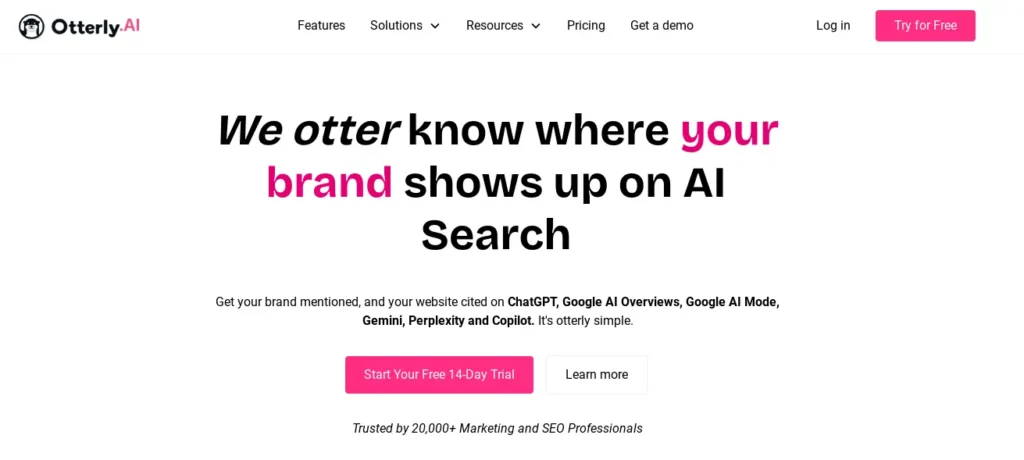
Otterly AI is where I recommend most small businesses and startups begin their AI visibility journey. It focuses on the three platforms that matter most and keeps pricing accessible for companies without massive marketing budgets.
Best For: Small businesses just getting started with AI visibility tracking, startups with limited budgets, and solo marketers who need simple tools that work without complexity.
Key Features:
- Specializes in Google AI Overviews audits, showing you exactly when and how your content appears in Google’s AI powered search results
- Citation tracking identifies which of your pages are being used as sources by AI platforms
- Brand mention monitoring across the three most important platforms
- Simple dashboard that you can understand in minutes, not hours
- Quick setup process that most users complete in under 30 minutes
Platform Coverage: Google AI Overviews, ChatGPT, Perplexity
Pricing: Budget friendly tiers starting around $20 to 25 per month, with a free trial available so you can test before committing
Honest Pros:
- Very affordable, making it accessible even for bootstrapped startups
- Quick setup means you can start gathering data immediately
- Good choice for beginners who find enterprise tools overwhelming
- Free trial lets you validate value before paying
- Focuses on the three platforms that drive the most AI search traffic
Honest Cons:
- Limited to only three platforms, so you miss visibility on Gemini, Claude, and others
- Less deep analytics compared to premium tools. You get the basics but not advanced insights
- No predictive features or optimization recommendations
- May outgrow this tool as your needs become more sophisticated
When to Choose Otterly AI: Your budget is under $50 per month, you’re just getting started with AI visibility and don’t need every bell and whistle, or you only care about tracking the major platforms where most of your customers actually search.
3. Peec AI: Best for Daily Prompt Based Monitoring
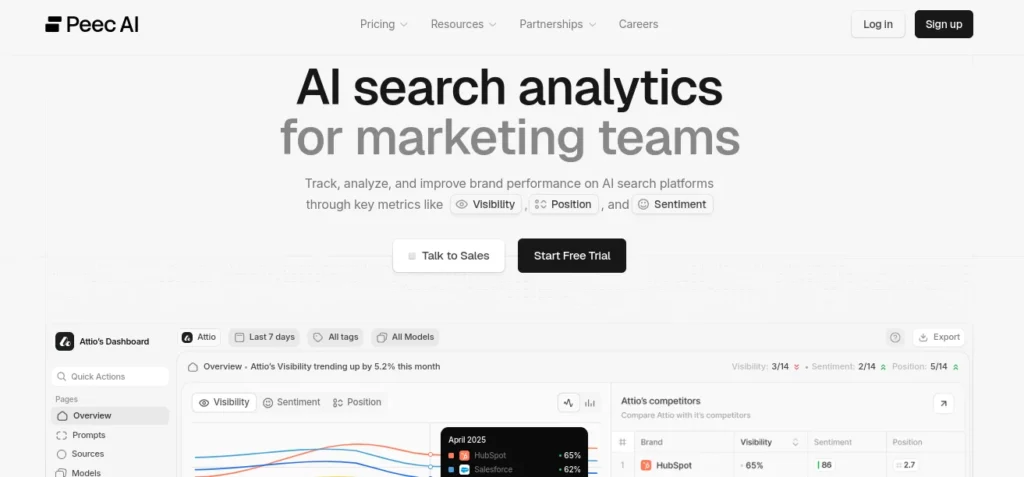
Peec AI takes a different approach than most tools by focusing heavily on prompt discovery and daily monitoring. It’s the tool I’ve seen agencies gravitating toward because it automates a lot of the manual work.
Best For: Marketing agencies managing multiple clients, brands that need detailed prompt level insights, and teams that want the platform to suggest what they should be tracking rather than figuring it out themselves.
Key Features:
- Automatically suggests prompts you should be tracking based on your industry and brand
- Daily monitoring keeps you updated on changes in real time
- Sentiment analysis shows whether AI platforms are portraying your brand positively or negatively
- Entity checks verify what information AI models know about your brand
- Hallucination detection alerts you when AI platforms are stating incorrect information about your company
Platform Coverage: ChatGPT, Perplexity, Claude, Bing Copilot, and other major engines
Pricing: Entry level friendly with various tiers, though specific pricing varies and some advanced features or additional models require extra fees
Honest Pros:
- Setup takes under 10 minutes according to users I’ve talked to
- Automatically suggests prompts so you don’t have to guess what to track
- Unlimited team seats make it cost effective for agencies with multiple team members
- Detects false claims and hallucinations, which is crucial for protecting brand reputation
- Daily updates keep you informed without having to manually check
Honest Cons:
- Primarily a monitoring tool with limited optimization guidance. It tells you what’s happening but not always what to do about it
- Some AI models require additional fees beyond the base subscription
- Described as having a learning curve for setting up custom prompts beyond the automated suggestions
- Less robust for competitive analysis compared to dedicated enterprise platforms
When to Choose Peec AI: You want automated prompt discovery rather than manual tracking, you need sentiment analysis to understand how AI portrays your brand, you have a small team that needs access, or you’re an agency managing multiple client accounts.
4. Semrush AI Visibility Toolkit: Best for Existing Semrush Users
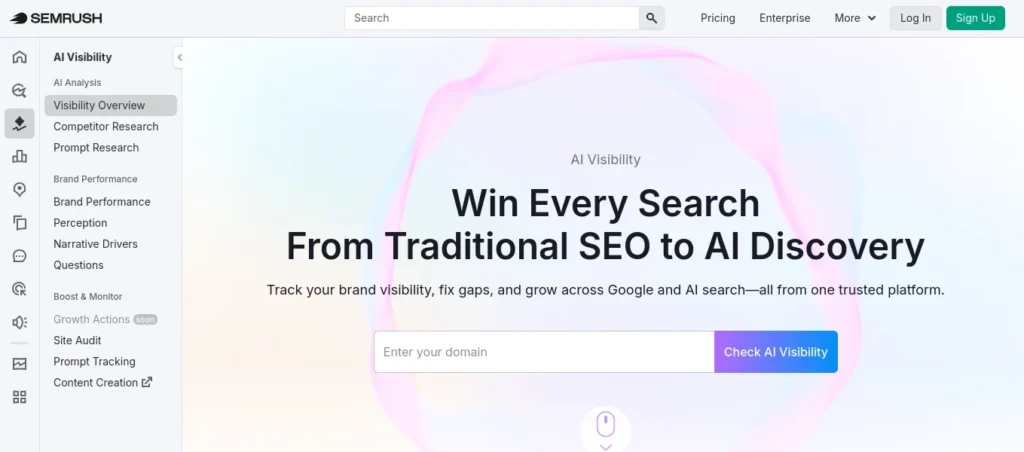
If you’re already paying for Semrush, the AI Visibility Toolkit is the obvious choice because it integrates directly with the traditional SEO data you’re already collecting. I’ve seen case studies showing how traditional SEO performance correlates with AI visibility, and this tool makes that connection visible.
Best For: Current Semrush subscribers who want to add AI visibility without buying a separate tool, SEO teams that want unified reporting across traditional and AI search, and marketers who need competitor insights.
Key Features:
- Competitor gap analysis shows you prompts where competitors appear but you don’t
- Trust factors tracking reveals how often AI associates your brand with specific features or benefits
- Content idea generation based on questions people are asking AI platforms
- Access to a database of over 3 million real AI prompts showing what users actually search for
- Integration with traditional SEO data creates a complete picture of search visibility
Platform Coverage: ChatGPT with and without search enabled, Google AI Mode and AI Overviews, Perplexity
Pricing: $99 per month per domain as a standalone add on, or included in Semrush One plans starting at $199+ per month
Honest Pros:
- Integrates seamlessly with existing SEO workflow if you’re already a Semrush user
- Competitor prompt research helps you find visibility gaps quickly
- Source citation tracking shows which websites AI platforms trust in your industry
- Large prompt database gives you real search volume data for AI queries
- Single platform for both traditional SEO and AI visibility simplifies reporting
Honest Cons:
- Doesn’t cover all LLM models, notably missing Claude and some smaller platforms
- Semrush is known for frequent upsells and limitations that push you toward higher tiers
- Limited to specific platforms compared to tools that track 10+ engines
- Requires Semrush subscription, so total cost can be significant
When to Choose Semrush AI Visibility Toolkit: You’re already using Semrush for traditional SEO, you want unified dashboards combining both SEO and AI visibility, you need robust competitor analysis, or you prefer working within a familiar platform rather than learning something new.
One case study I reviewed showed a pet product brand with strong traditional SEO rankings achieving only 6% share of voice on standard ChatGPT but 25% on Google AI Mode. The Semrush toolkit made that platform variance visible and actionable.
5. Embberos: Best for Predictive Analytics & Risk Management
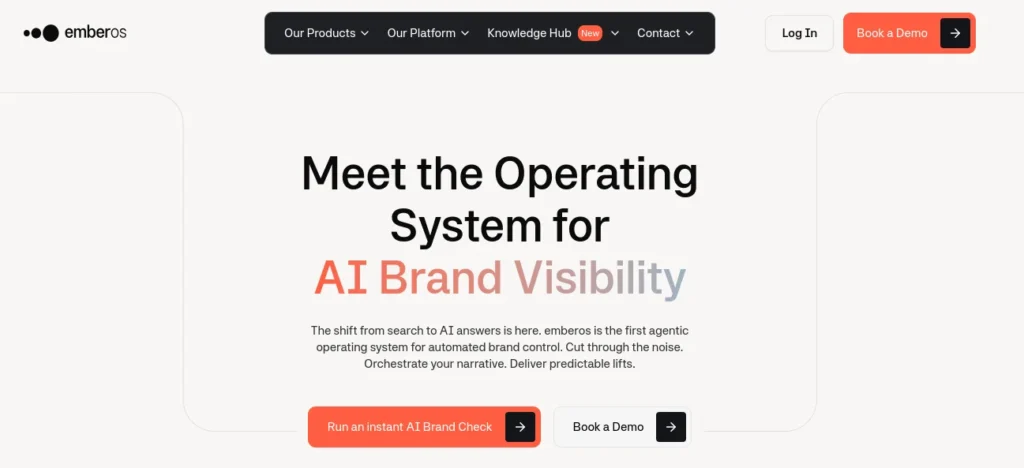
Embberos is the only tool I’ve found that focuses on predictive analytics rather than just reporting what already happened. If you need to forecast the impact of changes or manage misinformation risks, this is the platform to evaluate.
Best For: Enterprise brands where reputation risk matters, companies needing ROI attribution for AI visibility efforts, teams that want predictive insights rather than just historical data, and organizations requiring workflow automation.
Key Features:
- Predictive analytics forecast how content changes or optimization efforts will impact future visibility
- Hallucination detection identifies when AI platforms are stating false information about your brand
- Real time misinformation alerts notify you immediately when problematic content appears
- Workflow integration with Slack, Jira, and HubSpot pushes insights directly into your existing tools
- Measures lift and ROI by tracking how visibility changes correlate with business outcomes
Platform Coverage: ChatGPT, Claude, Google AI Overviews, Perplexity
Pricing: Custom enterprise pricing with no publicly listed rates. You need to contact sales for a quote.
Honest Pros:
- Only platform offering true predictive analytics showing forecasted impact before you invest resources
- Risk mitigation focus makes it valuable for brands where AI misinformation could cause real damage
- Workflow automation reduces manual work by pushing insights where your team already works
- Measures actual business lift, helping you prove ROI to stakeholders
- Enterprise grade with the sophistication large organizations need
Honest Cons:
- Expensive with custom pricing that typically exceeds smaller dedicated tools
- Complex setup and steeper learning curve than simpler monitoring platforms
- May be overwhelming for small teams without dedicated resources
- Requires sales conversation to even learn pricing, which some buyers find frustrating
When to Choose Embberos: You need predictive insights to prioritize optimization efforts, risk management is a priority due to brand sensitivity, you have an enterprise budget and team to support a sophisticated platform, or you require workflow integration with existing business tools.
6. Writesonic: Best for Content Creation + AI Visibility Combo
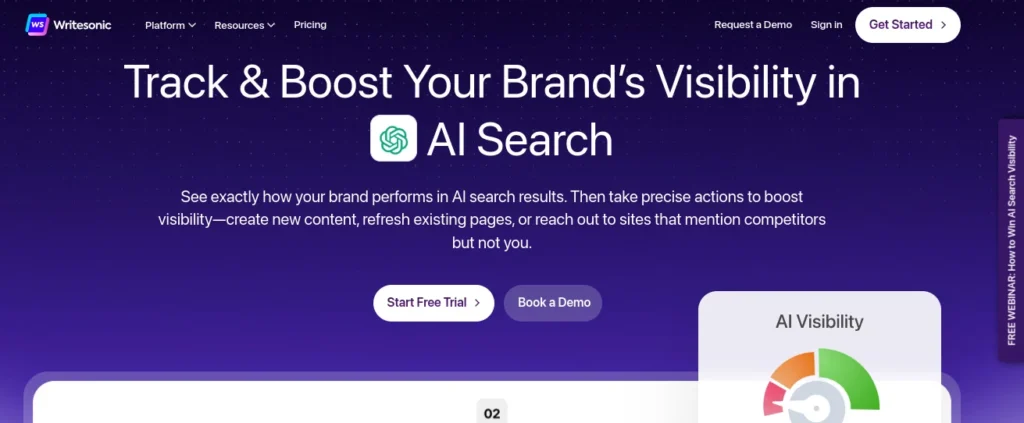
Writesonic started as an AI content writing platform and added visibility tracking as a complementary feature. If you need both content production and basic tracking, this all in one approach might save you from managing multiple subscriptions.
Best For: Content teams that need both writing assistance and visibility tracking, bloggers producing high volumes of content, brands that want a single platform for creation and monitoring.
Key Features:
- AI content generation for creating SEO optimized articles, blog posts, and web copy
- Citation tracking shows when and where your content gets cited by AI platforms
- SEO optimization tools built into the content workflow
- Content calendar and workflow management features
- Integration between content creation and visibility tracking
Platform Coverage: Multiple LLMs with specific coverage varying by subscription tier
Pricing: Tiered plans that bundle content generation credits with tracking features
Honest Pros:
- All in one solution eliminates need for separate writing and tracking tools
- Strong content creation capabilities if that’s a primary need
- SEO focused approach aligns content optimization with visibility goals
- Tracks citations showing ROI of content production efforts
- Single subscription simplifies billing and tool management
Honest Cons:
- Visibility tracking is more limited, focusing on citations rather than comprehensive brand mentions
- Content creation is the primary focus, making tracking feel like a secondary feature
- Not as robust for pure visibility monitoring compared to dedicated platforms
- May pay for content features you don’t need if tracking is your main priority
When to Choose Writesonic: You need an AI content writing tool and want basic visibility tracking included, you want a single platform instead of managing multiple tools, you prioritize content production volume, or you’re a blogger or content marketer rather than a pure SEO professional.
Industry experts note that Writesonic is seasoned in SEO but the AI tracking capabilities are limited to citations rather than full brand mention analysis. Keep that limitation in mind when evaluating.
7. Nightwatch: Best Hybrid SEO + LLM Tracking
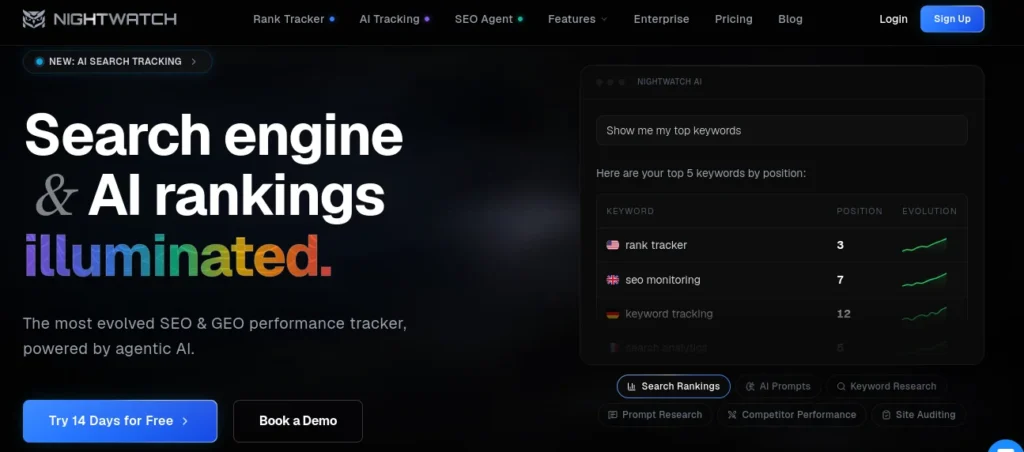
Nightwatch represents the traditional SEO tool category that’s adding AI visibility features. If you’re already using Nightwatch for rank tracking and SEO monitoring, the AI features extend your existing subscription without requiring a separate tool.
Best For: SEO professionals who want unified tracking across traditional and AI search, agencies managing both SEO and AI optimization for clients, teams that prefer familiar interfaces over learning new platforms.
Key Features:
- Traditional rank tracking for Google and other search engines
- AI visibility monitoring integrated into the same dashboard
- Combined reporting shows both traditional rankings and AI mentions
- SEO and GEO metrics side by side for complete search visibility picture
- Familiar interface for people already comfortable with SEO tools
Platform Coverage: Major AI platforms with specific coverage detailed in subscription tiers
Pricing: Included in SEO tool subscription tiers with no separate charge for basic AI visibility features
Honest Pros:
- Unified SEO and AI dashboard simplifies workflow and reporting
- No separate subscription required if you’re already a Nightwatch user
- Familiar interface reduces learning curve for SEO professionals
- Good choice for agencies that need both traditional and AI reporting for clients
- Single login and billing for all search visibility needs
Honest Cons:
- AI features may be less robust than dedicated AI visibility platforms
- Traditional SEO is clearly the primary focus with AI as secondary
- May lack advanced AI specific features found in specialized tools
- Newer AI capabilities still developing compared to platforms built specifically for LLM tracking
When to Choose Nightwatch: You’re already using Nightwatch for SEO and want to add AI visibility, you prefer a single dashboard for all search visibility metrics, you want to avoid managing multiple tool subscriptions, or you’re an SEO professional comfortable with traditional rank tracking interfaces.
8. Ahrefs: Best for Benchmarking Brand Performance
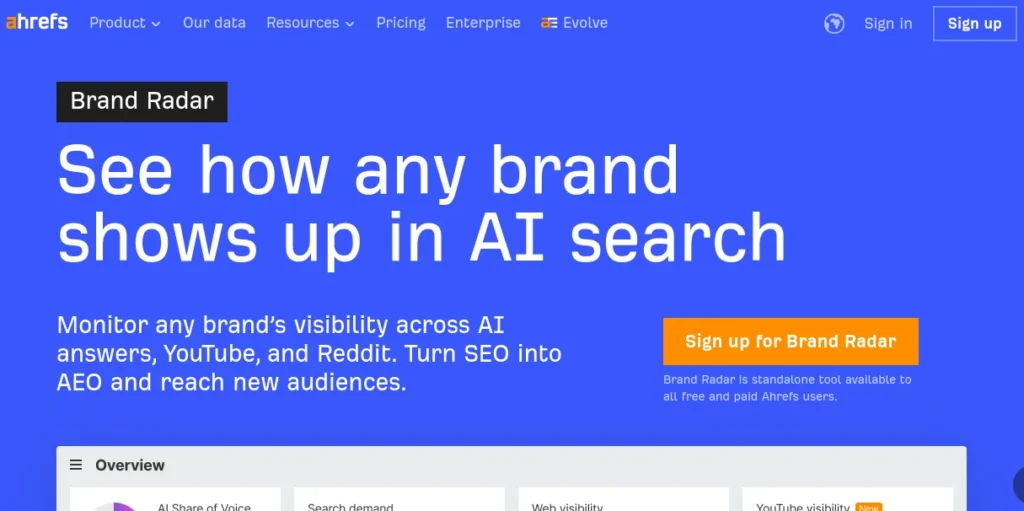
Ahrefs is adding AI visibility features to their comprehensive SEO platform. While the AI tracking capabilities are still developing, the platform’s strength is in competitive benchmarking backed by extensive research.
Best For: Existing Ahrefs users who want to add AI visibility, data driven teams that value research backed insights, brands wanting competitive performance benchmarking.
Key Features:
- Brand mention tracking across major AI platforms
- Competitive analysis comparing your visibility to industry competitors
- Research backed insights based on analysis of 75,000 brands and 25 million AI generated responses
- Integration with Ahrefs’ comprehensive SEO data
- Benchmarking tools showing how your performance compares to industry standards
Platform Coverage: Major AI platforms with ongoing expansion
Pricing: Included as part of Ahrefs subscription starting at $99+ per month
Honest Pros:
- Trusted brand with proven track record in SEO data accuracy
- Data driven insights backed by extensive research rather than just anecdotal advice
- Competitive benchmarking helps you understand where you stand in your industry
- Unified platform combining traditional SEO with emerging AI visibility
- Strong credibility with SEO professionals
Honest Cons:
- AI features still developing and not as mature as dedicated AI visibility platforms
- Requires full Ahrefs subscription, making it expensive if you only want AI tracking
- Premium pricing may not be justified if AI visibility is your only need
- Feature set growing but currently less comprehensive than specialized tools
When to Choose Ahrefs: You’re already an Ahrefs subscriber and want to add AI visibility, you prioritize data driven and research backed insights, you need competitive benchmarking in your industry, or you value brand trust and credibility in your tool selection.
Research from Ahrefs found that branded mentions have the strongest correlation with AI visibility and that 86% of citation sources are unique to specific AI platforms. This kind of research backed insight is what Ahrefs brings to the table.
9. Relixir: Best for Content Gap Detection & Automation
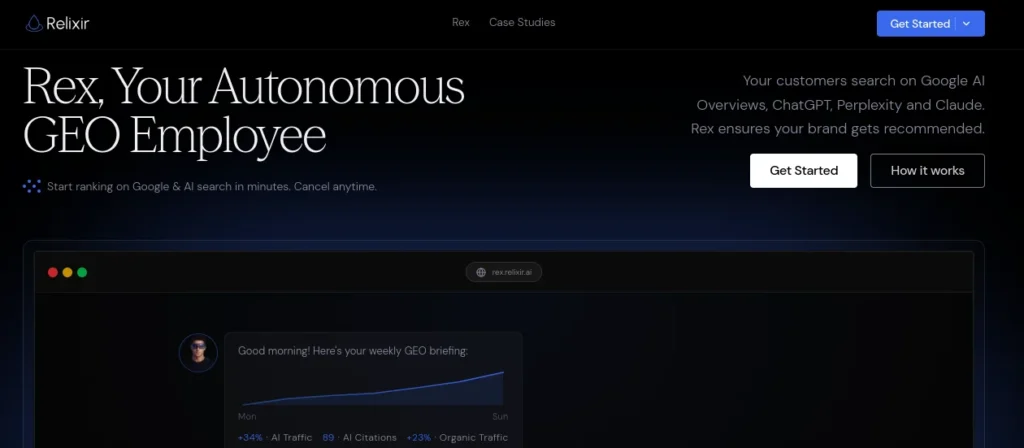
Relixir focuses on automation and content gap analysis rather than just reporting. If you manage a large content library and need help identifying what’s missing, this platform takes a different approach worth considering.
Best For: Content heavy websites with hundreds or thousands of pages, teams needing automation to scale efforts, brands with large knowledge bases requiring continuous updates.
Key Features:
- Large scale query simulation finds content gaps where competitors appear but you don’t
- Autonomous knowledge base refresh agents automatically update content to maintain relevance
- CMS agent layer integrates directly with your content management system
- Automatic publishing capabilities for approved content updates
- Gap analysis showing specific topics and queries you should create content for
Platform Coverage: Major LLMs with focus on content optimization across platforms
Pricing: Mid tier pricing with specific rates varying based on content volume and automation features
Honest Pros:
- Automated content updates reduce manual work significantly
- Gap analysis is more actionable than simple mention tracking
- CMS integration means insights lead directly to execution
- Good for scaling content efforts without proportionally scaling team size
- Reduces the ongoing maintenance burden for large content libraries
Honest Cons:
- Requires technical setup and CMS integration which may need developer help
- Automation features need oversight to ensure quality control
- Newer platform without the track record of established tools
- May be overpowered for small sites with limited content
When to Choose Relixir: You manage a large content library with hundreds of pages, you want automation to reduce manual updating work, you need content gap analysis showing exactly what to create, or you have technical resources to handle CMS integration.
10. WAK: Best Affordable Reputation Management
WAK, which stands for What AI Knows, takes a reputation focused approach at a price point that makes it accessible to small businesses. If your primary concern is making sure AI platforms have accurate information about your brand, this is worth evaluating.
Best For: Small businesses with limited budgets, reputation conscious brands worried about misinformation, budget users who want quality over feature quantity.
Key Features:
- Fact checking of AI responses to identify incorrect or missing information about your brand
- Hallucination detection alerts you when AI platforms state false claims
- Missing knowledge identification shows gaps in what AI platforms know about you
- Simple onboarding process gets you started quickly
- Topic suggestions help you understand what you should be tracking
Platform Coverage: Major AI platforms
Pricing: Approximately $70 per month, making it one of the most affordable options
Honest Pros:
- Very affordable at roughly $70 monthly, accessible even for bootstrapped businesses
- Easy onboarding means you can start without extensive training
- Focuses on accuracy and reputation rather than vanity metrics
- Suggests what topics you should track instead of requiring you to figure it out
- Good middle ground between free manual tracking and expensive enterprise tools
Honest Cons:
- More basic feature set compared to premium platforms
- Smaller platform without the name recognition of established tools
- Less comprehensive than tools costing 3x to 4x more
- May lack advanced features needed by larger organizations
When to Choose WAK: Your budget is $50 to 100 per month, you prioritize accuracy and reputation over comprehensive analytics, you want something simple without overwhelming complexity, or you’re a small business that needs professional tools at accessible pricing.
11. Rank Prompt: Best All Rounder for Multi Location Tracking
Rank Prompt specializes in geographic and multi location AI visibility tracking. If you operate in multiple markets or manage multiple client locations, this platform offers capabilities others miss.
Best For: Multi location businesses like franchises or regional chains, agencies managing multiple client accounts, brands needing geographic segmentation in reporting.
Key Features:
- Multi location tracking shows visibility by city, region, or country
- Google Search Console integration pulls your existing SEO data
- Google Analytics integration connects visibility to traffic and conversions
- Kanban board for task management helps organize GEO workflow
- All rounder capabilities beyond just geographic tracking
Platform Coverage: Major AI platforms
Pricing: Mid tier specialist pricing reflecting the advanced location features
Honest Pros:
- Excellent for geographic tracking which most other tools handle poorly
- Integrates with data sources you already have in Search Console and Analytics
- Task management features help teams stay organized
- Good all rounder capabilities make it viable even without multi location needs
- Strong dashboards that present data clearly
Honest Cons:
- May have more features than single location businesses need
- Operates on credit based pricing system that can become expensive at scale
- Specialist focus means it may not compete feature for feature with generalist platforms
- Pricing can be unpredictable with credit consumption models
When to Choose Rank Prompt: You’re a multi location business tracking visibility across different markets, you’re an agency with multiple clients each needing separate tracking, you need geographic segmentation in your reports, or you want data integrations with Google’s tools.
Industry testing found that Rank Prompt integrates well with existing analytics and provides excellent dashboards, but the credit based system means you need to monitor usage to avoid unexpected costs.
That covers the 11 best AI visibility tools I’ve thoroughly researched and evaluated. Each has strengths and limitations. The right choice depends entirely on your specific situation, budget, and priorities. In the next section, I’ll show you how to actually choose between these options based on your business type and needs.
Quick Comparison: 11 Tools at a Glance
If you’re feeling overwhelmed by all the detailed information above, I created this comparison table to help you see the best AI visibility tools side by side. Sometimes you need the forest view before diving back into the trees.
I use this table myself when I need to quickly remember which LLM tracking platforms excel at what. It’s especially helpful if you’re narrowing down your options based on budget or specific requirements like multi platform coverage or geographic tracking.
Scan through this table first to identify your top three candidates, then go back and read those detailed reviews more carefully. That’s the approach that worked best for me when I was making my own tool selection.
| Tool Name | Best For | Starting Price | Platform Coverage | Key Strength | Main Limitation |
|---|---|---|---|---|---|
| Profound | Enterprise accuracy | $99/month (ChatGPT only) | 10+ platforms | Most accurate data (buys user data from LLM providers) | Expensive, steep learning curve |
| Otterly AI | Budget-conscious startups | $20-25/month | 3 platforms | Very affordable, quick setup | Limited to 3 platforms only |
| Peec AI | Automated monitoring | Varies by tier | 4+ platforms | Auto-suggests prompts, detects hallucinations | Monitoring only, limited optimization |
| Semrush AI Toolkit | Existing Semrush users | $99/month | 3 platforms | Integrates with SEO data, 3M+ prompt database | Doesn’t cover all LLMs, upsells |
| Embberos | Predictive analytics | Custom pricing | 4 platforms | Only tool with predictive forecasting | Expensive, complex setup |
| Writesonic | Content + tracking combo | Tiered plans | Multiple LLMs | All-in-one content creation and tracking | Tracking limited to citations |
| Nightwatch | SEO professionals | Included in SEO subscription | Major platforms | Unified SEO + AI dashboard | AI features less robust than dedicated tools |
| Ahrefs | Competitive benchmarking | $99+/month | Major platforms | Research-backed insights (75K brand study) | AI features still developing |
| Relixir | Content automation | Mid-tier | Major LLMs | Automated content gap detection | Requires technical setup |
| WAK | Reputation management | ~$70/month | Major platforms | Affordable, focuses on accuracy | More basic features |
| Rank Prompt | Multi-location tracking | Mid-tier | Major platforms | Excellent geographic tracking | Credit-based pricing can get expensive |
A few patterns jump out when you look at this comparison. Tools under $100 per month typically track three to four platforms, while tools costing more offer broader coverage or specialized features like predictive analytics or automation.
The key strength column is where I focus most of my attention. If you need a specific capability like hallucination detection, automated prompts, or geographic tracking, that column tells you immediately which tool to investigate further.
The main limitation column is equally important. Every tool has tradeoffs. Knowing the biggest weakness upfront helps you decide if that limitation is a dealbreaker for your situation or something you can work around.
I keep coming back to this table whenever someone asks me for a quick recommendation. My answer always starts with “What’s your budget and what’s your biggest priority?” Those two questions combined with this comparison table usually narrow the field to two or three viable options within minutes.
Use this as your quick reference guide. Bookmark it. Screenshot it. Whatever helps you make a faster, more informed decision when you’re ready to invest in AI visibility tracking.
How to Choose the Best AI Visibility Tool for Your Business
Knowing all the options doesn’t automatically tell you which one to pick. I’ve talked to dozens of business owners who read every review, compared every feature, and still felt paralyzed by the decision. The problem isn’t lack of information. It’s lack of a clear framework for matching tools to specific situations.
Let me give you the decision framework I wish someone had given me when I started. I’m going to segment this by business type and budget because those two factors matter more than any feature checklist. A startup with three employees has completely different needs than an enterprise team with dedicated SEO staff.
For Startups & Small Businesses (Budget: $0 to $100/month)
If you’re bootstrapped or working with a tight marketing budget, you need to maximize value while minimizing cost. The good news is you don’t need enterprise features to get started with AI visibility tracking.
Start with manual tracking first. I know I already covered this, but it bears repeating for small businesses. Spend four to six weeks tracking manually using the free method I described earlier. This teaches you what AI visibility actually means for your business before you spend money. You’ll learn which platforms your customers use and which queries actually matter.
When you’re ready to invest, choose Otterly AI or WAK. Otterly AI starts around $20 to 25 per month and covers the three platforms that drive most AI search traffic. WAK costs roughly $70 per month and focuses more on reputation management and accuracy. Both are legitimate ai visibility tools for small businesses that won’t break your budget.
Upgrade to Peec AI if you need prompt automation. If manually figuring out which queries to track feels overwhelming, Peec AI automatically suggests what you should monitor based on your industry. The time savings might justify the slightly higher cost, especially if you’re a solo marketer wearing multiple hats.
Your priorities at this stage should be simple setup, clear ROI, and tracking only the major platforms where your customers actually search. Don’t pay for features you won’t use. Focus on ChatGPT, Google AI Overviews, and Perplexity. You can expand to other platforms later if needed.
For Growing Companies & Agencies (Budget: $100 to $300/month)
Once you’ve validated that AI visibility matters and you’re ready to scale your efforts, you need more sophisticated tools with better competitive intelligence and reporting capabilities.
Choose Semrush AI Visibility Toolkit if you’re already a Semrush user. The integration with your existing SEO data is incredibly valuable at this stage. You can see how traditional rankings correlate with AI visibility and create unified reports. The competitor gap analysis feature helps you find opportunities your competitors are capturing.
Pick Rank Prompt if you’re an agency managing multiple clients. The multi location tracking and client management features are built specifically for agencies. You can track different brands separately, generate client specific reports, and manage everything from one dashboard. The Google Search Console and Analytics integrations help you connect AI visibility to actual business results.
Consider Peec AI for agency focused features. The unlimited team seats make it cost effective when you have multiple people working on client accounts. The automated prompt suggestions save time across multiple client projects. Industry experts specifically recommend Peec AI for agencies that need prompt level detail without enterprise complexity.
Your priorities at this growth stage shift to competitor visibility analysis, client reporting capabilities, tracking more than just the three major platforms, and integrating AI visibility data with your existing analytics. You need tools that scale across multiple projects or clients without becoming unmanageable.
For Enterprise Brands (Budget: $300+/month)
Enterprise teams have different requirements than small businesses. You need proven accuracy, security compliance, predictive capabilities, and tools that integrate with existing workflows.
Choose Profound if accuracy is your top priority. Industry testing shows Profound delivers the most accurate data because it reportedly purchases exact user data from LLM providers rather than relying solely on APIs. The SOC2 Type 2 compliance makes it viable for regulated industries. The prompt laboratory feature gives you deep testing capabilities that justify the premium pricing.
Select Embberos if you need predictive analytics and risk management. This is the only platform offering true forecasting of how optimization efforts will impact future visibility. The misinformation alerts protect your brand reputation. The workflow integration with Slack, Jira, and HubSpot means insights flow directly into your existing processes. The ability to measure actual business lift helps you prove ROI to executives.
Consider custom enterprise solutions for unique requirements. At this budget level, you might need API integration with proprietary systems, white label reporting for board presentations, dedicated account management, or custom data science support. Several platforms offer enterprise tiers with these capabilities.
Your priorities at the enterprise level include security and compliance requirements, predictive analytics for strategic planning, workflow automation to reduce manual work, dedicated support and account management, and the ability to prove ROI with hard numbers. You’re not just buying a tool. You’re buying a strategic platform that becomes part of your marketing infrastructure.
Decision Factors Beyond Budget
Budget and business size are starting points, but four other factors matter when you’re choosing between tools in the same price range.
Platform priorities matter more than total platform count. A tool tracking 10 platforms sounds better than one tracking 3 platforms, but only if you actually need those additional platforms. Figure out where your customers search before you pay for comprehensive coverage. Most businesses get 80% of their value from ChatGPT, Google AI Overviews, and Perplexity. Paying extra for Claude, Gemini, and Grok only makes sense if your audience uses those platforms regularly.
Integration needs can be a deciding factor. If you’re already using Semrush, Ahrefs, or another SEO platform, choosing an AI monitoring platform that integrates directly saves you time and creates better insights. Switching between disconnected tools wastes time and makes it harder to see the complete picture. I prioritize tools that work with my existing stack over standalone tools with slightly better features.
Technical capability determines which tools are realistic. Some platforms require CMS integration, developer resources, or technical knowledge to set up and use effectively. Tools like Relixir offer powerful automation but need technical setup. If you don’t have developer resources, you need plug and play platforms like Otterly AI or Peec AI that you can configure yourself in under an hour.
Monitoring versus optimization focus reveals different tool philosophies. Some tools just show you what’s happening. They track mentions, measure sentiment, and create reports. Other tools focus on the action layer, providing content gap analysis, optimization recommendations, and predictive insights. Industry experts emphasize this distinction because monitoring without action doesn’t improve results. If you’re serious about improving visibility, lean toward tools that help you optimize, not just observe.
The accuracy versus coverage tradeoff is real. Tools tracking more platforms often sacrifice some accuracy. Tools with the highest accuracy often cover fewer platforms or cost significantly more. You need to decide which matters more for your specific situation.
My recommendation is to start with your business type and budget, narrow down to two or three options, then evaluate those finalists based on platform priorities, integration needs, your technical capabilities, and whether you need monitoring or optimization focus. That process will get you to the right choice faster than comparing feature lists across all 11 tools.
The goal isn’t finding the objectively best tool. It’s finding the best tool for your specific situation, budget, and priorities. That’s a much easier question to answer once you have a clear framework.
5 Critical Features Your AI Visibility Tool Must Have
When I was evaluating tools, I made the mistake of getting distracted by flashy features that sounded impressive but didn’t actually matter for my business. One platform bragged about tracking 15 different AI platforms. Another highlighted their custom dashboard colors. A third emphasized their mobile app.
None of those things moved the needle for my actual visibility or business results.
After months of using these tools in real world situations, I’ve identified five features that genuinely matter. These aren’t nice to have extras. They’re the minimum requirements that separate useful tools from expensive dashboard decorations.
If a tool you’re evaluating lacks any of these five capabilities, you should either find a workaround or keep looking.
1. Multi Platform Tracking Across the Right AI Engines
This seems obvious, but the devil is in the details. You need multi platform tracking, but not necessarily across every AI platform that exists. The key is tracking the platforms your actual customers use.
I rank platforms in two tiers based on usage data and importance. Tier 1 platforms are absolute must track engines. If a tool doesn’t monitor these, don’t buy it. Tier 2 platforms are nice to have but not critical unless your specific audience heavily uses them.
Tier 1 must track platforms include ChatGPT, which has the largest user base and the most commercial query volume. Google AI Overviews and AI Mode are essential because they’re integrated directly into regular Google search. And Perplexity is growing fast among researchers and professionals making purchase decisions.
If a tool only tracks these three platforms, that covers roughly 80% of commercial AI search activity. You’re getting most of the value without paying for comprehensive coverage you don’t need.
Tier 2 nice to have platforms include Gemini, which Google is pushing but hasn’t achieved mass adoption yet. Claude has a smaller but highly engaged user base, particularly in technical fields. Grok is growing among certain demographics. Bing Copilot matters if your audience skews toward Microsoft ecosystem users.
Here’s what I learned from research: approximately 86% of the sources that AI platforms cite are unique to specific assistants. ChatGPT prefers different sources than Perplexity, which prefers different sources than Google AI Overviews. This means you need platform specific strategies, not one size fits all optimization.
During tool demos, ask specifically which platforms they track and how frequently they update the data. Daily updates matter more than tracking 10 platforms with weekly updates. Real time or daily tracking on three platforms beats weekly tracking on eight platforms.
2. Brand Mention Tracking AND Sentiment Analysis
This is where I see the biggest gap between basic tools and sophisticated platforms. Cheap tools tell you if your brand was mentioned. Good tools tell you how your brand was portrayed when it got mentioned.
The difference matters enormously for actual business results.
I discovered this when I noticed my brand was mentioned in 60% of relevant AI queries but my demo requests weren’t increasing proportionally. When I dug into the sentiment data, I found that AI platforms were mentioning my brand in neutral or slightly negative contexts. I was being included in lists but not being recommended or highlighted positively.
Brand mention sentiment analysis shows whether the AI describes your brand as the best option, a viable alternative, an expensive choice, a budget option, or something with specific limitations. The exact language and framing dramatically impacts whether users click through or keep looking.
Industry experts emphasize that it’s not just if you are mentioned, but whether AI portrays your brand positively or negatively. You want to track trust factors showing how often AI associates your brand with desirable characteristics like “affordable,” “easy to use,” “best for small teams,” or whatever positioning you actually want.
During tool evaluations, ask to see examples of sentiment analysis. Good tools break down mentions into positive, neutral, and negative categories. Great tools show you the specific language and context around each mention so you can understand exactly how your brand is being framed.
Platform Coverage: Which LLMs Actually Matter
I already touched on this, but it’s worth expanding because this is where tool pricing often gets inflated with features you don’t need.
ChatGPT visibility matters most because of sheer user volume. Millions of people use ChatGPT daily for research, and a significant percentage ask commercial intent questions. If you only tracked one platform, this would be it.
Google AI Overviews deserve equal priority because they appear directly in traditional Google search results. Users don’t have to go to a separate AI platform. The AI powered answers appear right in their normal search flow. This integration makes Google AI Overviews critical for most businesses.
Perplexity AI tracking is essential for B2B and professional services because Perplexity users tend to be researchers, analysts, and decision makers doing deep investigation before purchases. The user base is smaller but higher quality for many industries.
Gemini, Claude, Grok, and Bing Copilot fall into tier 2. Track them if your budget allows and your audience analysis shows meaningful usage. Skip them if you’re working with limited resources and need to focus spending on the platforms that drive actual results.
The platform coverage you need depends entirely on your industry and customer behavior. Run manual tests on different platforms asking questions your customers would ask. See which platforms your brand appears in and which ones your competitors dominate. That analysis tells you where to focus your tracking budget.
Sentiment Analysis: Beyond Simple Mentions
Let me give you a concrete example of why sentiment matters more than mention count.
I worked with a software company that was thrilled to discover they were mentioned in 70% of relevant ChatGPT queries about project management tools. That’s fantastic visibility, right? They were beating most competitors on pure mention frequency.
But when they analyzed the sentiment, they discovered ChatGPT consistently described their product as “more expensive” and “better for large enterprises” even though their pricing was actually mid range and they specifically targeted small to medium businesses.
That negative framing in the brand mention sentiment was killing conversions. People would see the mention, visit the website, and immediately leave because they’d been primed to think the product was too expensive for them.
Fixing this required identifying which sources ChatGPT was citing and updating content on those authoritative sites to reflect accurate pricing positioning. Within six weeks, the sentiment shifted to “affordable for growing teams” and demo requests increased by 40% even though mention frequency stayed roughly the same.
That’s the power of sentiment analysis. Getting mentioned with the wrong framing is sometimes worse than not getting mentioned at all.
Citation Source Tracking
Understanding which websites and articles AI platforms use as sources when they mention your brand or discuss your industry is strategic intelligence you can act on immediately.
Citation tracking tools show you the specific URLs, blog posts, reviews, news articles, and industry publications that AI platforms trust and reference. This creates a roadmap for your outreach and content strategy.
Here’s how I use this feature practically. I run commercial intent queries related to my product in ChatGPT and look at the citations listed at the bottom of the response. Those sources are the platforms that influence what ChatGPT says about my industry.
If an industry blog is cited frequently but never mentions my brand, that’s an outreach opportunity. I can pitch a guest post, offer expert commentary, or get included in their next product roundup. Getting mentioned on sources that AI platforms already trust is far more valuable than getting mentioned on random sites.
AI citation analysis reveals patterns across multiple queries. You might discover that review sites like G2 or Capterra heavily influence AI responses in your category. Or that specific industry publications are cited disproportionately. Or that Reddit discussions are being used as sources more than you expected.
One expert I follow recommends entering your commercial keywords in ChatGPT, examining every citation, and building an outreach target list from those sources. Focus your link building and PR efforts on the platforms AI engines already cite. This strategy delivers better results than generic outreach to any authoritative site.
4. Competitor Visibility Analysis
Tracking your own visibility only tells half the story. You need to see how competitors are performing to understand if you’re winning or losing in your category.
Good competitor visibility analysis tools let you add competitor brands to your monitoring dashboard. You can then see comparative mention frequency, sentiment comparisons, position in AI responses, and which queries competitors dominate that you’re missing from.
I use this feature to identify content gaps. If a competitor appears for 15 queries where I’m absent, I analyze those specific queries to understand what content or positioning they have that I’m lacking. This creates a clear roadmap for content development and optimization.
The comparison data also helps you benchmark your progress. If your mention rate is 30% and the category leader is at 65%, you know how far you need to go. If you’re at 45% and competitors average 35%, you know you’re ahead and should focus on maintaining that advantage.
5. Historical Trend Data and Tracking Over Time
The final critical feature is the ability to track changes over time rather than just seeing current snapshots. AI visibility fluctuates based on content updates, algorithm changes, and new sources being published. You need historical data to spot trends and measure whether your optimization efforts are actually working.
I look for tools that provide at least 90 days of historical data, ideally six months or more. This lets you see seasonal patterns, measure the impact of specific optimization efforts, and identify when sudden drops in visibility need investigation.
When evaluating tools, ask how far back their data goes and whether you’ll have access to historical trends from before you signed up or only from your signup date forward. Some tools have been monitoring AI platforms for months and can show you historical context immediately. Others only start tracking when you become a customer.
These five features form the foundation of any useful AI visibility tool. Everything else is secondary. Fancy dashboards, mobile apps, custom color schemes, and extra integrations are nice bonuses, but they don’t determine whether the tool actually helps you improve your AI search presence.
Focus your evaluation on these five capabilities first. Once you’ve confirmed a tool handles these essentials well, then you can consider the bonus features that might justify choosing one option over another at similar price points.
I Tested These Tools – Here’s What Actually Happened
Reading feature lists and marketing pages only tells you what tools claim to do. I wanted to know what actually happens when you use these platforms in real situations with real queries and real brands.
I spent considerable time researching hands-on testing from SEO professionals and tool creators who’ve put these platforms through rigorous evaluation. What I discovered surprised me in several ways. Some tools that looked impressive on paper disappointed in practice. Others that seemed basic delivered unexpectedly accurate results.
Let me share the most revealing findings from real world testing that changed how I think about AI visibility analytics.
One AI optimization agency founder tested every major tool on the market and reached a controversial conclusion: only three tools actually work well enough to recommend. His testing revealed that most platforms provide data that looks helpful but doesn’t lead to actionable improvements. They show you numbers without giving you the context needed to actually improve your AI search performance.
The three that passed his rigorous evaluation were tools that either provided exceptionally accurate data, offered genuine optimization guidance beyond just monitoring, or delivered unique capabilities you couldn’t get elsewhere. Everything else fell into the category of “nice dashboards showing vanity metrics.”
That harsh assessment made me more skeptical when evaluating tools. I started asking not just “does this tool track mentions” but “does this tool help me actually improve my visibility in ways that drive business results?”
Another fascinating discovery came from testing platform variance. A case study tracking a pet product brand revealed something that changed my entire strategy. The brand had strong traditional SEO, ranking for over 25,000 keywords with solid domain authority.
When they started tracking AI visibility, they discovered massive differences between platforms. Their share of voice on standard ChatGPT was only 6%, meaning they appeared in just 6 out of 100 relevant queries. But on Google AI Mode, their share jumped to 25%. That’s more than four times better performance on one platform versus another.
This variance isn’t random. Different AI platforms have different preferences for sources, different ways of weighting authority, and different algorithms for selecting which brands to mention. You can’t assume that optimizing for one platform will improve your visibility across all platforms.
Accuracy Test: Do Tools Show the Same Data?
This is the question that kept bothering me: if two tools claim to track ChatGPT, do they report the same results? Or are there methodology differences that lead to different data?
An SEO tool creator spent a week testing Profound against his own platform to answer exactly this question. He ran the same query on both tools: “how to automate sales process.” Both platforms correctly identified that the brand Zoho appeared in fourth position in ChatGPT’s response.
So far, so good. The core data matched. Both tools accurately detected the mention and the ranking position.
But the deeper analysis revealed important differences. The tools used different methodologies for gathering data. Some platforms rely purely on APIs provided by the AI companies. Others use actual browser agents with residential proxies to simulate real user experiences.
The API approach is cleaner and easier to scale, but it might not reflect exactly what real users see. The browser agent approach with residential proxies is more complex and expensive, but it shows you the actual user experience including any personalization or geographic variations.
This methodology difference matters when you’re making strategic decisions based on the data. If a tool reports you’re mentioned but uses an API that doesn’t account for user location or search history, you might be getting visibility in the API response but not in real user sessions.
During my research, I learned that Profound’s exceptional accuracy comes from reportedly purchasing exact user data directly from LLM providers. They’re not simulating queries or using APIs. They’re analyzing actual user interactions. That explains why Profound costs more but delivers more reliable data.
The lesson here is that not all tracking is created equal. Real time monitoring means different things to different platforms. When evaluating tools, ask specifically about their data collection methodology. Understanding how they gather information helps you interpret the reliability of their reports.
Speed Test: How Fast Can You See Results?
One of the most encouraging findings from testing relates to how quickly AI visibility can change when you make improvements. Traditional SEO often takes months to show results. AI search optimization can happen much faster.
An SEO expert demonstrated this in real time during a presentation. He took an existing blog post that wasn’t being cited by Perplexity and made targeted updates to improve its relevance for specific queries. Then he requested re-indexing through Google Search Console.
The result was dramatic. Within minutes of the re-indexing request, that same blog post started appearing as a cited source in Perplexity responses. The timestamp in the video shows the update happening at the 22 minute 44 second mark. From content update to Perplexity citation in less than half an hour.
This speed is possible because AI platforms use real time retrieval for many queries. Unlike traditional search engines that might take weeks to fully re-crawl and re-rank a page, AI platforms can fetch updated content almost immediately when they need it to answer a question.
The practical implication changed how I think about content updates. When I improve a piece of content now, I don’t wait passively for results. I request re-indexing immediately and then test whether AI platforms start citing the updated version within days instead of months.
Not every update will show results this quickly. The speed depends on whether AI platforms already consider your domain authoritative, whether the query triggers real time retrieval, and whether your content genuinely became more relevant for that specific question.
But knowing that fast results are possible motivates me to make improvements rather than assuming nothing will change for months. AI search optimization rewards quick iterations and testing in ways that traditional SEO often doesn’t.
These testing insights fundamentally changed my approach to AI visibility. I became more skeptical of tools that just show numbers without explaining methodology. I started tracking platform variance to understand where I’m strong and where I’m weak. And I got more aggressive about making improvements because I learned results can appear within days instead of months.
The gap between what tools claim and what they actually deliver is real. Choose platforms that have been tested by independent experts, not just marketed by their own sales teams.
5 Expensive Mistakes to Avoid When Choosing AI Visibility Tools
I’ve made mistakes with AI visibility tools that cost me time, money, and results. I’ve also watched other businesses make errors that were completely avoidable with the right information upfront.
These aren’t small oversights. These are expensive mistakes that waste your budget, create false confidence in bad data, or worse, make you invisible to AI search engines while you think everything is fine.
Let me walk you through the five biggest mistakes I’ve seen and experienced so you can avoid them completely.
Mistake 1: Buying Tools Without Having a Strategy
This is the mistake I made first, and it’s the one I see most often. You get excited about AI visibility, buy an expensive tool, and then realize you have no idea what to actually do with all the data it provides.
An industry expert who’s tested every major platform put it bluntly: tools are not strategy. Success in AI search requires consistent execution of actual optimization work. Having a sophisticated dashboard doesn’t improve your visibility. Taking action based on insights does.
I wasted three months paying for a tool while I figured out what I should actually be tracking and optimizing. I had beautiful reports showing my mention rates and sentiment scores, but I wasn’t doing anything differently because I didn’t have a clear plan.
Here’s what I should have done instead: develop a strategy first, then buy tools to support that strategy. Figure out which platforms matter most for your audience. Identify the commercial queries where you need visibility. Understand what content and optimization work you’re actually willing to commit to doing. Then choose tools that help you execute that specific strategy.
The tool should serve your strategy, not be your strategy. If you’re not ready to consistently create content, build citations, and optimize for AI search, save your money. Manual tracking is enough until you have a real plan to act on the insights.
Mistake 2: Accidentally Blocking AI Crawlers in Your Robots.txt File
This mistake is shockingly common and completely invisible unless you specifically check for it. Research analyzing thousands of websites found that approximately 5.9% of sites accidentally block OpenAI’s GPT bot in their robots.txt file.
Think about what this means. Nearly 6% of websites are completely invisible to ChatGPT not because their content is poor or their SEO is weak, but because they accidentally told ChatGPT’s crawler not to access their site.
I almost made this mistake myself. When AI search engines started crawling aggressively, some developers added blanket bot blocking rules without understanding which bots they were blocking. A well intentioned attempt to reduce server load ended up making websites invisible to the fastest growing search channel.
Here’s how to avoid this: go to your website’s robots.txt file right now. It’s at yoursite.com/robots.txt. Look for any rules blocking GPTBot, ChatGPT-User, PerplexityBot, Claude-Web, or Google-Extended. If you see these blocked, you’re invisible to major AI search engines.
Remove those blocking rules immediately unless you have a specific strategic reason to block AI crawlers. Most businesses should want AI platforms to access their content, not prevent it.
This is the kind of technical mistake that costs you months of potential visibility while you’re investing in AI visibility tools that can’t help you because AI platforms literally can’t see your website.
Mistake 3: Tracking Vanity Metrics Instead of Business Impact
I got really excited when my first AI visibility tool told me my brand was mentioned 83 times across various platforms in the first month. That number felt like success. I was being mentioned dozens of times. Progress, right?
Then I dug into the actual queries where those mentions appeared. Most were informational questions that had nothing to do with purchase intent. I was getting mentioned when people asked general industry questions, but I was absent from the commercial queries where people were actually evaluating solutions.
Those 83 mentions were vanity metrics. They made me feel good but didn’t drive business results.
Tools that provide basic monitoring without optimization guidance tend to encourage this mistake. They show you total mention counts, overall sentiment scores, and other aggregate numbers that don’t tell you whether you’re winning the queries that actually matter.
The fix is focusing on commercial intent queries specifically. Track your share of voice across 20 to 50 queries where users are ready to make decisions, not across hundreds of informational queries where they’re just learning.
I now ignore my total mention count completely. I only care about my visibility in queries that lead to demo requests, trial signups, or direct sales. That’s a much smaller number, but it’s the number that correlates with actual revenue.
Mistake 4: Ignoring Data Collection Methodology Differences
Not all AI visibility tools gather data the same way, and these methodology differences lead to different results. I learned this the hard way when two tools showed me conflicting data for the same queries.
Some tools use API only methods to collect data. They ping the AI platform’s API and record the response. This approach is clean and scalable but may not reflect what real users actually see. APIs sometimes return different results than the consumer facing interface, especially when personalization or location factors are involved.
Other tools use real browser agents with residential proxies. They simulate actual user sessions, seeing exactly what a real person in a specific location would see when asking the same question. This method is more accurate but more expensive and complex to maintain.
The difference matters when you’re making strategic decisions based on the data. If a tool reports you’re mentioned in 40% of queries but uses an API that doesn’t account for personalization, the real user experience might be significantly different.
I now specifically ask about data collection methodology during tool evaluations. I want to know if they’re using APIs, browser agents, or actual user data. Tools that purchase real user data from LLM providers are more expensive but deliver the most accurate picture of what’s actually happening.
Don’t assume all tracking is equivalent. Methodology differences explain why premium tools cost more and why their data is often more reliable than cheaper alternatives.
Mistake 5: Not Starting with Manual Tracking Before Buying Tools
I jumped straight into paid tools without understanding what I actually needed to track or whether AI visibility even mattered for my specific business. That was backwards and expensive.
Manual tracking for four to six weeks teaches you more about your AI visibility needs than any sales demo will. You learn which platforms your customers actually use. You discover which queries drive valuable traffic. You see how often your brand naturally appears without any optimization.
This baseline data is invaluable when evaluating tools. You can ask specific questions like “I need to track these 30 commercial queries across ChatGPT and Perplexity weekly. Can your tool do that efficiently?” instead of generic questions like “What can your tool do?”
Starting with manual tracking also prevents you from paying for features you don’t need. Maybe you discover your audience only uses ChatGPT and Google AI Overviews. Why pay for a tool that tracks 10 platforms when you only need two?
I recommend everyone start with the free manual tracking method I described earlier. Invest a month of weekly effort before investing a dollar in tools. The knowledge you gain makes your tool selection dramatically better and prevents you from choosing based on flashy features that don’t match your actual needs.
One final warning about a specific pricing mistake: some tools use credit based pricing models where you pay per query tracked or per platform checked. These can become unexpectedly expensive as your needs scale. If you start tracking 20 queries and grow to 200 queries, your monthly cost can explode.
Always calculate total monthly costs based on your realistic usage, not just the starting price. Ask specifically about usage limits, overage charges, and how pricing scales as you track more queries or add more platforms.
These five mistakes have cost businesses thousands of dollars and months of missed opportunity. Learn from these errors instead of repeating them. Start with strategy, check your technical setup, focus on metrics that matter, understand methodology differences, and validate your needs with manual tracking before committing budget to tools.
Your First 30 Days: From Tool Selection to Measurable Results
You’ve read about tools, features, pricing, and mistakes to avoid. Now you need a concrete plan for actually getting started and seeing results within your first month.
I’m going to give you the exact 30 day roadmap that industry experts recommend and that I’ve personally followed. This structured approach prevents paralysis and ensures you’re making measurable progress each week instead of getting lost in endless research and planning.
The goal is simple: by day 30, you should have baseline data, a tool in place, initial optimizations completed, and your first measurable improvements in brand visibility across AI platforms.
Week 1: Establish Your Baseline
Your first week is all about understanding where you currently stand. You cannot improve what you don’t measure, and you cannot measure improvement without a starting point.
Start by creating accounts on ChatGPT, Perplexity, and Google AI Mode if you don’t already have them. These three platforms represent the majority of commercial AI search activity and give you a representative sample of your current visibility.
Next, build your priority query list. Identify 10 to 20 commercial intent questions that your ideal customers would actually ask when they’re evaluating solutions in your category. Don’t just search for your brand name. That’s not useful data.
Think about the questions people ask at different stages of their buying journey. “Best project management tools for remote teams.” “How to choose accounting software for small business.” “Affordable alternatives to popular product.” These are the queries where you need visibility.
Run each query on all three platforms and document the results in a simple spreadsheet. Note whether your brand appears, what position you’re in if mentioned, which competitors appear, and what the overall sentiment seems to be.
This manual baseline tracking should take about two hours total across the week if you spread it over a few sessions. By the end of week one, you’ll have concrete data showing your current state of brand visibility in AI search.
You’ll also discover something valuable: whether AI visibility actually matters for your business right now. If you run 20 commercial queries and discover competitors are dominating while you’re invisible, that confirms the urgency. If nobody in your industry appears consistently, AI search might not be critical yet for your specific market.
Week 2: Choose Your Tool & Complete Setup
Now that you have baseline data and understand your needs, you’re ready to make an informed tool selection. Use the decision framework I provided earlier based on your business type and budget.
If you’re a startup with limited budget, focus on Otterly AI or WAK. If you’re a growing company or agency, evaluate Semrush AI Toolkit, Rank Prompt, or Peec AI. If you’re enterprise with serious budget, test Profound or Embberos.
Sign up for free trials where available. Most platforms offer at least a 7 to 14 day trial period. Use your baseline query list to test whether the tool accurately detects the visibility you already documented manually. This validates data accuracy before you commit.
During setup, make sure you’re tracking the same queries you tested manually. Configure the AI monitoring platform to check the platforms that matter most for your audience. Set up any integrations with Google Search Console, Google Analytics, or your existing SEO tools if the platform supports them.
Industry experts note that tools like Peec AI can be set up in under 10 minutes, while more sophisticated platforms might require a few hours to configure properly. Budget the time based on which tool you choose.
By the end of week two, you should have a tool actively tracking your queries, baseline historical data available, and your first automated reports showing current visibility across platforms.
Week 3: Identify Gaps & Start Optimizing
Week three is where you shift from observation to action. This is the AI search optimization phase where you actually start improving your visibility.
Use your tool’s competitor analysis features to identify specific queries where competitors appear but your brand doesn’t. Make a prioritized list focusing on the highest value queries first. These are commercial intent searches where visibility directly impacts sales.
Look at the citation sources that AI platforms are using when they mention competitors. What websites are being cited? What type of content appears to be favored? Are they citing product reviews, comparison articles, how-to guides, or industry news?
This citation analysis reveals your content optimization targets. If review sites like G2 or Capterra are heavily cited in your industry, focus on building your presence there. If industry blogs are the primary sources, pitch guest posts or expert commentary to those publications.
Update your existing content to better align with the queries where you’re missing visibility. Add sections that directly answer the questions people are asking. Include the specific terminology and framing that AI platforms seem to prefer based on how they describe the topic.
Request re-indexing for updated pages through Google Search Console. Remember that AI platforms can pick up changes quickly, sometimes within hours or days rather than weeks. Don’t wait passively for results.
By the end of week three, you should have identified your top 10 visibility gaps, updated or created content targeting at least 3 to 5 of those gaps, and requested indexing for all changes.
Week 4: Monitor Changes & Iterate
The final week of your first month focuses on measuring the impact of your optimization work and refining your approach based on what’s working.
Check your search visibility tracking data to see if your mention frequency has improved for the queries you targeted. Even small improvements are meaningful in the first month. Going from 0% to 10% visibility on a key query is significant progress.
Pay attention to AI search performance metrics beyond just mention counts. Has your average position improved when you are mentioned? Has sentiment shifted from neutral to positive? Are you being cited from the new sources you built presence on?
Look for quick wins you can replicate. If updating a specific type of content led to improved visibility, update similar content following the same pattern. If getting mentioned on a particular review site led to citations, focus more effort on that platform.
Expand your tracking to additional queries now that you understand the process. Add 10 to 15 more commercial intent questions to your monitoring list. The goal is building comprehensive coverage over time, not tracking everything at once from day one.
Document what worked and what didn’t during your first month. This becomes your playbook for month two and beyond. AI visibility is not a one time project. It’s an ongoing process of monitoring, optimizing, and iterating based on results.
By day 30, you should see measurable improvements in at least a few key queries. You’ll have a clear process for finding gaps and optimizing. And you’ll have momentum that makes month two easier and more effective than month one.
The businesses that succeed with the best ai visibility optimization tools are the ones that treat this as a continuous process, not a one time setup. Use this 30 day framework as your starting point, then repeat the cycle: identify gaps, optimize content, build citations, measure results, refine approach.
That’s how you move from invisible to visible in AI search. Not overnight, but through consistent, strategic effort following a proven process.
Frequently Asked Questions
How much do AI visibility tools actually cost?
AI visibility tools range from free to over $300 per month depending on features and coverage.
Free manual tracking costs only your time. Budget tools like Otterly AI start at $20 to 25 monthly. WAK costs around $70 per month. Mid-tier options like Semrush AI Toolkit and Profound run $99 to 199 monthly. Enterprise platforms cost $300+ or require custom pricing.
My budgeting guide: startups should plan $0 to 50 monthly, growing companies $100 to 300, and enterprises $300 or more. Most platforms offer free trials, so test before buying.
Which AI platforms should I monitor first?
Start with the three platforms that matter most: ChatGPT has the largest user base, Google AI Overviews appears in regular Google search, and Perplexity is growing fast among professional researchers.
These three cover roughly 80% of commercial AI search activity. Add Gemini, Claude, or Grok only if your budget allows or your specific audience uses them heavily.
Research shows 86% of sources are unique to each platform, so focus on where your customers actually search rather than trying to track everything.
Can I track AI visibility for free before paying for tools?
Yes. Create accounts on ChatGPT, Perplexity, and Google AI Mode. Run 10 to 20 commercial queries weekly and log results in a Google Sheet tracking mentions, positions, and competitors.
This manual method works perfectly for baseline data but becomes time consuming beyond 20 to 30 queries. It’s ideal for validating whether AI visibility matters for your business before investing in paid tools.
How long until I see results from AI optimization?
Quick wins can happen in 7 to 14 days. Technical fixes like updating content and requesting re-indexing can show results within minutes to days because AI platforms use real time retrieval.
Building consistent visibility across multiple platforms typically takes 30 to 90 days of continuous optimization. Brands with strong existing SEO see faster results, often achieving 20 to 25% share of voice within the first 60 days.
Do I still need traditional SEO if I’m optimizing for AI search?
Absolutely yes. AI platforms perform query fanout, breaking your question into smaller searches on Google or Bing before generating answers. If you don’t rank well in traditional search, AI platforms can’t retrieve and cite your content.
Think of it this way: SEO gets you into the retrieval pool, AI optimization gets you cited in the answer. I allocate roughly 70% effort to traditional SEO and 30% to AI specific optimization.
What’s the difference between monitoring tools and optimization tools?
Monitoring tools show you what’s happening: mentions, positions, sentiment, and trends. They answer “Where do I stand?” but don’t tell you what to do next.
Optimization tools provide actionable recommendations, predictive analytics, content gap analysis, and automated fixes. They answer “What should I do to improve?”
Start with monitoring if you have strong internal SEO expertise. Choose optimization platforms if you need strategic guidance along with data.
Why does my brand appear in ChatGPT but not Perplexity or vice versa?
Each platform uses different sources. Research shows 86% of citations are unique to specific platforms.
ChatGPT prefers major news outlets and authoritative publications. Perplexity favors niche blogs and recent content. Google AI Overviews relies heavily on YouTube, Reddit, and Quora.
You need platform specific strategies because what works for ChatGPT doesn’t automatically work for Perplexity or Google AI.
Are expensive AI visibility tools more accurate than cheaper ones?
Not always. Accuracy depends on methodology, not price.
Profound is accurate because it reportedly buys exact user data from LLM providers. Tools using real browser agents with residential proxies can be accurate at lower prices. API only tools are often less accurate regardless of cost.
Always ask: How do you collect your data? Methodology matters more than price when evaluating accuracy.