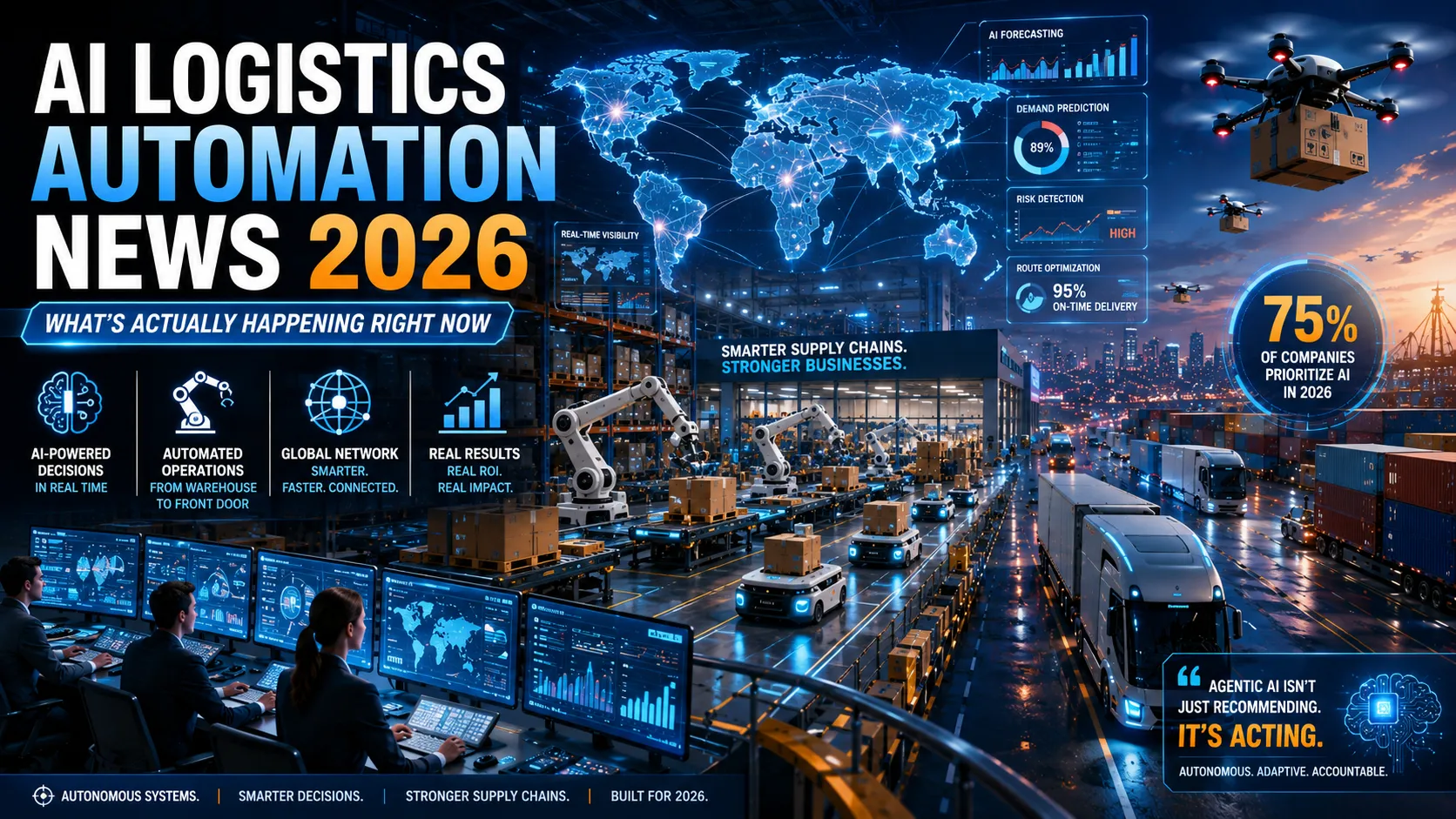

AI LOGISTICS AUTOMATION NEWS 2026
The Biggest Shift in AI Logistics Automation News 2026: From Pilots to Real Operations
The shift happening right now in logistics is fundamental. AI has moved from being an experimental investment that companies test in isolated projects to being the core operating system for supply chains. This isn’t news from five years ago anymore. In 2026, 75% of companies have made artificial intelligence logistics their number one priority for investment, and 7 out of 10 businesses are already running AI in their daily operations.
I noticed this shift clearly when looking at the actual numbers. Early adopters who deployed AI for supply chain automation over the past year are seeing 77% return on investment within twelve months. That’s not theoretical potential. That’s real money coming back. Companies aren’t asking if they should invest in logistics technology trends 2026 anymore. They’re asking how fast they can deploy it before competitors pull ahead.
What changed between 2024 and now is the focus. Two years ago, companies built AI models. They experimented. They ran pilots that sometimes worked and sometimes collected dust. Today, the conversation is completely different. Organizations have moved from building AI to making AI work as a core worker in their supply chains. This means AI isn’t just recommending decisions anymore. It’s executing them.
The data backs this up. Seven out of ten businesses are utilizing AI for operations like quality control and risk prediction. Some are using it to forecast demand. Others have deployed it to optimize routes, reduce fraud, or automate warehouse picking. The common thread across all these implementations is that they’re running in live production environments, handling real shipments, solving real problems, generating real value.
What’s driving this acceleration? The stakes have gotten higher. Geopolitical disruptions, tariff uncertainty, and supply chain vulnerability mean that companies can’t afford to move slowly anymore. AI supply chain automation has become less about efficiency and more about survival. The companies that implemented AI first have proof that it works. That proof is spreading fast.
The logistics AI adoption rates 2026 tell the real story. When 75% of companies list AI as their top investment priority, that’s not a trend anymore. That’s the new operating standard.
AGENTIC AI IN LOGISTICS
Agentic AI in Logistics: When the System Makes Decisions Without Asking You
The biggest change happening in agentic AI supply chain management right now is a fundamental shift in how decisions get made. Traditional AI systems analyze data and recommend actions. Someone has to read that recommendation, approve it, and then execute it. Agentic AI is different. It analyzes the situation, makes the decision, takes the action, and then tells you what it did.
Think about what this means in practice. A shipment is delayed at a port. Old AI flags it as a problem and waits for a human logistics manager to decide what to do. Agentic AI detects the delay, reroutes the shipment through an alternative carrier, adjusts the purchase order to account for timing changes, and files the necessary customs compliance documentation. All of that happens without anyone asking permission. The system just handled it.
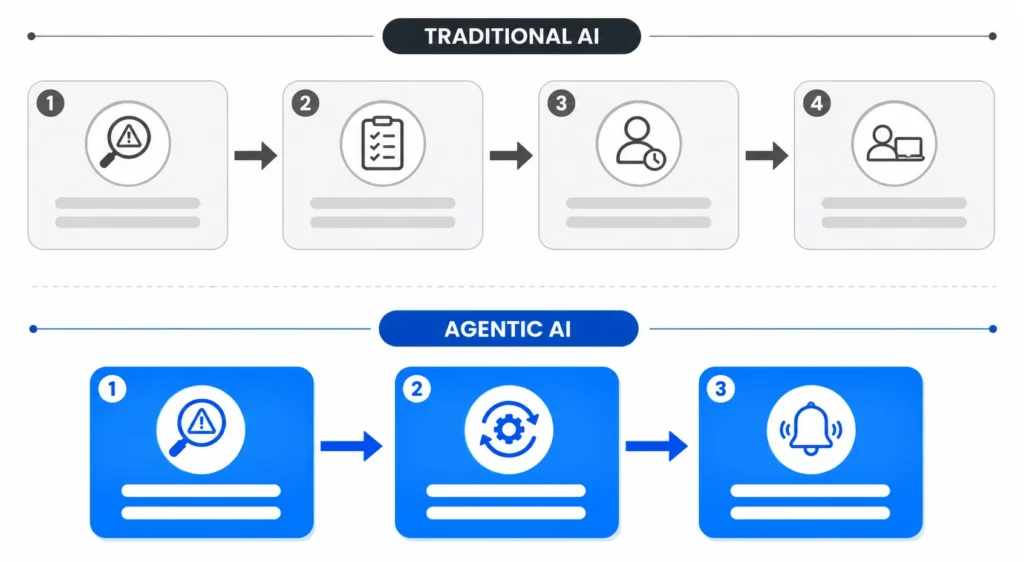
This is what autonomous logistics systems look like in 2026. The shift away from AI that recommends toward AI that acts is the most important thing happening in supply chain automation right now. It’s not just faster. It’s fundamentally different in how it approaches problems.
What Agentic AI Actually Means and Why 2026 Is the Turning Point
Agentic AI operates like a core worker in your supply chain. That’s the frame technology leaders at Cisco are using to describe what’s changing. The AI doesn’t sit in the background providing suggestions anymore. It works alongside your team, making decisions, executing tasks, and solving problems in real time.
The difference between 2024 and 2026 is dramatic. Two years ago, AI was breaking down professional silos by giving regular employees access to analytical capabilities that once only specialists had. That was powerful. Today, agentic AI is taking it further. It’s performing specialized tasks entirely on its own. An AI agent now handles customs compliance, reroutes shipments, and adjusts inventory without waiting for human approval.
Here’s what makes this a turning point. When AI was just analytical, it scaled your existing processes. When AI becomes agentic, it transforms those processes entirely. The speed of decision making jumps from hours to seconds. The accuracy improves because the system doesn’t get tired or miss details. And the cost drops because fewer humans need to be in the approval chain.
What does this actually look like for a logistics operation? A surge in demand hits unexpectedly. An agentic AI system detects the pattern in real time, adjusts demand forecasts, reroutes inventory from warehouses with excess stock to locations with shortage risk, and notifies suppliers about potential increased orders. All of that happens while your team is doing other work. The system managed the surge before it became a crisis.
I understand this feels like it might replace human workers, and I’ll address that directly later in the article. For now, the key insight is that agentic AI moves supply chain automation from operational to strategic. Humans stop handling routine decisions and start handling exceptions and strategy.
The “Shared AI Spine”: Why Isolated AI Tools Are Already Obsolete
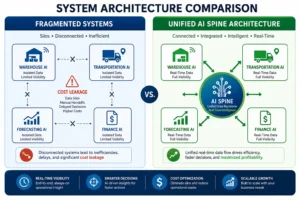
Most companies today use disconnected tools. They have one system for transportation management, another for shipment tracking, a third for freight auditing. These systems don’t talk to each other. Information gets stuck in silos. Visibility breaks down. Costs leak out and nobody catches it.
The Shared AI Spine concept changes this entirely. Instead of isolated point solutions, companies are building unified data backbones that integrate transport, warehouse, and e-commerce systems into one connected nervous system for the supply chain.
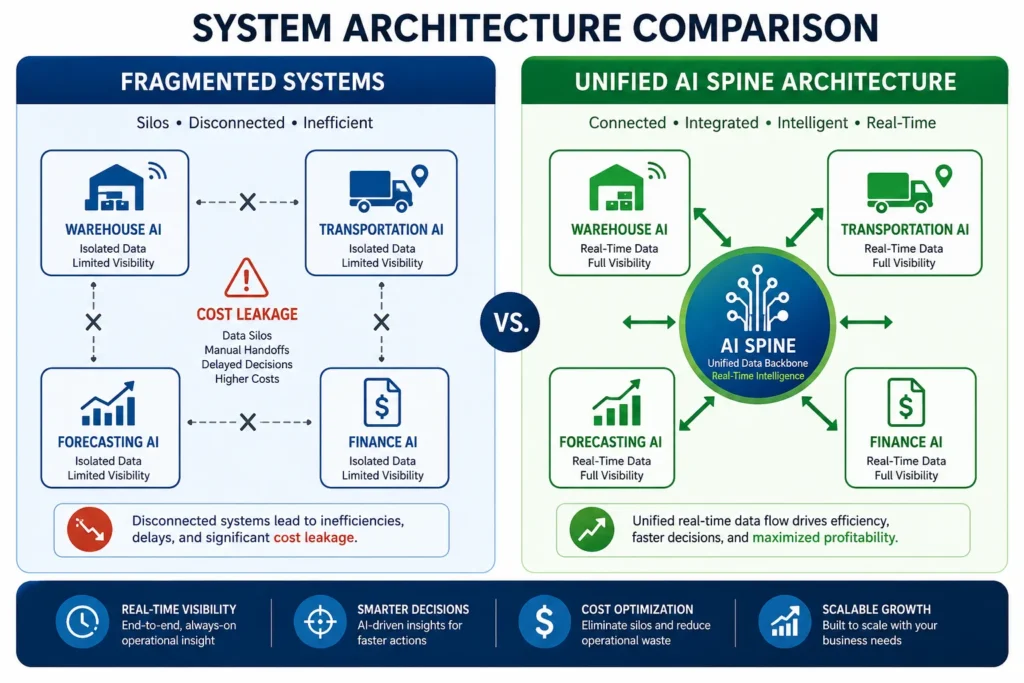
Why does this matter so much? Here’s the honest truth from logistics operations that tried the fragmented approach. When you use separate AI tools that don’t integrate, you create blind spots. A warehouse AI optimizes inventory placement without knowing what transportation costs actually are. A transportation AI minimizes route costs without seeing real-time warehouse capacity. Nobody has a complete picture. Money leaks out through inefficiencies that nobody even sees because no single system has visibility across the whole network.
The Shared AI Spine solves this by creating real-time supply chain visibility across every function. One unified platform connects logistics software platforms for inventory, transportation, customs, and fulfillment. The AI can now make decisions with complete information. When demand shifts, it doesn’t just reroute a shipment. It reroutes the shipment while adjusting inventory strategy, optimizing warehouse picking sequences, and recalculating freight costs all at once.
I’ve seen organizations discover hundreds of thousands of dollars in hidden cost leakage once they implemented unified platforms. The money wasn’t being wasted on purpose. It was getting lost in the gaps between disconnected systems. Nobody had visibility into where the leakage was happening.
This is why companies that still use isolated AI tools are falling behind fast. They think they’re optimizing their supply chain. What they’re actually doing is optimizing individual pieces while the whole system bleeds efficiency.
SMART WAREHOUSES IN 2026
Smart Warehouses in 2026: Robots That Learn, Adapt, and Never Clock Out
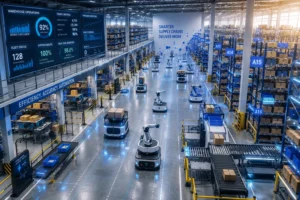
Smart warehouse technology has moved from being an experimental advantage to being a competitive necessity. The transformation is happening right now, and the numbers prove it. A major warehouse facility in Beijing handles 12,000 outbound orders daily during peak season, dispatching an average of three items every single second. Robot operations at that facility improved transfer efficiency by 73% compared to traditional manual warehouse work. That’s not theoretical. That’s a real facility running real operations.
I’m sharing these numbers because they explain why warehouse robotics 2026 matters so much. Companies aren’t adopting these systems because it sounds futuristic. They’re adopting them because they see measurable results. Speed increases. Errors drop. Costs fall. And the robots get smarter every day.
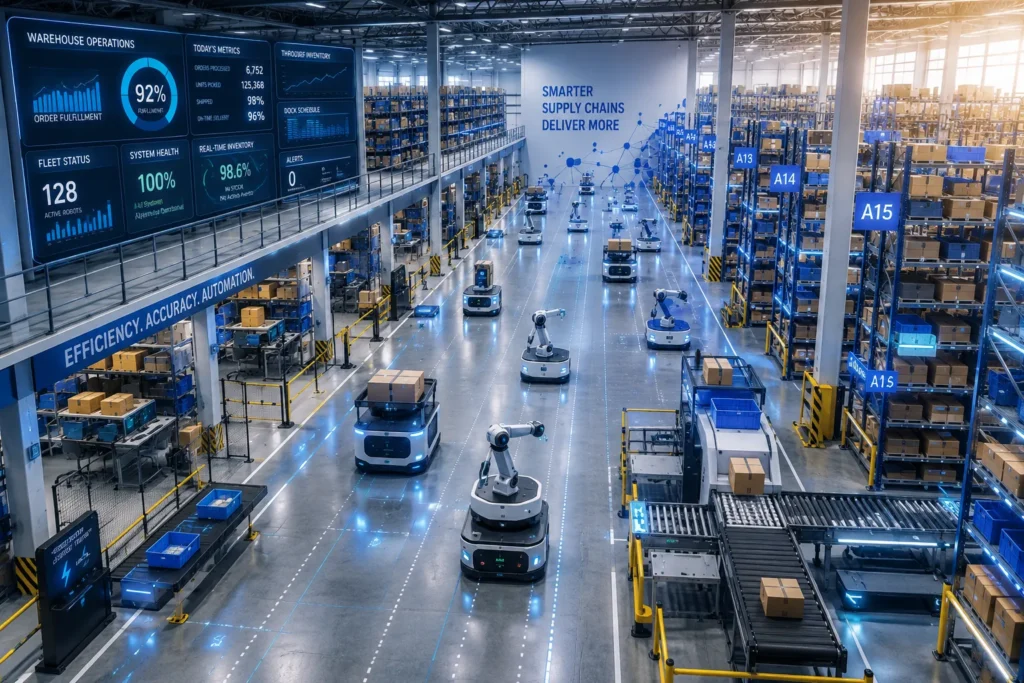
The warehouse technology landscape changed fundamentally when robots started learning from their own experience. Early automated systems followed rigid programming. Do this task exactly this way every single time. Modern smart warehouses operate completely differently. The robots learn. They improve. They teach each other. And they handle complexity that rigid automation could never manage.
AMRs and Swarm Intelligence: How Robots Learn From Each Other
Autonomous mobile robots, or AMRs, form the nervous system of modern warehouses. These aren’t traditional forklifts that humans operate. AMRs move independently through warehouse aisles using LiDAR navigation without needing painted lines or floor markers. They sense obstacles, calculate routes, and avoid collisions all on their own.
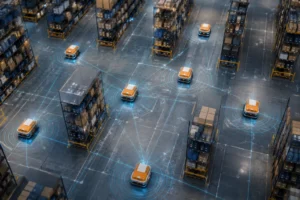
What makes this revolutionary is swarm intelligence. Individual robots in a smart warehouse don’t just follow their own programming. They share learned experiences across the entire fleet. When one robot discovers a more efficient picking path, that improvement spreads to every other robot in the warehouse instantly. When one robot learns how to handle a difficult product type, that knowledge becomes available to all robots.
A Brightpick installation demonstrates how this works in practice. That facility operates 48 autonomous robots picking 50,000 items per day. The robots navigate at speeds up to 5 miles per hour with precision measured in inches, using LiDAR and AI guidance. But the real power comes from the learning network. Each robot captures performance data from every single pick. That data gets analyzed. Patterns get identified. Inefficiencies get eliminated. And every robot benefits from those discoveries.
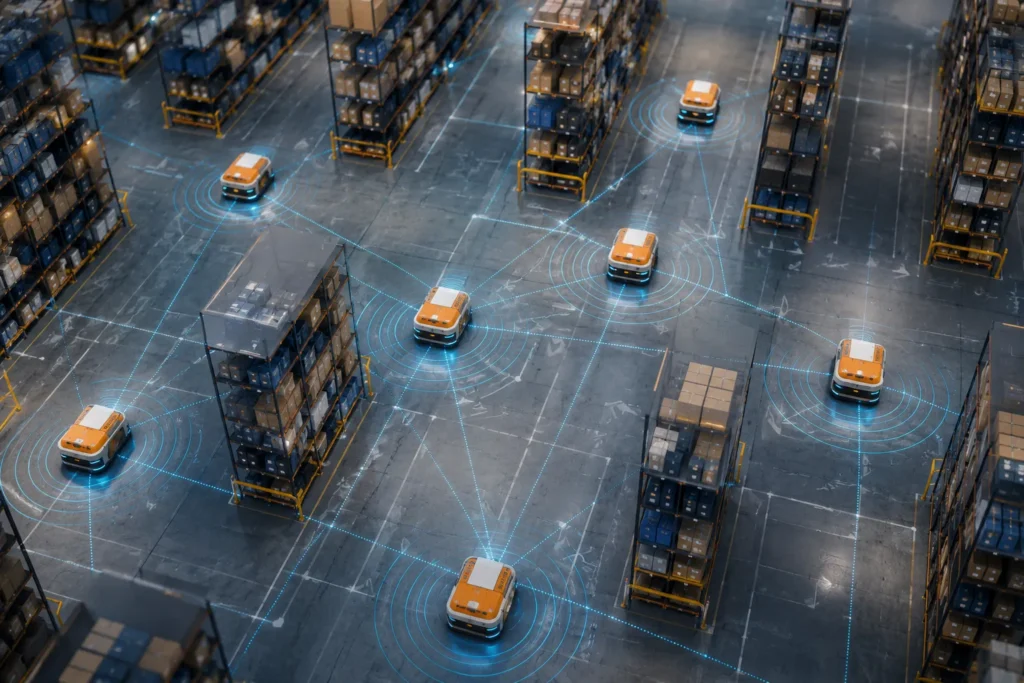
The swarm intelligence approach means warehouse robotics 2026 isn’t about individual machines getting better. It’s about the entire fleet becoming smarter together. A robot doesn’t need to personally experience every possible scenario. It learns from the collective experience of 47 other robots in the same warehouse, plus tens of thousands of robots in other Brightpick installations worldwide.
Computer Vision and Zero-Touch Quality Control
Computer vision gives warehouses the ability to see and understand what they’re handling. This technology enables quality checks, label scanning, automated sorting, and inventory tracking without any human manual verification.
Think about the complexity here. A warehouse receives thousands of different products with thousands of different shapes, sizes, and packaging styles. Computer vision systems identify each item from any angle. A box arrives upside down? The system recognizes it anyway. A package wrapped differently than usual? The system adapts. The AI learns the visual signature of each product and spots it instantly, regardless of orientation or minor variations.
JD.com’s Flying Wolf sorting system shows what this looks like at scale. The Flying Wolf is a 3D-vision-powered automated system that sorts packages 6 to 8 times faster than human workers. Its robotic arms recognize labels from any angle, identify package dimensions instantly, and route items to the correct shipping zones without stopping to reconsider. The system handles everything from small envelopes to oversized boxes, learning from every single item it processes.
Computer vision also powers real-time inventory tracking. Every product that moves through a smart warehouse is visually identified and logged. Loss rates drop. Misplaced inventory gets found. And the warehouse always knows exactly what it has and where it is. This visibility gets fed into the warehouse management system, creating a real-time inventory picture that feeds demand forecasting and purchasing decisions.
The Dark Warehouse: What 24/7 Automated Operations Look Like in Practice
A dark warehouse is a facility that operates around the clock with no human workers inside. No lights. No breaks. No shift changes. The building runs in complete darkness because robots don’t need illumination.
This sounds extreme until you understand what it enables. Most warehouses operate on human schedules. Two shifts. Maybe three. Orders arrive at night and wait until morning for processing. The dark warehouse concept eliminates that delay. Orders get picked overnight and buffered in temporary holding zones. When morning arrives, those orders are already staged and ready to ship. The facility processes orders continuously without waiting for human shift changes.
Dynamic slotting makes dark warehouses even more efficient. The AI warehouse execution system doesn’t just store products randomly. It places fast-moving items closer to packing stations, reducing robot travel distance. Slow-moving products go to deeper storage. This inventory placement strategy changes dynamically as order patterns shift. The system recalculates optimal placement daily based on actual demand, continuously optimizing for speed.
Robotics as a Service removes the massive capital investment barrier that made dark warehouses impossible for mid-market companies. Instead of spending millions on robot hardware upfront, companies now pay per-pick fees. As order volume increases, companies add more robots. As volume drops, robot count decreases. The financial risk moves from the company to the service provider, making warehouse automation accessible to businesses that couldn’t justify a full automation investment before.
The dark warehouse concept represents where warehouse robotics 2026 is heading. Full automation. Continuous operation. Zero downtime waiting for human availability. And increasingly affordable through service models that spread capital costs over time.
AI DEMAND SENSING
AI Demand Sensing Has Changed How Warehouses Stock Shelves
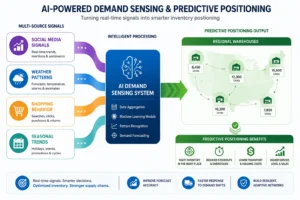
The way warehouses think about inventory has completely flipped. Five years ago, warehouses reacted to orders. An order came in, the system found the product, picked it, and shipped it. Today’s smart warehouses work backwards. They predict what customers will want before the orders arrive and position inventory to meet that demand.
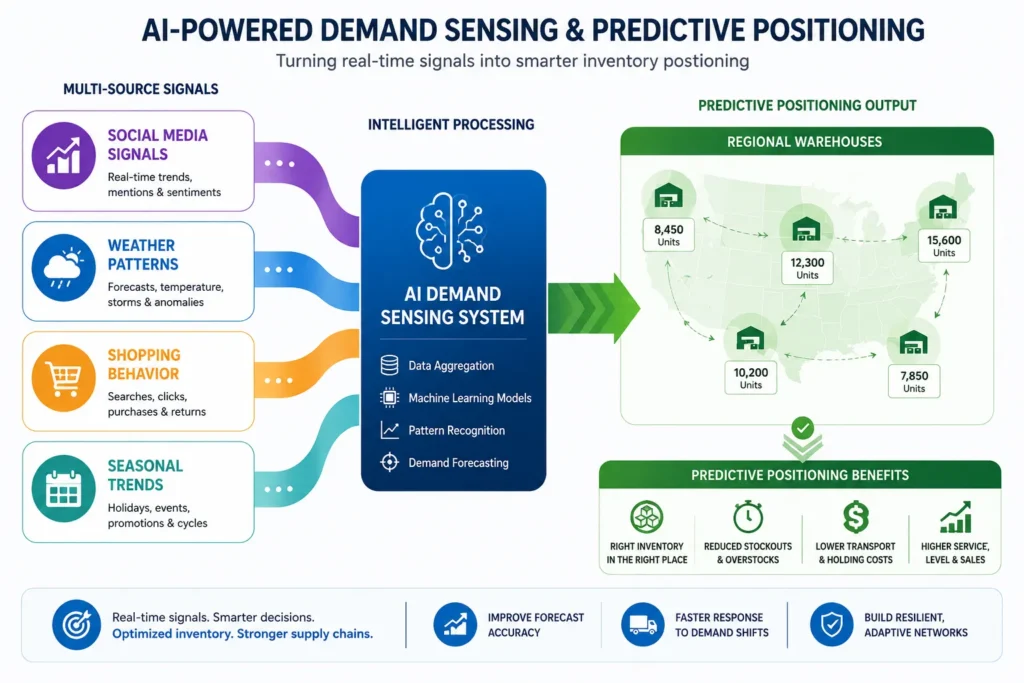
Demand forecasting AI isn’t just analyzing historical sales data anymore. Modern systems scan social media activity, weather patterns, shopping behavior, and seasonal trends simultaneously. The system sees a trend building on social media, cross references it with weather forecasts and historical buying patterns, and calculates what regional warehouses need to stock right now to meet orders that haven’t even been placed yet.
This shift from reactive to proactive logistics changes everything about how warehouses operate. DHL implemented predictive analytics and reduced shipment delays by 30%. That’s not a minor improvement. That’s transforming customer experience. When delays drop, on-time delivery rates climb. When customers get packages faster, satisfaction increases. The entire supply chain feels faster because it actually is faster.
From Gut Instinct to Social Media Signals: How AI Predicts Demand Before You Order
Traditional demand forecasting relied on historical sales data and human intuition. A merchandiser would look at last year’s sales for a product, maybe adjust for trends, and make a prediction. The system would stock based on that prediction. Sometimes it was right. Sometimes you ended up with warehouses full of products nobody wanted while shortage situations developed across the country.
AI demand sensing eliminates most of that guesswork. The system doesn’t just look at what customers bought. It looks at what they’re talking about, what the weather will be, what competitors are promoting, and what patterns are emerging across social platforms. A weather forecast predicts heavy snowfall in a region. The AI projects increased demand for snow removal equipment and winter clothing in that area. Warehouses in neighboring regions pre-position inventory to ship quickly once demand spikes.
Machine learning algorithms analyze historical data to predict future order volumes, allowing companies to prepare for seasonal spikes and minimize empty miles. That last part matters more than most people realize. An empty mile is a truck driving without cargo, which wastes fuel, burns time, and costs money. When demand forecasting improves, trucks move with full loads more often. Efficiency climbs. Costs drop.
I notice this dynamic playing out in real seasonal patterns. Major shopping holidays create predictable demand spikes. But secondary impacts are harder to catch. When holiday shopping peaks, return rates also spike a week later. Most warehouses react by scrambling to handle returns. Smart warehouses with strong demand sensing predict the return surge and staff accordingly. The result is smoother operations when chaos would normally hit.
Real Results: What DHL, Amazon, and China’s Logistics Brain Are Actually Achieving
The numbers from companies actually implementing advanced demand forecasting are striking. DHL’s predictive analytics reduced shipment delays by 30%. That’s not theoretical improvement. That’s real delivery times getting faster.
Amazon’s logistics operations show demand sensing in action at massive scale. The company doesn’t just react to orders placed on its website. Amazon pre-positions inventory in regional warehouses based on predicted demand patterns. Some customers in major cities now receive packages the same day they order because Amazon already had the product sitting in a nearby warehouse, waiting for the order that artificial intelligence predicted was coming.
China’s logistics infrastructure demonstrates the most advanced implementation of demand sensing technology. The country’s Logistics Brain system scans billions of potential routes and delivery patterns in real time. But more impressively, the Logistics Brain is learning to predict package surges before they happen. During major shopping events, the system doesn’t wait for order spikes to develop. It pre-emptively moves inventory, adjusts carrier capacity, and optimizes warehouse staffing based on predictions of what demand will look like hours or days in advance.
A facility in Beijing runs an “AI New Year Goods Map” during the Chinese New Year season. This specialized predictive system analyzes regional preferences, historical demand patterns, and cultural shopping behaviors to predict exactly what products each region will want during the holiday period. The system then orchestrates smart inventory allocation, positioning goods across multiple warehouses to ensure every region has what it needs when demand peaks. The result is a holiday season that runs smoothly despite handling billions of transactions.
These real world examples show what demand forecasting AI actually delivers. Faster delivery. Lower costs. Better availability. And warehouses that feel like they can read minds because they’re predicting demand so accurately it almost seems like magic.
SUPPLY CHAIN DISRUPTION IN 2026
Supply Chain Disruption in 2026: How AI Is Managing Tariffs, Geopolitics, and Port Shutdowns
The conversation about supply chain resilience has fundamentally changed. Five years ago, supply chain strategy focused on cost optimization and efficiency. Today, the priority is survival through disruption. Tariffs are rising. Geopolitical tensions are creating unpredictable shocks. Port closures happen without warning. Cybersecurity threats target logistics infrastructure. Companies aren’t asking how to build the cheapest supply chain anymore. They’re asking how to build one that won’t collapse when the next crisis hits.
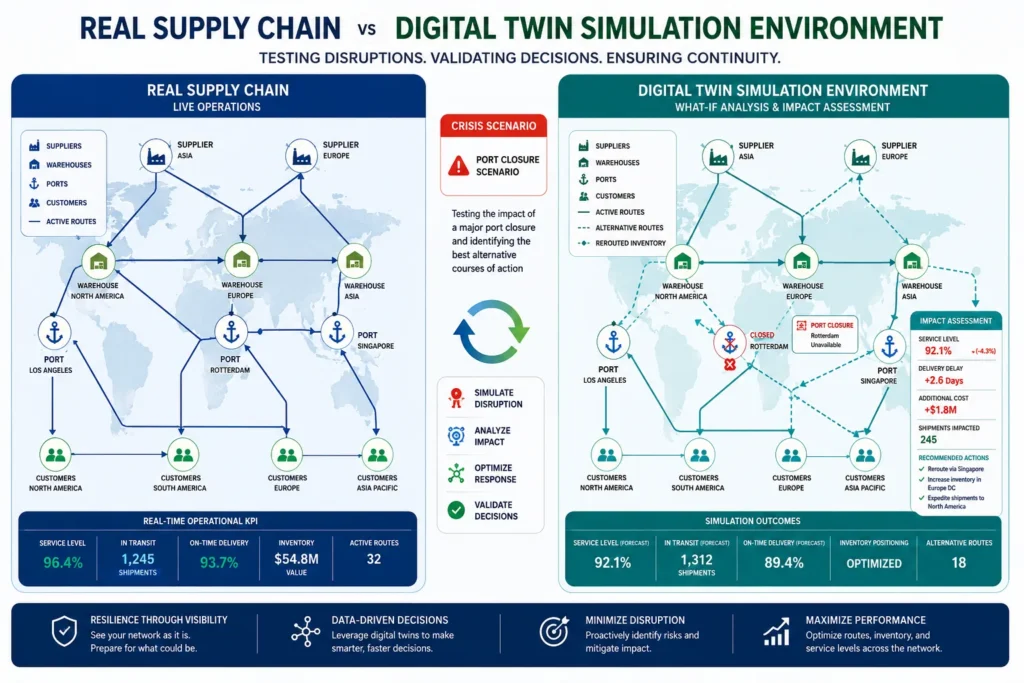
Artificial intelligence is becoming the primary tool for managing this new reality. But AI isn’t solving disruption by making operations faster or cheaper. AI is solving it by letting companies test responses to disasters before those disasters happen. Digital twins simulate thousands of potential crisis scenarios. Predictive disruption management systems identify vulnerabilities before they become catastrophic. And agentic AI systems respond to emerging threats in real time without waiting for human approval.
The shift happening right now is as important as any logistics transformation I’ve seen. Companies aren’t just adopting AI for optimization anymore. They’re adopting it for survival.
Digital Twins: Testing Port Shutdown Scenarios Before They Happen
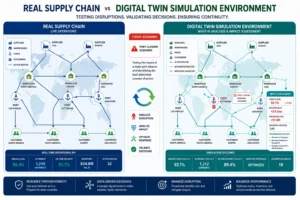
A digital twin is a virtual replica of your entire supply chain. Every warehouse, every transportation route, every supplier relationship, every inventory position gets modeled in a computer simulation that mirrors your real operations.
Here’s where digital twins become genuinely powerful. Let’s say a major port suddenly closes due to geopolitical tension. What happens to your supply chain? In the old world, you find out when it actually happens and scramble for solutions. With digital twins, you simulate that port closure right now. The virtual supply chain reroutes shipments through alternative ports. It adjusts inventory positions. It recalculates shipping costs. It identifies which products get delayed and by how much. All of that happens in a computer simulation before any real disruption occurs.
Digital twins simulate thousands of scenarios and present real time dashboards to test decisions before execution. This means companies test their crisis response plan against hundreds of potential disruptions simultaneously. A supplier suddenly fails. The digital supply chain shifts volume to backup suppliers and identifies which customer orders get affected. A natural disaster closes a warehouse. The system reroutes inventory and recalculates fulfillment timelines. A tariff suddenly increases shipping costs by 25%. The simulation shows the immediate profit impact and tests pricing adjustments to maintain margins.
The advantage is massive. When a real crisis happens, you’re not discovering your vulnerabilities for the first time. You’ve already tested multiple responses in simulation and know which one works best. Decision making speed jumps from days to minutes because you’ve already done the analysis.
I understand this sounds like science fiction, but companies are already doing this. The ability to test crisis responses before they happen is becoming table stakes for enterprise logistics operations.
Geopolitical Shocks, Tariffs, and Why 75% of Companies Are Going Regional
The strategic response to supply chain disruption in 2026 isn’t just better AI. It’s a fundamental restructuring of where companies source and position inventory. Fifty eight percent of global executives now expect supply chains to be more localized by 2030. That’s not a small fraction. That’s the majority of leadership planning a massive geographic shift.
Over 75% of companies are already building regional hubs closer to their customer markets. This isn’t happening because localization is trendy. It’s happening because location decisions have completely changed. A decade ago, companies chose warehouse locations based on cheap labor. Today, location choices are driven by energy reliability and geopolitical stability, not just cost.
Think about what this means strategically. Long global supply chains create vulnerability. A single port closure, a geopolitical conflict, or a tariff increase can disrupt operations across an entire continent. Regional hubs spread that risk. If one region experiences disruption, other regions continue operating. Inventory positioned regionally reaches customers faster. Supply chain resilience improves dramatically.
The geopolitical supply chain risk landscape in 2026 includes tariff uncertainty, trade tensions between major economies, cybersecurity attacks targeting logistics infrastructure, and energy security concerns. Companies can’t control these threats. But they can reduce their exposure to them by building regional supply chain networks instead of relying on long intercontinental routes.
This is where AI logistics supply chain automation fits into the bigger picture. Regional networks with localized inventory create enormous complexity. Multiple warehouses need coordinated forecasting. Inventory allocation across regions needs optimization. Tariff calculations need real time updates as trade policies change. AI handles that operational complexity while humans focus on strategic risk management.
The companies winning in 2026 are those that combined two approaches. They deployed AI to manage the operational complexity of regional networks. And they built those regional networks specifically to reduce exposure to the geopolitical and tariff shocks that could collapse older global supply chain models.
AI LOGISTICS WORKFLOW AUTOMATION
How AI Logistics Workflow Automation Moves Goods From Warehouse to Front Door
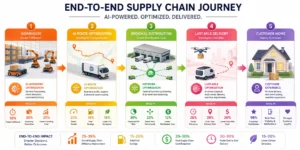
The journey from warehouse to customer door has become a sophisticated dance of optimization. AI logistics workflow automation orchestrates every step from the moment a package leaves the warehouse until it arrives at someone’s front door. The system doesn’t just move packages. It plans routes, predicts problems, adapts to disruptions, and learns from every delivery to improve the next one.
This end-to-end workflow is where most companies still struggle. Warehouses have gotten smarter. But transportation and last-mile delivery remain fragmented and inefficient for many operations. The companies winning in 2026 are those that connected warehouse automation to intelligent transportation systems. When those pieces work together, delivery speed improves dramatically, costs plummet, and customer satisfaction reaches new levels.
I want to be clear about something. This isn’t theoretical. UPS saves 10 million gallons of fuel annually through AI route optimization. Tesla’s autonomous semi-trucks cut fuel costs by 20%. These aren’t promises. These are results from companies actually running these systems at scale.
Route Optimization That Thinks in Real Time: UPS, Tesla, and What AI Is Actually Saving
AI in transportation management starts with route optimization, but it’s nothing like the GPS routing you used five years ago. Modern route optimization factors in real-time traffic conditions, weather forecasts, fuel costs, vehicle capacity, delivery time windows, and driver preferences simultaneously. The system calculates thousands of possible routes and selects the one that minimizes cost while meeting delivery commitments.
UPS demonstrates what this looks like at massive scale. The company’s AI routing system saves 10 million gallons of fuel annually and prevents 100,000 metric tons of carbon emissions each year. That’s not just an environmental benefit. That’s a cost advantage that compounds. Every gallon saved increases profit margins. Every ton of CO2 not emitted reduces the company’s environmental liability.
Tesla’s autonomous semi-trucks show what happens when you remove the human driver cost from the equation entirely. Fuel costs drop by 20%. Labor costs disappear. Vehicle utilization increases because trucks can run around the clock without driver fatigue concerns. The economics become dramatically more favorable.
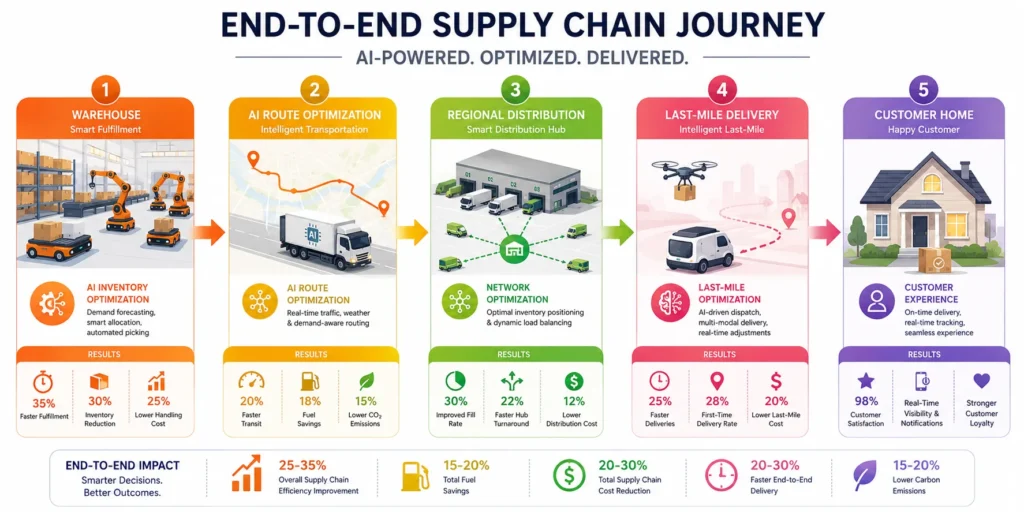
But here’s what’s important to understand. The fuel savings and cost reductions come from optimization, not just automation. The AI system doesn’t just drive. It plans. It calculates. It routes traffic in ways that humans never would because the optimization happens across dimensions humans struggle with. A human driver sees traffic and chooses a faster route. AI route optimization sees traffic, weather, fuel prices, vehicle wear patterns, and delivery windows all at once and chooses the route that minimizes total cost while meeting all constraints.
The result is freight automation that actually delivers measurable value. Less fuel burned. Fewer delays. Lower costs. Better margins.
Last-Mile Delivery in 2026: Drones, Autonomous Vehicles, and the 30-Minute Window
Last-mile delivery is the final stretch from a regional warehouse to someone’s front door. It’s also the most expensive part of the logistics journey. Every stop costs money. Every delay costs money. Every failed delivery attempt costs money. That’s why companies are investing heavily in transforming last-mile delivery automation.
Drone delivery represents one transformation. Lightweight drones bypass road congestion entirely by delivering packages through the air. In certain areas, customers now receive orders in under 30 minutes because the package goes directly from a regional warehouse to their home via drone instead of taking hours in ground transportation. Amazon has led investment in this technology, and other companies are racing to catch up.
Autonomous delivery vehicles handle higher volume routes that drones can’t economically serve. These vehicles operate in cities like Beijing and Shanghai, navigating urban streets and delivering packages without human drivers. The vehicles communicate with traffic systems, other autonomous vehicles, and the logistics network to optimize delivery sequences and avoid congestion.
What drives investment in e-commerce logistics automation is simple economics. The cost to get a package to someone’s door using traditional ground transportation keeps increasing. Labor costs rise. Fuel costs fluctuate. Vehicle maintenance expenses climb. Autonomous systems and drones reduce those variable costs. More importantly, they enable speed improvements that change the competitive landscape. When some companies can deliver in 30 minutes and others take days, customer expectations shift permanently. Everyone has to keep up.
Predictive Maintenance: How AI Stops Trucks From Breaking Down Mid-Route
Here’s a problem most people never think about. A delivery truck breaks down mid-route. That single vehicle failure disrupts dozens of scheduled deliveries. Customers get delayed. The logistics operation pays emergency repair costs. The entire system ripples with inefficiency.
AI in transportation management solves this through predictive maintenance. The system monitors vehicle performance data continuously. Engine temperature patterns. Oil quality changes. Brake wear indicators. Tire pressure trends. Suspension stress. All of these data streams flow into machine learning models that predict mechanical failures before they happen.
When the AI system predicts that a vehicle will need maintenance within the next week, it schedules that maintenance during a downtime window instead of waiting for a breakdown. A truck gets serviced before a critical component fails. The delivery operation continues smoothly. Emergency repair costs disappear. Unexpected delays vanish.
Predictive maintenance might sound like a minor advantage, but the operational impact is substantial. Fleet downtime drops. On-time delivery rates improve. Repair costs decrease. And customer satisfaction increases because deliveries happen on schedule instead of getting disrupted by unexpected vehicle failures.
This is what end-to-end AI logistics workflow automation actually delivers. Optimized routes. Fast last-mile delivery. Reliable transportation. Every component of the journey from warehouse to front door working together instead of operating in isolation.
INTELLIGENT DOCUMENT PROCESSING
The Paperwork No One Talks About: Intelligent Document Processing in 2026
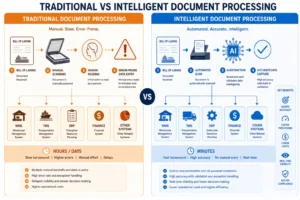
International trade runs on paperwork. Every shipment crossing borders requires bills of lading, commercial invoices, customs declarations, and compliance documentation. Someone has to read those documents, extract the information, verify accuracy, and input the data into the logistics system. That someone is usually a human doing repetitive manual work that slows everything down and introduces errors constantly.
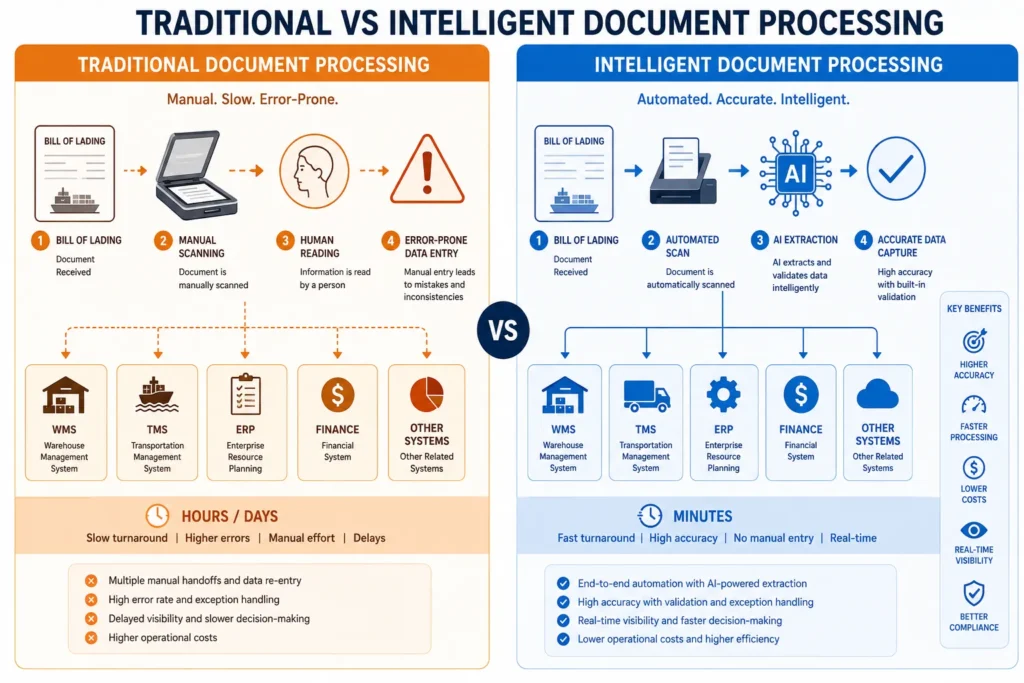
Intelligent document processing changes this entirely. AI reads documents, extracts information, verifies accuracy, and routes data into the supply chain automation system automatically. No human manual entry. No delays waiting for documentation teams. No data entry errors cascading through the system.
This is one of the most impactful AI logistics automation software innovations happening in 2026, yet almost nobody talks about it. The technology sits in the background, quietly eliminating the bottlenecks that logistics professionals have complained about for decades. That’s why I want to shine a light on what intelligent document processing actually does and why it matters so much for global supply chains.
What IDP Actually Automates: Bills of Lading, Invoices, and Customs Forms
A bill of lading is the legal document that proves you own a shipment during transportation. An invoice describes what’s in the shipment and its value. Customs forms declare the contents to border authorities. These documents traditionally get printed, mailed, scanned, read by a human, and manually entered into multiple systems. The process takes days. Errors are common. Delays cascade through the entire supply chain.
Intelligent document processing automates the entire workflow. The system scans incoming documents, reads the text regardless of formatting or printing quality, extracts relevant data fields, and verifies accuracy automatically. A bill of lading arrives. The system identifies the shipper, consignee, cargo description, weight, dimensions, and shipping terms. That information flows directly into the warehouse management system, customs declarations, and carrier systems without any human intervention.
The impact on efficiency is dramatic. Manual document processing takes hours per shipment. Intelligent document processing takes minutes. The system never makes transcription errors. Data flows consistently into all connected systems simultaneously. Customs documentation gets prepared and submitted faster. Border clearance times drop. Shipments move through ports without the delays that used to plague international trade.
But here’s what makes intelligent document processing truly valuable. The system learns from every document it processes. If a particular customs form has an unusual format, the AI adapts and reads it correctly. If document standards change, the system recognizes the new format and extracts the right fields. The logistics software platforms handling international trade become smarter over time instead of needing manual reconfiguration.
Intelligent Order Release: Why Timing Is Now an AI Decision
Intelligent order release might sound technical, but it solves a practical problem every warehouse faces. When should an order be released from the warehouse into the fulfillment system? Release too early and the order sits in a queue. Release too late and you miss the shipping window. Get the timing wrong and you miss promised delivery dates.
Traditionally, warehouses released orders based on simple rules. Release all orders at 6 AM. Release orders when a shipping container is full. Release orders when the customer pays. These simple rules worked when logistics was slower and less complex.
Modern supply chain automation requires smarter timing. Intelligent order release considers warehouse capacity, available shipping windows, carrier availability, and customer delivery requirements simultaneously. The AI determines that releasing this order right now allows it to be picked and packed before the next carrier pickup. That order should wait two hours until more orders arrive so they can ship together and reduce costs. That third order needs to release immediately to meet the customer’s time window.
This sounds like micromanagement, but the cumulative impact is substantial. Warehouse efficiency improves because orders flow through the picking and packing area in optimized sequences. Shipping costs drop because orders consolidate intelligently instead of shipping separately. On-time delivery improves because release timing aligns with actual carrier availability rather than arbitrary daily schedules.
The best part is that intelligent order release is enabled by the Shared AI Spine concept discussed earlier in this article. Making these timing decisions requires sophisticated AI tools for supply chain decisions, which increasingly integrate across systems to provide real-time optimization. When all your warehouse, transportation, and order management systems connect to a unified data backbone, the AI can make release decisions based on real-time information across the entire supply chain. No blind spots. No disconnected decisions. Just optimized order flow from placement through delivery.
AI LOGISTICS WORKFORCE AUTOMATION
What AI Logistics Workforce Automation Actually Means for Jobs in 2026
The question everyone asks about automation is simple but loaded. Will this eliminate my job? The honest answer is more nuanced than yes or no. Some jobs are disappearing. Some jobs are being created. And some jobs are transforming completely. The outcome depends largely on how companies implement automation and whether they invest in retraining their existing workforce.
I want to address this directly because the fear around AI logistics workforce automation is real and legitimate. Ninety percent of organizations report talent shortages, yet at the same time they’re deploying automation that reduces certain types of work. That seems contradictory until you understand which roles are being automated and which roles are in demand.
The pattern is clear. Repetitive work is disappearing. Skilled, strategic work is growing. The transition is uncomfortable, but it’s not universally catastrophic if companies handle it thoughtfully.
Jobs Being Automated vs. Jobs Being Created: The Real 2026 Picture
Roles centered on repetitive documentation, manual data entry, and predictable information handling are increasingly being automated. If your job involves typing information from one system into another system, or manually processing documents, or handling routine data entry, that work is vulnerable. These jobs don’t require specialized judgment. They require accuracy and consistency. Machines excel at both.
But here’s what’s actually happening in supply chain operations. Those automation gains are creating demand for different skills. Someone needs to oversee the AI agents making autonomous decisions. Someone needs to manage exceptions when the AI encounters something it wasn’t programmed to handle. Someone needs to monitor computer vision systems ensuring quality control accuracy. Someone needs to understand supply chain strategy at a deeper level because the routine work is handled automatically.
The companies winning in this transition are those moving people from repetitive tasks into oversight and strategic roles. The people losing are those hoping repetitive work will remain unchanged forever.
I understand the skepticism here. It’s easy to say new jobs will appear, but harder to retrain for those jobs if you spent fifteen years doing data entry. That’s why I’m sharing what’s actually in demand so readers can start thinking about skills development now.
One Real Case Study: How Brightpick Automated a Warehouse Without Firing Anyone
The Brightpick facility at The Feed handles 50,000 picks per day using 48 robots. That’s extraordinary volume and extraordinary automation. By every reasonable assumption, that facility should have eliminated hundreds of jobs. Instead, the existing workforce of 50 to 100 people stayed employed. The company didn’t fire anyone. It repurposed them.
Workers who previously spent eight hours a day manually picking items from shelves transitioned into quality control and final packing roles. Their job changed. Their employment continued. They went from physically exhausting repetitive picking to more varied work that uses different skills.
This is the model that makes automation work without creating human suffering. The company invested in automation technology. The company also invested in training existing employees for new roles. The result is a facility that handles massive volume efficiently while keeping its workforce employed and valued.
Why is this case study important? Because it proves that automation and employment don’t have to be in direct conflict. The Brightpick example shows that thoughtful implementation can achieve both operational excellence and workforce stability.
Not every company will follow this path. Some will use automation as an excuse to reduce headcount without reinvestment in people. That’s a choice, not an inevitability. The best companies recognize that trained, experienced logistics workers are valuable assets even when their specific tasks change.
The skills landscape is shifting too. In 2026, robotics is no longer just mechanical engineering. The field blends AI, 5G connectivity, and advanced materials into an integrated discipline. Computer vision and reinforcement learning are becoming must-have skills. ROS 2, the robot operating system, is becoming industry standard. The people who learn these skills are finding strong demand and competitive salaries.
For someone in logistics today wondering about their future, the practical answer is this. If your job involves routine, repetitive, predictable tasks, start learning new skills now. If your job involves judgment, exception handling, or strategic thinking, you’re positioned well for the automated supply chain future. And if you work for a company like Brightpick that invests in workforce development alongside automation investment, your security actually increases even as the work transforms.
AI LOGISTICS AUTOMATION ROI
AI Logistics Automation in 2026: Is the Investment Actually Paying Off?
Every company making a technology investment asks the same question. Will this actually deliver returns? AI logistics automation news 2026 is filled with impressive claims about speed improvements and cost savings. But the real question for a business decision maker is simple. What are early adopters actually seeing on their bottom line?
The answer is direct. Yes, the investment is paying off. Not theoretically. Not eventually. Right now. Companies deploying AI logistics automation are seeing measurable returns within twelve months, and those returns are substantial enough to justify the investment immediately.
I want to be specific here because vague promises of future benefits don’t help anyone make a decision today. The companies that moved first have results. Those results are being documented. And those results show that AI investment in logistics isn’t a bet on the future. It’s a decision that improves financial performance today.
The Numbers: What AI Is Actually Delivering for Early Adopters
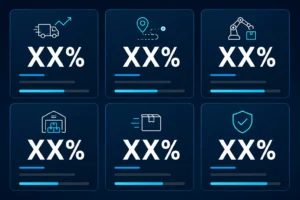
Early adopters of AI logistics automation are reporting returns of up to 77 percent within just one year of implementation. That’s not a theoretical projection. That’s actual money coming back from investments made twelve months ago. For a company spending one million dollars on AI logistics automation, that means earning 770,000 dollars in returns in year one. The math is compelling.
Beyond overall ROI, the performance improvements break down across multiple categories. Delivery times improve by up to 30 percent. That translates directly to customer satisfaction improvements and competitive advantage. When some companies deliver in two days and competitors take four, customers remember. They return. They recommend the service to others.
Fuel costs drop by 12 percent through AI route optimization. That’s money saved on every single shipment. For a company running thousands of shipments monthly, the cumulative savings are significant. UPS saves 10 million gallons of fuel annually through AI route optimization. That’s not a small company experiment. That’s a massive operation proving the concept at scale.
Fraud detection powered by AI slashes financial losses by 40 percent. That’s a direct hit to the bottom line. Every fraudulent claim prevented is money that stays in the company instead of disappearing to criminals. The logistics industry loses billions annually to fraud. AI systems catch patterns humans miss. The financial impact is immediate and measurable.
Demand forecasting accuracy improves by 50 percent. That means fewer overstocked situations where products sit in warehouses losing value. It means fewer stockouts where customers want to buy but products are unavailable. Better forecasting translates to better inventory turnover. Inventory moves faster. Working capital becomes more efficient. Cash flow improves.
Warehouse efficiency improves by 73 percent through robotics and automation. That’s the throughput improvement documented at actual facilities handling thousands of picks daily. More products move through the same physical space. Fewer labor hours are required. Fewer errors occur. The efficiency gains compound across the entire operation.
The trend is unmistakable. Fifty six percent of organizations are increasing technology spending, and they’re doing it specifically for ROI-driven initiatives, not undefined AI experiments. The days of companies spending money on AI as a prestige project are ending. Companies now evaluate AI on the same metrics they use for any capital investment. They want documented returns. And early adopters are delivering them.
Over 40 percent of shippers now select logistics providers based on AI capabilities. That’s the market voting with its wallet. Customers prefer companies that have invested in AI logistics automation because they know those companies deliver better service. The competitive advantage of being an early adopter isn’t temporary. It compounds as more customers come to expect faster, more reliable service.
This is why logistics AI adoption rates 2026 are accelerating so rapidly. The returns are proven. The technology works. The companies that deployed it first have competitive advantages that are tough to overcome.
HUMANOID ROBOTS AND PHYSICAL AI
Humanoid Robots and Physical AI in 2026: Real Progress, Real Problems
You’ve probably seen videos of humanoid robots dancing, doing backflips, or performing impressive athletic feats. Those videos are impressive but misleading. Physical AI in 2026 is genuinely important and advancing rapidly, but it’s not at the stage where robots are replacing human workers across the board. The industry is at a critical inflection point where 2026 is the year companies must prove that robots can actually do real jobs rather than just perform impressive demonstrations.
This is the section where I separate the hype from the honest reality. Some humanoid robots are working in real logistics operations. Other humanoid robots are still dropping products and requiring human supervision to ensure accuracy. Both things are true simultaneously. The companies betting on humanoid robots are learning what works and what still needs development.
The investment is real. China pledged 140 billion dollars to emerging technology, fueling over 140 companies building humanoid robots. That’s not speculative venture capital. That’s a national strategy with serious government backing. But investment level and current capability are two different things. Money is flowing fast into robotics development. Actual working deployment is still selective and specialized.
Where Physical AI Is Actually Working in 2026
GXO Logistics operates humanoid robots in freezer environments where the working conditions are genuinely harsh for humans. Extreme cold. Repetitive movements. Extended periods without breaks. These are environments where human workers suffer fatigue and discomfort. Humanoid robots excel in those specific conditions. They work continuously without needing warmth, rest, or the psychological toll that cold environments impose.
Major companies including BMW, Amazon, and Hyundai are running controlled pilots of humanoid robots in manufacturing and logistics settings. These are not theoretical experiments. These are real companies testing robots in actual production environments. The companies proceed carefully because they understand that premature deployment of unreliable robots damages both profitability and worker trust. But the fact that these major manufacturers are investing in pilots confirms that progress is real enough to warrant serious testing.
Robot-to-robot learning represents genuine advancement in autonomous logistics systems. The more data a robot collects from real-world performance, the more it refines its skills. A robot learns to pick a fragile item carefully by analyzing its own mistakes. That learning spreads to other robots in the facility. The next robot in the fleet already knows how to handle that item because the first robot learned through experience and shared that knowledge across the network.
Where Humanoid Robots Are Still Falling Short
Here’s the honest part that matters for anyone considering investing in humanoid robotics. The robots still drop products. They still misplace inventory. They still have limited battery life that restricts deployment to specific shift windows. And they still require human audits to ensure accuracy before items leave the warehouse.
That last point is critical. If a humanoid robot needs human verification before the work is considered complete, then the robot hasn’t actually replaced the human. It’s added an extra step. The robot does the work. A human audits the work. The process is faster than it would be if a human did the entire task, but it’s not fully autonomous yet.
The core problem is data scarcity. Humanoid robots need to be trained on real-world motion data. A robot learns to pick by watching thousands of examples of how humans pick. A robot learns to pack by analyzing thousands of packing sequences. That training data doesn’t exist yet for most tasks. There aren’t millions of hours of recorded video showing exactly how robots should handle every possible product variation and situation.
Companies are solving this through teleoperation and simulation. A human wearing a VR headset remotely controls a robot, and every movement gets recorded as training data. Another approach uses simulated environments where millions of virtual robots train in hyper realistic scenarios. These training methods are working, but they’re expensive and time-consuming. That’s why deployment is still selective rather than widespread.
The return on investment for humanoid robots in 2026 is still unclear compared to traditional warehouse robotics. Autonomous mobile robots for picking and packing deliver proven ROI. Humanoid robots? The case is still being made. Some deployments show promise. Others show that current-generation humanoids aren’t ready for the demands of continuous logistics work. The industry is in the learning phase, not the deployment phase.
This doesn’t mean humanoid robots are failures. It means they’re still developing. By 2028 or 2029, we might look back and see 2026 as the year when humanoid robots proved themselves ready. But in 2026 itself, the honest assessment is that they’re improving rapidly while still falling short of fully replacing human workers in most logistics environments.
COMMON MISTAKES IN AI LOGISTICS ADOPTION
6 Mistakes Companies Make When Adopting AI Logistics Automation
Every company thinks they’ll be different. They’ll avoid the common pitfalls. They’ll implement AI perfectly. Then reality hits. Most companies making the transition to AI logistics automation hit at least one major mistake that costs them money, time, or both. Some hit all six. I want to share the mistakes I see repeatedly so you can avoid them.
These aren’t theoretical problems. These are real obstacles that companies encounter when deploying supply chain automation at scale. Understanding them now saves significant headaches later.
Mistake 1: Adopting isolated point solutions instead of unified platforms.
Many companies start by buying a single AI tool. Transportation optimization software. Or demand forecasting. Or warehouse execution systems. Each tool works well in isolation. Then reality sets in. The tools don’t communicate with each other. Data from transportation doesn’t flow into warehousing. Forecasting happens independently from inventory positioning. The result is disjointed workflows with high integration complexity and restricted financial visibility. You optimize one piece while the whole system bleeds inefficiency through the cracks. Companies that choose unified logistics software platforms instead of point solutions experience dramatically better outcomes because every system sees the same data and makes coordinated decisions.
Mistake 2: Deploying AI without investing in data quality first.
Poor data quality makes every downstream AI decision unreliable. If your historical sales data contains errors, your demand forecasting will inherit those errors. If your inventory records are inaccurate, your supply chain automation will optimize around wrong numbers. Companies that skip data quality investment discover this painfully when AI systems start making confidently wrong decisions. The system works perfectly from a technical standpoint. The decisions it makes are just fundamentally flawed because the input data was bad. Investing in data cleansing and normalization before deploying AI is unglamorous but absolutely essential.
Mistake 3: Deploying humanoid robots in environments where they’re not ready.
Humanoid robots work well in specific environments like freezers where human workers suffer discomfort. Deploying them in general warehouse environments with product variety and unpredictable conditions leads to product drops and failed return on investment. The technology isn’t mature enough for semi-structured environments yet. Companies that deployed humanoid robots prematurely discovered that the robots couldn’t handle the complexity. They dropped fragile items. They misplaced inventory. They required constant human oversight. The investment didn’t pay off because the environment wasn’t suitable for current-generation robots.
Mistake 4: Relying on demand forecasting without understanding its limitations.
AI demand forecasting is powerful but not perfect. It improves accuracy by 50 percent over traditional methods, but that’s not the same as perfect prediction. Companies that treat AI forecasts as gospel truth and stock inventory based purely on AI recommendations end up with either overstock or stockout situations when the forecast misses. The best approach integrates AI forecasting with human judgment from people who understand market nuances the data doesn’t capture. Use AI as a powerful tool, not as a substitute for strategic thinking.
Mistake 5: Treating AI implementation as a one-time project instead of a continuous process.
AI systems improve when they capture feedback from real-world performance and use that feedback to refine algorithms. Companies that deploy AI and then leave it alone discover that performance plateaus. Systems that capture performance metrics continuously and feed that data back into algorithm refinement experience ongoing improvement. The difference between static and adaptive AI systems is dramatic. One stagnates. The other keeps getting smarter.
Mistake 6: Ignoring governance, security, and compliance protocols.
Deploying AI without clear governance, security, and compliance frameworks creates accountability gaps and trust breakdowns throughout the organization. When an AI system makes a decision that causes a problem, who’s responsible? Who can explain why the decision was made? How do you ensure data privacy? These questions need answers before deployment, not after. Companies that treat governance as an afterthought discover problems when issues arise. By then, the damage is done and recovery is expensive. Implementing proper AI governance tools and frameworks before deployment helps establish clear accountability, decision tracking, and compliance protocols from day one.
CONCLUSION
What 2026 Is Proving About AI Logistics Automation
The story of AI logistics automation news 2026 isn’t about future promises anymore. It’s about current reality. Warehousing automation works. The ROI is measurable and proven. Companies implementing smart warehouse technology are seeing efficiency improvements of 73 percent and cost reductions across every operation. That’s not a prediction. That’s what’s happening right now in real facilities handling real shipments.
Agentic AI and intelligent document processing are moving from experimental pilots to operational standards. Companies are no longer asking whether to deploy these systems. They’re asking how fast they can scale them. The shift from AI that recommends to AI that acts is happening. The technology is working. The risk of waiting has become greater than the risk of implementing.
Humanoid robots and full end-to-end autonomous systems are still developing. They’re advancing rapidly, but they’re not yet at the production readiness level that warehouse robotics and route optimization have reached. That’s important to understand because it shapes investment decisions. The proven technologies deserve priority. The emerging technologies deserve monitoring and selective pilots.
By 2030, AI will drive decisions across every segment of the supply chain. That’s not speculation. That’s the trajectory confirmed by corporate investment patterns and executive planning documents. The companies winning that future are making decisions today. They’re not waiting for perfect technology. They’re deploying proven capabilities and learning as they scale.
Here’s the practical bottom line. Adopting robotics and artificial intelligence logistics is no longer optional for businesses. Companies still relying on manual systems risk falling behind competitively. That doesn’t mean you need to deploy every emerging technology immediately. It means you need a clear roadmap for integrating proven AI capabilities while staying informed about developing technologies.
If you work in supply chain operations, logistics, or business strategy, this moment matters. The companies that move thoughtfully now will have years of operational advantage. The companies that wait will spend the next decade catching up.
The question isn’t whether AI logistics automation news 2026 affects your business. It already does. The question is whether you’re going to guide that change or react to it after competitors move first.
FAQ SECTION: COMMON QUESTIONS ABOUT AI LOGISTICS AUTOMATION 2026
What does “agentic AI” mean in logistics, and how is it different from regular AI?
Agentic AI is the difference between a system that suggests what to do and a system that actually does it. Traditional AI analyzes your supply chain data and recommends that you reroute a shipment or adjust inventory levels. A human reads that recommendation and decides whether to act on it. Agentic AI skips that approval step. It detects a delayed shipment, reroutes it through an alternative carrier, adjusts your purchase orders accordingly, and files the necessary customs compliance documentation. All of that happens automatically. The system notifies you afterward.
This shift from AI that recommends to AI that acts represents the fundamental change happening in 2026. Agentic AI moves beyond analytics to autonomous action. Companies that deployed agentic systems moved from pilot programs to real operational deployment this year. The technology works. The companies using it are seeing measurable results. That’s why the transition is accelerating so rapidly.
Are warehouses actually replacing workers with robots, or is that overhyped?
The honest answer is both. Some warehouse roles are being eliminated while others are being created. The outcome depends on how companies implement automation.
The Brightpick warehouse at The Feed facility handles 50,000 picks daily using 48 robots. The company didn’t eliminate its 50 to 100 person workforce. Instead, it repurposed them into quality control and final packing roles. Workers kept their jobs. They transitioned into different work. That’s one path forward.
But industry-wide, roles centered on repetitive data entry and manual documentation are genuinely being reduced. Companies are deploying automation specifically to eliminate that repetitive work. The question isn’t whether those roles will disappear. The question is whether companies will invest in retraining their existing staff into new positions or simply reduce headcount.
The companies handling this transition well are those investing in workforce development alongside automation investment. The companies handling it poorly are those using automation as an excuse to cut staff without reinvestment. The technology doesn’t determine the outcome. Management choices determine the outcome.
What ROI can a company realistically expect from AI logistics investment in 2026?
Early adopters are reporting returns of up to 77 percent within one year of implementation. That’s actual money coming back from investments made twelve months prior.
The specific improvements break down clearly. Delivery times improve by 30 percent. Fuel costs drop 12 percent. Fraud detection reduces financial losses by 40 percent. Demand forecasting accuracy improves by 50 percent. These aren’t theoretical projections. These are documented results from companies running these systems at scale.
For a company spending one million dollars on AI logistics automation, that 77 percent return means earning 770,000 dollars in the first year alone. The financial case for investment is proven. That’s why 75 percent of companies now list AI as their number one supply chain investment priority.
What is Intelligent Document Processing and why does it matter for global logistics?
Intelligent Document Processing, or IDP, is AI that reads trade documents and extracts information automatically. A bill of lading arrives. The system reads it, extracts the shipper, consignee, cargo description, and shipping terms. That data flows directly into your warehouse, customs, and carrier systems without any human manual entry.
International trade documentation is a massive source of delays and errors. Bills of lading get misread. Invoice data gets transcribed incorrectly. Customs forms get submitted late. All of that creates delays at border crossings and increases compliance risk. IDP eliminates those bottlenecks.
What makes IDP powerful is that the system learns from every document. If customs documentation changes format, the AI adapts. If a shipper uses an unusual bill of lading structure, the system recognizes it and extracts the correct fields. The logistics software platforms using IDP become smarter over time. Manual document processing takes hours per shipment. Intelligent document processing takes minutes.
What is a “dark warehouse” and are they really the future of logistics?
A dark warehouse is a fully automated facility that operates 24 hours a day, 7 days a week without human workers inside. No lighting. No breaks. No shift changes. The building runs continuously with only AI and robots managing operations.
This isn’t theoretical. China’s major logistics hubs operate this way. During peak seasons, dark warehouses handle thousands of orders daily. Products move via autonomous mobile robots. Orders get picked overnight and buffered in temporary storage zones so they’re ready to ship the moment morning operations begin.
Whether dark warehouses become the standard depends on your scale. They make economic sense for high-volume operations processing tens of thousands of shipments daily. For smaller operations, they’re overkill. But dark warehouses are becoming increasingly accessible through Robotics as a Service models, where companies pay per pick instead of investing millions in robot hardware upfront.
Are humanoid robots actually working in warehouses in 2026, or is it still just demos?
Humanoid robots are working in specific environments right now. GXO Logistics deploys humanoids in freezer environments where extreme cold is a significant challenge for human workers. The robots work continuously in conditions where human fatigue and discomfort would limit productivity. That’s a genuine, productive deployment.
BMW, Amazon, and Hyundai are running controlled pilot programs testing humanoid robots in manufacturing and logistics settings. These are real companies testing robots in actual production environments. That’s progress beyond demonstrations.
But honest assessment shows that humanoids still drop products. They misplace inventory. They have limited battery life. They require human audits to ensure accuracy before items ship. The robots haven’t yet reached the reliability level where they operate independently without human oversight. The industry needs to prove that robots can do real jobs at scale, not just perform impressively in controlled demonstrations. 2026 is that proving year.
What AI logistics tools should companies avoid investing in right now?
Avoid isolated point solutions. These are tools that solve one specific problem like transportation optimization or demand forecasting but don’t connect to your other systems. Point solutions create blind spots.
Imagine this scenario. Your transportation optimization system plans efficient routes without knowing your warehouse capacity. Your warehouse system picks and packs without knowing what shipping windows are actually available. Your forecasting system predicts demand without communicating with inventory management. Each system optimizes independently while the overall operation bleeds efficiency through the gaps between them.
Fragmented systems create cost leakage that companies often can’t identify or measure. A unified platform approach that integrates logistics planning, shipment execution, and financial oversight delivers dramatically better outcomes. Every system sees the same data. Every decision considers the full context. That’s where supply chain automation becomes genuinely powerful.