What Is the ZipTie AI Search Performance Tool?
When I first realized my regular SEO dashboard tracked nothing about AI search, that sinking feeling was immediate. I’d asked ChatGPT about my own brand. Nothing. No mention. No link. That specific moment made me understand why tools like ZipTie had to exist.
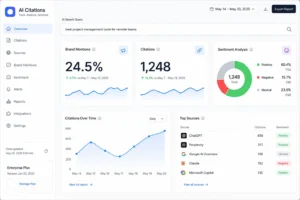
The ZipTie AI Search Performance Tool is a cloud-based platform that tracks where and how your brand appears inside Google AI Overviews, ChatGPT, and Perplexity. It does not show you keyword rankings. Instead, it shows you the harder problem: whether those AI systems mention your business by name, link to your website as a source, or talk about you positively or negatively.
In practice, here is what that looks like. The tool watches three specific data points. Brand mentions does the AI name your company when someone asks a relevant question? Citations does the AI link back to your site as a source? Sentiment when the AI does mention you, is the tone positive, neutral, or negative? These three measurements form the foundation of everything else the tool measures
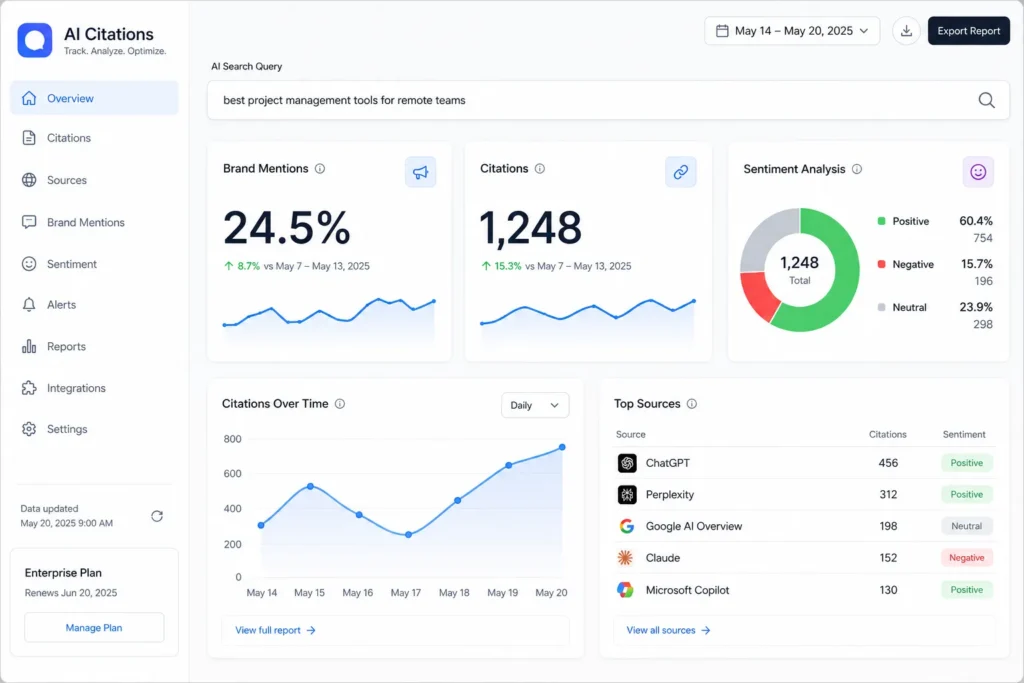
These three pieces mentions, citations, sentiment combine into the AI Success Score, which I will detail in depth later. For now, the core concept: it tells you exactly which queries represent your biggest opportunities for improvement.
The team behind ZipTie carries real weight. Tomasz Rudzki, Bartosz Góralewicz, and Sebastian Skowron built this at Onely, a technical SEO agency with a reputation for accuracy-first research, not marketing claims. Real testing. Real data. No fluff.
Industry experts back this up. Lily Ray someone who tracks AI Overviews more closely than nearly anyone calls ZipTie her go-to tool for monitoring client inclusion in AI Overviews. Aleyda Solís recommends it specifically for identifying which keywords actually trigger AI Overviews. When the people who do this work every day recommend a new tool, you notice.
The feature set evolves constantly. As of 2026, ZipTie includes an indexing health monitor and direct Google Search Console integration which means you stop guessing about page eligibility for AI citations and start knowing. That shift from guessing to knowing changes your entire optimization approach.
I do not drop my other SEO tools. Keyword research still requires Ahrefs or SEMrush. Backlink analysis lives in those platforms. But ZipTie does something none of them can: it shows me what AI search engines actually say about my brand. One blind spot solved. One blind spot too big to leave unfixed.
Why Traditional SEO Tools Fail in AI Search (The Data Problem)
I spent years obsessing over Google rankings. Then I asked ChatGPT about my own industry. My brand was nowhere in the answer. That moment made something clear: the rules had shifted, and nobody had sent an announcement.
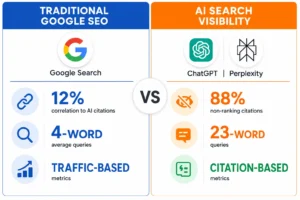
Here is what the data actually shows. Traditional SEO tools fail because Google rankings have almost no relationship to whether an AI engine cites your brand. Only 12 percent of the URLs that ChatGPT, Perplexity, or Copilot cite even rank in Google’s top ten results. Which means: a page invisible on Google can be highly cited by AI. The reverse is equally true. Rank first on Google and still never get mentioned.
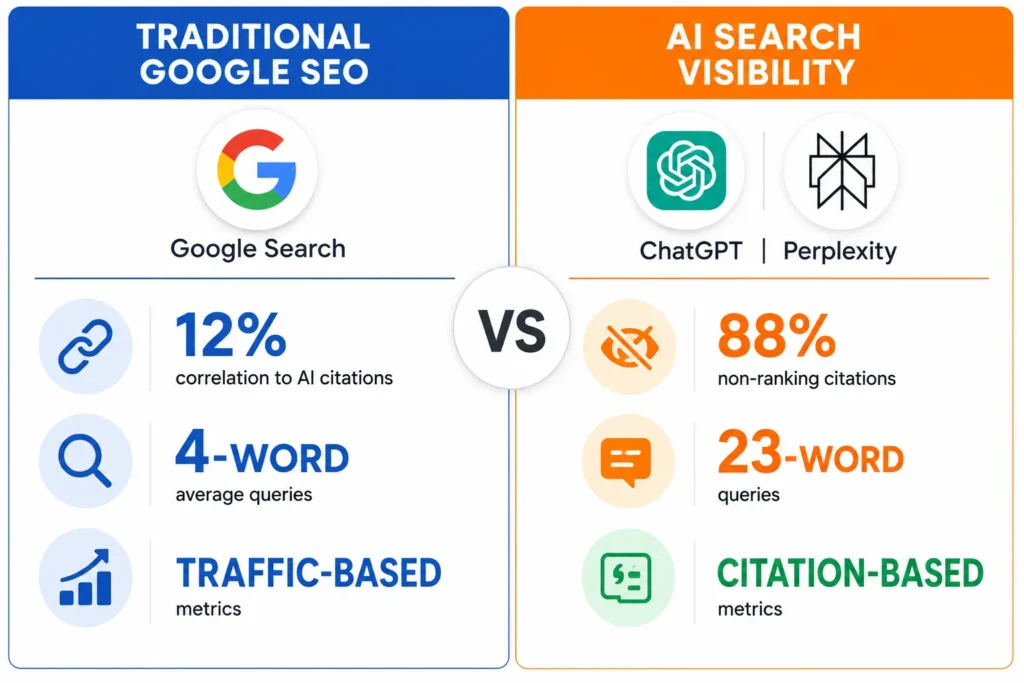
The question gap explains part of this. About 70 percent of ChatGPT prompts have no equivalent keyword in traditional search. An average Google search is four words. An average ChatGPT prompt is 23 words. That is not just a longer question. That is a completely different way of asking. Traditional keyword tools cannot track what they were never built to see: conversational language at scale.
The broken correlation runs deeper. A website with zero organic traffic can receive hundreds of AI citations. I have watched this happen. A small blog with almost no Google presence suddenly appears inside ChatGPT answers as a trusted source. Meanwhile, a high-authority site with thousands of monthly visitors gets completely ignored by AI systems.
The research confirms what seems impossible. Website traffic and AI citation behavior have almost zero correlation—around 0.05 on a scale where 1 would mean perfect correlation. Basically random. Traffic does not predict citations. Ranking position does not predict citations. Volume does not predict citations.
This creates a strange inversion for anyone measuring clicks. AI-referred traffic converts 23 times higher than organic search traffic—when it clicks through. But here is the catch: 93 percent of AI interactions produce zero clicks. The AI answers the question completely in the response. The user gets what they need and never visits your site. Your analytics show nothing.
The math does not add up in traditional reporting. Clicks-based metrics capture the tiny fraction of AI interactions that result in a visit. They miss the brand awareness. The citations. The positive sentiment building in AI responses. They measure the wrong success metric for an AI search era.
This is why traditional SEO tools fail. They measure rankings that do not predict AI citations. They measure keywords that do not match AI prompts. They measure clicks that do not capture what AI is actually doing for your brand. The blindspot is structural, not accidental. Dedicated AI search engine optimization tools have emerged specifically to fill this measurement gap.
I watch this same mistake repeat constantly. Someone assumes their Google rankings guarantee AI visibility. That assumption is the single biggest way to waste effort right now. And it is completely preventable once you understand the data.
Why Choose the ZipTie AI Search Performance Tool Over Traditional Trackers?
I have tested dozens of SEO tools over years. Most repeat the same insights with different dashboard colors. But the first ZipTie report I ran showed data I had never encountered. Actual ChatGPT citations. Sentiment tracking. A real answer to whether AI systems even registered my brand. That moment made the difference obvious.
Five capabilities set this tool apart. One: it monitors all three major AI search engines simultaneously Google AI Overviews, ChatGPT, and Perplexity. Not one. All three. Two: it uses real browser technology instead of API approximations. You see what actual users see, not what an API predicts. Three: an AI Success Score that identifies which queries need your attention first. Four: a content optimization module showing exactly what to change. Five: independent recommendations from industry experts who actually use this for client work.
The shift I am tracking right now confirms the urgency. As of April 2026, AI Overviews appear in nearly 87 percent of Google searches. One year earlier that number sat below 60 percent. This is not gradual. It is not a slow adoption. AI search has moved from emerging to dominant in twelve months. That velocity means ignoring it is not a choice anymore it is a liability.
Real Browser Tracking vs API Approximations: Why Accuracy Matters
Most tracking tools skip a critical step. They do not actually query the AI platforms themselves. Instead, they use APIs that simulate what an AI might say and these simulations are wrong constantly.
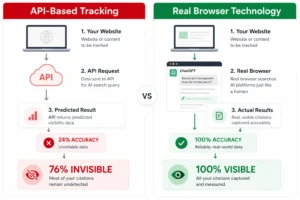
I learned this by testing both approaches side-by-side. API-based tools show only about 24 percent brand overlap with what real users actually see. Which means: 76 percent of the actual user experience is completely invisible. A tool says your brand appeared in an AI answer. But a real person running that same query sees nothing. Or the opposite happens your brand appears but the tool missed it entirely.
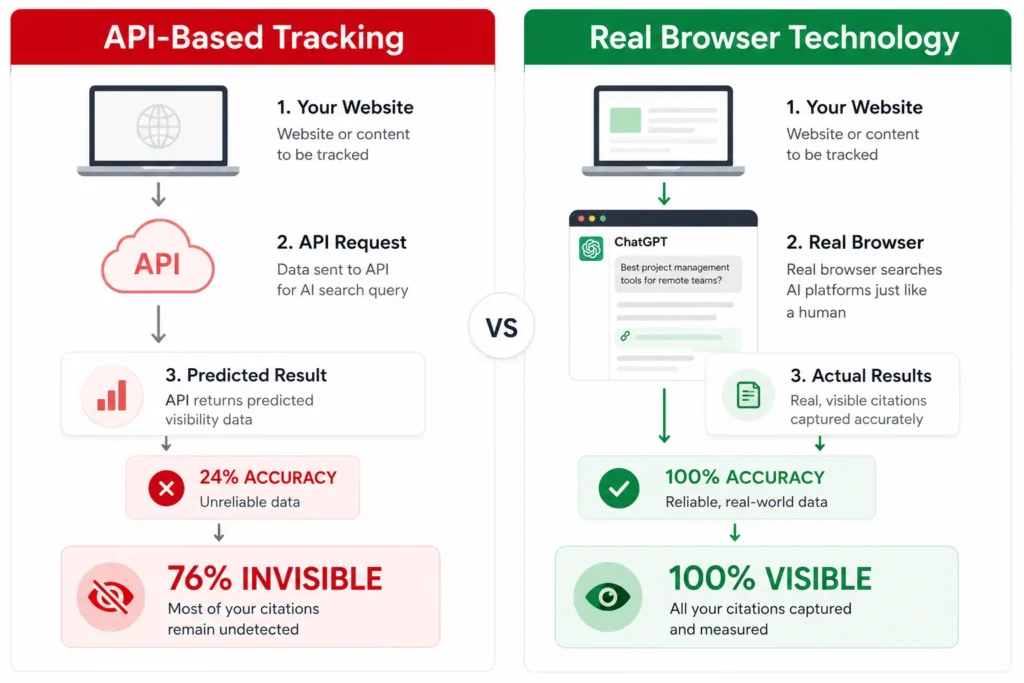
Real browser technology solves this problem completely. ZipTie opens an actual browser, runs your query exactly like a human would, captures the full response text and a screenshot. One approach shows what an API predicts. The other shows what someone actually sees when they ask a question. The difference is not subtle it is the difference between guessing and knowing.
Trusted by Industry Experts: Lily Ray, Aleyda Solís, and Seer Interactive
I pay attention when people who do this work every day recommend a tool. Lily Ray tracks AI Overviews more closely than almost anyone. She calls ZipTie her go-to tool for monitoring client inclusion in AI Overviews. Not marketing language. Direct professional endorsement from someone whose clients’ results depend on accurate data.
Aleyda Solís recommends ZipTie specifically for identifying which organic keywords trigger AI Overviews. Seer Interactive—a large enterprise agency—uses ZipTie across hundreds of client queries, tracking thousands of searches weekly.
Expert trust like this matters because these people have skin in the game. If the data was wrong, their clients would suffer. That means their recommendations carry real weight. The ZipTie AI search performance tool has moved from nice-to-have to necessity for anyone serious about understanding their AI search visibility.
How ZipTie Tracks Google AI Overviews, ChatGPT and Perplexity (All in One Check)
I used to think manual testing would work. Ask ChatGPT a few questions about my brand. Track it in a spreadsheet. Understand what it does. Then I asked the same question five times in a row. Five different answers. That is when manual tracking became obviously inadequate.
The ZipTie AI Search Performance Tool uses real browser technology to solve this. It opens an actual browser, runs your query exactly like a human would, captures the response text and a screenshot. All three platforms—Google AI Overviews, ChatGPT, and Perplexity—get checked simultaneously. One check does all three at once.
Why this matters comes down to URL consistency. Ask the same AI question twice. The cited URLs match less than 10 percent of the time. Less than 10 percent. Manual spot-checking gives you false data. It cannot work at scale. You need automation running the same queries on schedule, tracking changes over time, building trends.
ZipTie removes this friction completely. Each query you set up runs regularly and the tool saves every response. You see trends emerge. Did your brand appear more often in ChatGPT answers last month? Did sentiment shift negative on one specific question? The data shows you.
One Check, Three Platforms: What That Actually Means
When I first learned that a single check covered all three platforms, I misunderstood. I thought “check” meant one platform. Here is how it actually works.
One ZipTie check scans one query across all three AI search engines at the same time. So 500 checks on the Basic plan means tracking 500 different questions monthly. Each question gets checked on Google AI Overviews, ChatGPT, and Perplexity. That is significant data volume for the price.
The tool builds your query list intelligently. Paste any URL from your site into the query generator. ZipTie analyzes that page and generates a list of conversational prompts that real buyers would ask about that topic. Not generic guesses. Actual prompts based on real search behavior.
This feature alone cut my research time significantly. Instead of predicting what questions trigger AI citations, I feed the tool my best pages and it shows me what actually matters. The precision is the real time-saver.
What ZipTie Measures: Mentions, Citations and Sentiment
The tool tracks three specific measurements. Brand mentions whether the AI names your company. Citations whether the AI links to your site as a source. Sentiment whether the tone is positive, neutral or negative when it mentions you.
For brand citation tracking, ZipTie analyzes the full text of every AI response. It searches for your company name, your domain, and common misspellings. Then it classifies whether the AI treated you as a trusted source or just mentioned you in passing a crucial distinction.
The sentiment measurement is where most tools fail. I have watched brands celebrate a mention only to discover the AI was quoting a negative customer review. “This company has poor customer support.” That kind of mention damages reputation more than silence. The ZipTie AI search performance tool flags sentiment so you know whether to celebrate or investigate.
All three data points feed into the AI Success Score. Mention frequency plus citation presence plus answer placement plus sentiment equals one number per query. That score tells you which questions deserve your focus first because improving those will move your visibility the most.
No other tool combination can deliver this. Manual testing certainly cannot. That is why I abandoned the spreadsheet approach entirely.
ZipTie AI Success Score Explained: Mentions + Citations + Sentiment
When I first opened ZipTie’s dashboard, the AI Success Score left me without reference. Was 65 good? 80 great? I spent weeks guessing before the mechanics became clear.
Here is the actual structure. The AI Success Score folds three measurements into one number per query: how often the AI names your business, whether it links to your site as a source, where your brand appears in the answer, and whether the tone registers as positive or negative. The resulting score becomes your priority list showing you which queries need immediate attention because they have the highest improvement potential.
The difference between a mention and a good mention is everything. A citation counts. A positive citation counts more.
What a Good AI Success Score Looks Like (2026 Benchmarks)
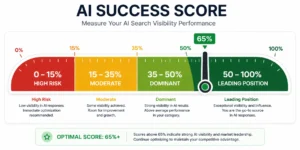
My benchmark is straightforward. If your citation share sits above 35 percent in your niche, you are dominant more than one out of every three AI answers in your category mentions your brand. That is winning territory.
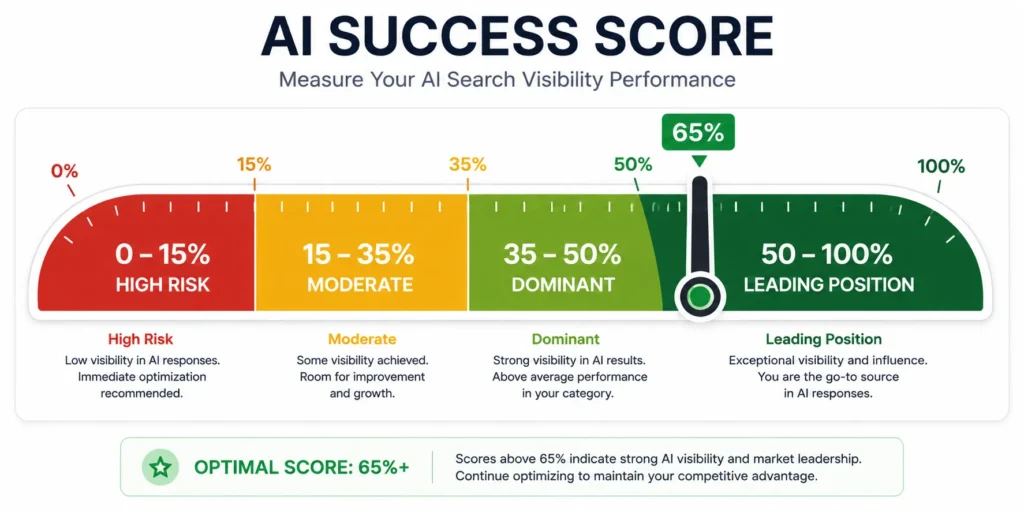
Below 15 percent signals genuine risk. Your competitors are getting cited. You are being passed over. That becomes a problem that demands immediate action.
But here is what watching my own trends taught me over several months. The static number matters far less than the direction. A score climbing from 20 to 35 over six months proves your optimization efforts are working. A score dropping from 40 to 25 tells you something broke and investigation is urgent.
Think of the AI Success Score as a compass, not a grade. It does not pass or fail you. It points you toward the specific queries where improving your content will actually move visibility. I always focus first on the queries with the lowest scores because they carry the biggest upside potential.
Why Sentiment Analysis Is Just as Important as Mentions
I made an early mistake that cost me traction. I saw my brand getting mentioned and I celebrated the visibility. Then I actually read what the AI said and realized it was quoting a negative customer review. A bad mention damages reputation more than silence ever could.
Sentiment analysis in the ZipTie AI Search Performance Tool catches this exact problem. It flags whether the AI talks about you positively, negatively, or neutrally. See negative sentiment on a specific query? That signals something is broken. Maybe a customer complaint ranks too high in search results. Maybe your product page buried the information people need.
Either way, fixing it becomes your priority.
Sentiment feeds directly into your AI Success Score calculation. Positive mentions boost the score. Negative ones drag it down. So when you see a low score, check sentiment first. It might not be that the AI ignores you. The AI might see you and dislike what it finds. That distinction changes your entire optimization strategy.
The ZipTie AI Success Score became my first stop each week. I check which queries dropped, which improved, where sentiment shifted. The data shows me exactly where to focus. No guessing. No wasted effort. Just clear direction on what to fix next.
ChatGPT, Perplexity and Google AI Overviews Share Only 10‑15% Citation Overlap
I spent months making a critical assumption. If my brand showed up in ChatGPT answers, I figured I was covered across all platforms. That assumption cost me significant visibility I never tracked because I did not know it existed.
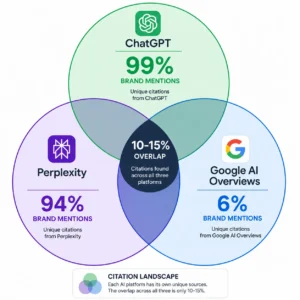
The reality is stark. Each AI platform operates on completely different citation rules. ChatGPT mentions brands in more than 99 percent of ecommerce-related responses—it loves naming names. Google AI Overviews mentions brands in only about 6 percent of the same queries. One platform is verbose about brands. The other is almost silent.
Citation overlap makes this worse. ChatGPT, Perplexity, and Google AI Overviews share only about 10 to 15 percent of the same citations. Track just one platform and you are blind to roughly 85 to 90 percent of what happens on the other two. That is not a minor gap. That is structural invisibility.
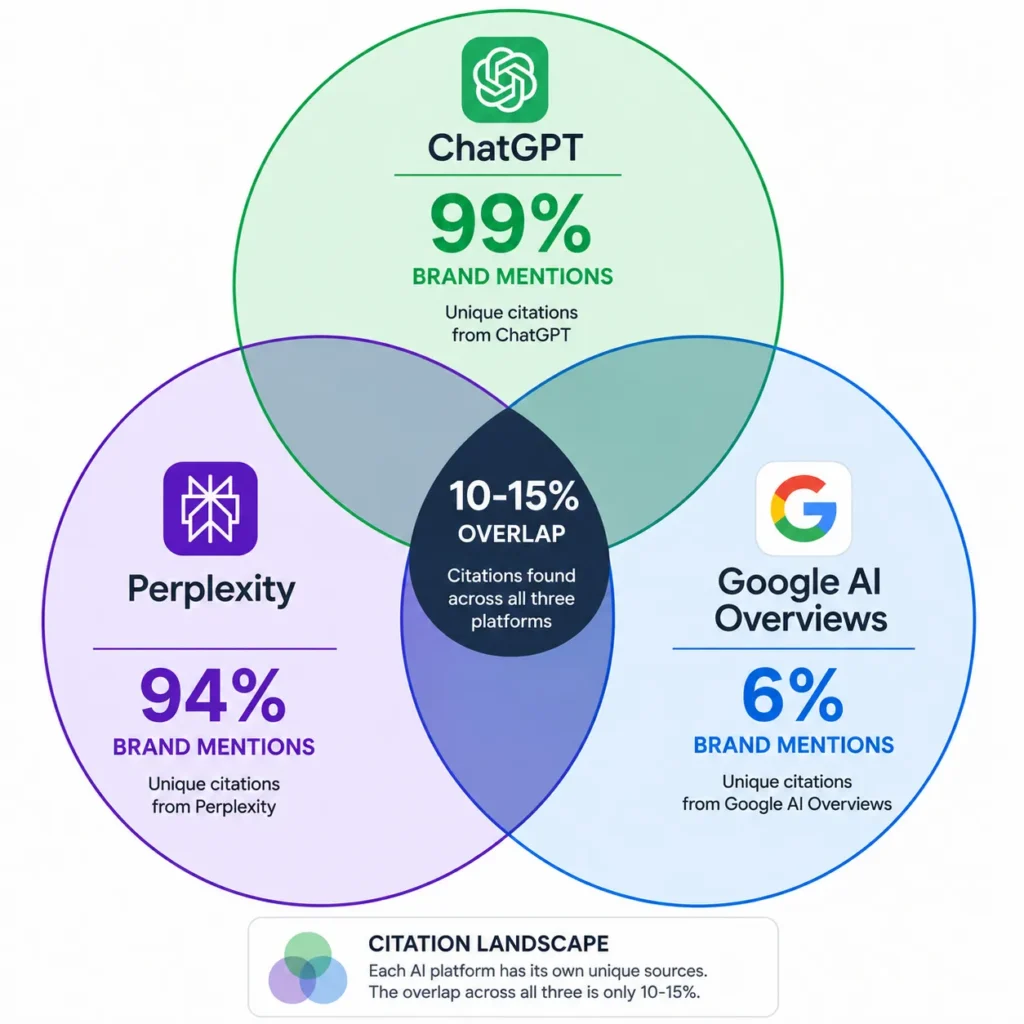
Imagine watching one security camera in a room with three entrances. You see one door completely. The other two doors might as well not exist. That is what tracking ChatGPT alone does to your AI visibility.
I discovered this the hard way. First time I ran a report across all three platforms simultaneously, my brand showed strong in ChatGPT but nearly invisible on Perplexity and Google AI Overviews. Had I only checked ChatGPT, I would have thought everything was fine. It was not. The other platforms were completely ignoring me.
The ZipTie AI Search Performance Tool eliminates this blind spot by tracking all three simultaneously. One check covers them all. You see the complete picture. You catch where you are strong and where you are weak on each platform.
The implication is straightforward. Do not assume one platform tells you anything about another. Citation habits differ. Brand mention rates differ. Your visibility on ChatGPT tells you nothing about your visibility on Perplexity. Tracking only one platform in 2026 is a risk you cannot afford to take.
ZipTie Pricing: How Much Does It Cost? (Plus Free Trial)
This is the question I get most: can you afford ZipTie before you’ve even tested it? Let me walk through the pricing structure and what each plan actually delivers.
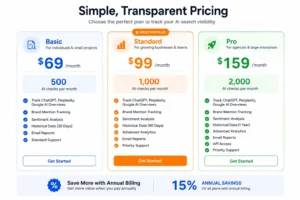
ZipTie has three pricing tiers. Basic costs $69/month for 500 checks. Standard costs $99/month for 1,000 checks. Pro costs $159/month for 2,000 checks. Annual payment saves about 15 percent, which is what I switched to after my first few months of monthly billing.
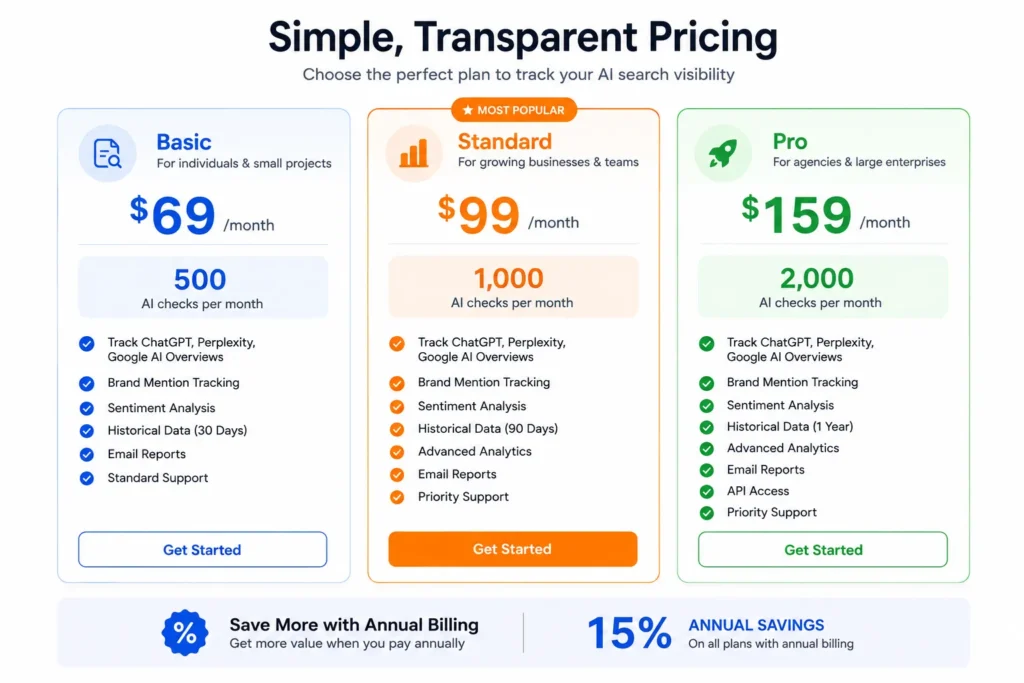
The terminology creates confusion. A “check” means one query scanned across all three AI platforms simultaneously. Ask one question. ZipTie runs it on Google AI Overviews, ChatGPT, and Perplexity at the same time. That one action equals one check. So 500 checks on Basic means 500 different queries tracked monthly, each checked on all three platforms.
For most small businesses and solo content creators, the Basic plan provides plenty of runway. Track your brand name, your main product categories, plus five or six competitor comparisons and you are still under 500 checks.
Agencies and larger teams need Standard or Pro. I upgraded to Standard after three months because I wanted to track long-tail variations. The additional 500 checks gave me room to test hypotheses.
Before committing financially, run the free trial. ZipTie provides 14 days with 10,000 credits enough to run initial reports, connect Google Search Console data, and evaluate whether the tool fits your workflow. I tested for a week before purchasing. On day three I discovered that my brand appeared in AI Overviews under queries I’d never tracked a gap that justified the subscription immediately.
The ZipTie AI search performance tool is not cheap compared to some basic SEO plugins. But compared to what you lose by being invisible in AI search, the price is reasonable. Most small businesses do fine with the Basic plan. Agencies usually need Standard or Pro. Either way, start with the trial and see what the data tells you before you commit.
ZipTie vs. SEMrush: Which Tool Actually Detects AI Overviews?
I have used SEMrush for years. It excels at keyword research, backlink analysis, and traditional Google ranking tracking. But the moment I ran my keyword set through ZipTie, the disparity became obvious.
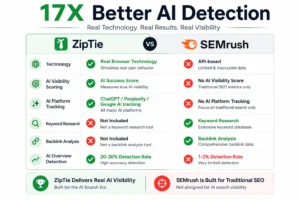
The numbers are stark. ZipTie detects AI Overviews on about 20 to 30 percent of my tracked keywords. SEMrush on the same keywords shows AI Overviews on only 1 to 2 percent. That is roughly a 17-to-1 advantage for ZipTie in AI Overview detection.
The gap exists because SEMrush relies on API approximations and sampled data. ZipTie uses real browser technology that directly queries Google AI Overviews, ChatGPT, and Perplexity. One approach shows you what an API predicts might happen. The other shows you what someone actually sees.
This does not mean you should abandon SEMrush or Ahrefs. Keep them. They do things ZipTie cannot do at all. Traditional SEO tools are still the best for keyword research, backlink analysis, site audits, and Google ranking tracking. The ZipTie AI Search Performance Tool does not compete in those areas.
Where ZipTie stands alone is AI visibility measurement. Your brand mentions inside ChatGPT. Your citations on Perplexity. Your sentiment on Google AI Overviews. Traditional SEO tools do not even attempt to measure this layer. That blind spot is ZipTie’s entire value proposition.
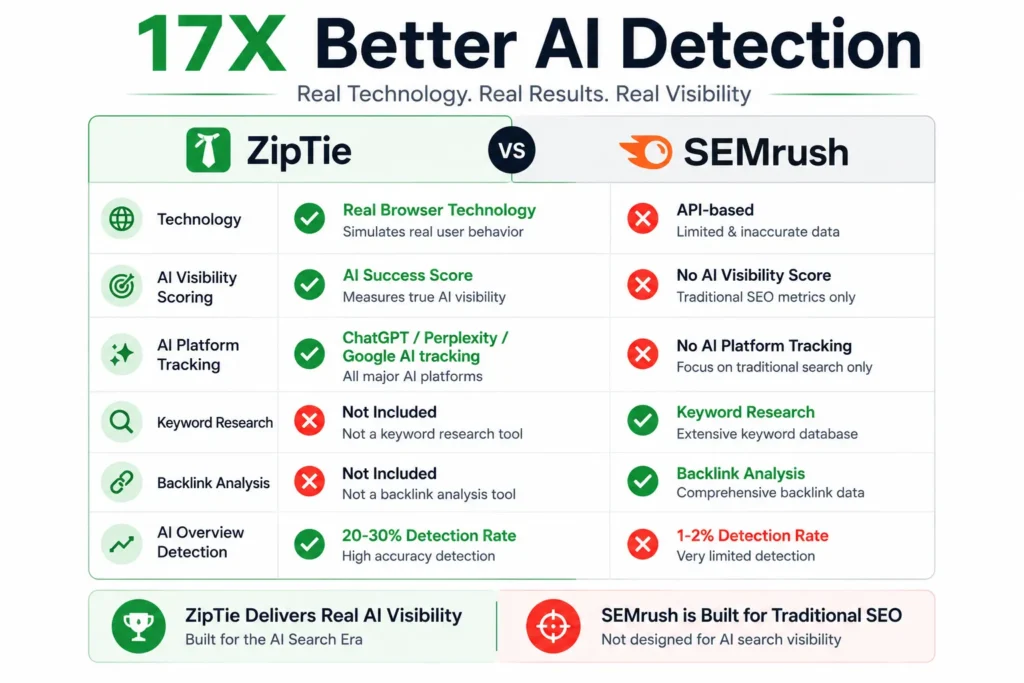
Quick Comparison Table: ZipTie vs. SEMrush
| What You Need | ZipTie | SEMrush |
|---|---|---|
| Track AI Overviews, ChatGPT, Perplexity | Yes, real browser | Limited, API based |
| Find which questions trigger AI citations | Yes, query generator | No |
| Keyword research and search volume | No | Yes |
| Backlink analysis and competitive research | No | Yes |
| AI Success Score with sentiment tracking | Yes | No |
| Content optimization for AI citations | Yes, specific recommendations | Basic only |
Do You Need Both? The Complementary Approach
I run both tools. Most teams should.
SEMrush shows me which keywords to target and where my competitors rank in traditional search. ZipTie shows me whether those optimization efforts actually result in AI citations. Each tool answers a different question. Neither answers both.
The ZipTie AI Search Performance Tool fills a gap that traditional SEO tools simply were not built to cover. Stop thinking about this as a choice between tools. Use ZipTie to track AI search visibility. Use SEMrush to track traditional search performance. That stack gives you complete visibility across both search channels.
How to Improve AI Search Visibility with ZipTie (Actionable Steps)
I have tested a lot of different approaches to get AI search engines to notice my content. Some worked. Most did not. Here is the exact process I use now with ZipTie. It is the same workflow that took my brand from invisible to regularly cited inside ChatGPT and Google AI Overviews.
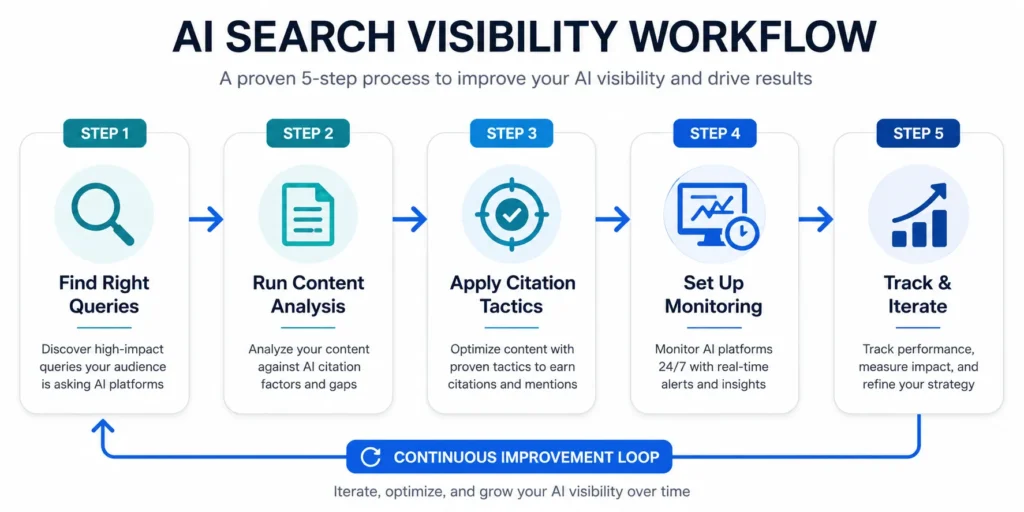
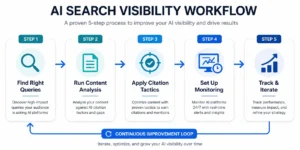
Step 1: Find the Right Queries (Don’t Just Track Your Brand Name)
The biggest mistake I made early on was only tracking queries that included my brand name. That tells you if people already know you. It does not tell you if AI recommends you when someone asks for the best option in your category.
Open ZipTie and go to the query generator. Paste your most important URL, like your homepage or your best product page. The tool analyzes that page and gives you a list of conversational prompts. These are the exact types of questions real people ask when they are researching a purchase.
Focus on category queries like best project management tool for small teams. And comparison queries like Tool A vs Tool B. Those are the questions that drive discovery and new customers. Brand name queries can wait.
Step 2: Run Content Optimization Analysis
Once you have your list of target queries, run them through ZipTie. The tool will show you how your brand currently appears across Google AI Overviews, ChatGPT, and Perplexity. Then go to the content optimization module.
Submit your best pages one at a time. ZipTie analyzes what the AI engines actually look for when deciding whether to cite a source. It will show you specific gaps. Maybe your page lacks clear headings. Maybe you buried your best point too far down. Maybe you have no statistics to back up your claims.
The report tells you exactly what to fix. Not general advice. Specific line items.
Step 3: Apply Proven Citation Tactics (Headings, Stats, Front Loading)
This is where the real work happens. Based on what ZipTie shows you, make these changes.
First, fix your heading structure. A logical H2 and H3 hierarchy makes your content roughly 2.8 times more likely to get cited by AI. Do not skip levels. Do not use fancy or vague headings. Make them clear and descriptive.
Second, add statistics wherever you can. Pages that include data get about 41 percent more AI citations. Real numbers. Survey results. Performance metrics. Anything factual that supports your point.
Third, front load your key information. Nearly half of all AI citations come from the first 30 percent of a page. That means if you bury your main point in paragraph 15, the AI probably never sees it. State your strongest claims and most useful data early. The supporting details can come later.
And here is something most people do not realize. AI citations rotate constantly. About 40 to 60 percent of the sources cited this month will be gone next month. You cannot fix your content once and forget it. Ongoing updates are not optional.
Step 4: Set Up Automated Monitoring
Manual checking does not work. I proved that to myself when I asked the same question five times and got five different answers. The URL consistency across repeated queries is below 10 percent.
Go into ZipTie and enable automated monitoring for your most important queries. Set the schedule to check every 7 to 14 days. The tool will run those queries on all three platforms automatically and save every response. You will see trends over time without lifting a finger.
Step 5: Track Trends and Iterate
Open the Trends tab in ZipTie every week or two. Look for queries where your citation share is dropping. That is your early warning system. Something changed. Maybe a competitor published better content. Maybe your page got outdated.
Look for queries where sentiment turned negative. That tells you the AI found a complaint or a bad review. Fix that source or add positive counterpoints.
And look for queries where you are completely invisible. Those are your biggest opportunities. Run the content optimization analysis on those specific topics and start the cycle again.
The ZipTie AI search performance tool gives you the data. But the improvement comes from acting on it consistently. Set aside one hour every two weeks to review your trends and make one small update. That consistent effort adds up faster than you think.
How to Improve AI Search Visibility with ZipTie (Actionable Steps)
I tested countless approaches trying to get AI systems to notice my content. Most failed completely. But the workflow below actually works. It took my brand from invisible in ChatGPT and Google AI Overviews to appearing regularly in both. This is exactly what I do now.
Step 1: Find the Right Queries (Don’t Just Track Your Brand Name)
My earliest mistake was tracking only brand-name queries. This only shows whether people already know you exist. It does not tell you whether an AI recommends your business when someone asks “best [category] for [use case].”
Open the ZipTie query generator. Paste your most important URL—your homepage or best-selling product page. The tool analyzes the page and generates a list of conversational prompts that real people ask when researching a purchase. Not guesses. Actual search phrases based on real behavior.
Focus on category queries first: “best accounting software for freelancers.” Then comparison queries: “Tool X vs Tool Y.” These drive discovery and acquire new customers. Brand-name queries come later once you have visibility.
Step 2: Run Content Optimization Analysis
Take your target queries and run them through ZipTie. The tool shows your current brand appearance across Google AI Overviews, ChatGPT, and Perplexity. Then access the content optimization module.
Submit your best-performing pages one at a time. ZipTie analyzes what AI systems actually look for when deciding whether to cite a source. The report identifies specific gaps. Missing clear headings. Main arguments buried too far down. Zero statistics to support claims.
The report gives you specific, actionable line items—not vague recommendations. This precision is what makes the difference.
Step 3: Apply Proven Citation Tactics
Three specific changes drive citation improvement.
Fix heading structure first. A logical H2/H3 hierarchy makes content roughly 2.8 times more likely to get cited by AI. Avoid skipping levels. Avoid vague headings. Make them clear and descriptive so an AI scanning the page knows exactly what each section covers.
Add statistics everywhere possible. Pages with data receive roughly 41 percent more AI citations. Real numbers. Survey results. Performance metrics. Anything verifiable supports citation eligibility. AI systems prefer citing hard data.
Front-load your key information. Nearly half of all AI citations come from the first 30 percent of a page. Bury your main point in paragraph 15 and the AI will never see it. Lead with your strongest claims and most useful data. Put supporting details after.
One more thing nobody anticipates: AI citations rotate constantly. About 40 to 60 percent of this month’s cited sources vanish next month. You cannot optimize once and forget it. Ongoing updates are not optional in an AI-driven search landscape.
Step 4: Set Up Automated Monitoring
Manual checking is unreliable. I tested this personally by asking ChatGPT the same question five times. Five different answers. The URL consistency across repeated queries sits below 10 percent. You cannot spot-check your way to reliable data.
Enable automated monitoring in ZipTie for your most important queries. Set the check frequency to every 7 to 14 days. The tool runs those queries across all three platforms automatically and archives every response. Over time, trends emerge without additional effort.
Step 5: Track Trends and Iterate
Review your Trends tab every week or two. Watch for queries where citation share is dropping—that is your early warning signal that something changed. Maybe a competitor published better content. Maybe your page got outdated.
Watch for queries where sentiment turned negative. The AI found a complaint or bad review. Fix the source or add positive counterpoints to balance it.
Watch for queries where you are completely invisible. Those represent your biggest opportunity. Run the content optimization analysis again and repeat the cycle.
ZipTie provides the data. Your improvement comes from acting consistently. Spend one hour every two weeks reviewing trends and making one targeted update. That consistent effort accelerates faster than sporadic overhauls. I have watched it happen on my own properties.
Who Is ZipTie For? (And Who Might Not Need It)
Not everyone needs this tool. I learned this when I recommended it to a friend who runs a small local coffee shop. She studied the dashboard and asked the obvious question: what am I supposed to do with this data? She was right to ask.
The ZipTie AI Search Performance Tool serves specific audiences. SEO agencies managing multiple client properties. Content marketers working to crack AI Overviews. E-commerce brands competing for visibility in ChatGPT recommendations. SaaS companies where discovery flows through comparison queries. Publishers and bloggers needing their articles cited as sources across AI platforms.
If you fit any of these categories, ZipTie provides something unavailable elsewhere: concrete data on whether AI systems see you, cite you, and talk about you positively.
But here is what most tool reviews skip over. If you run a very small local business with almost no online presence, you probably do not need ZipTie yet. A local pizza shop or plumbing service will not see meaningful AI search traffic. People asking AI about those categories usually ask generic questions that do not cite specific local businesses.
Also skip it if you do not care about AI search traffic at all. Some organizations remain focused entirely on traditional Google rankings. That choice is defensible. But understand what you are choosing to ignore. AI Overviews appear in nearly 9 out of 10 Google searches. Dismissing that channel is a deliberate decision.
Understand also what ZipTie does not do. It does not track traditional keyword rankings. It does not analyze backlinks. It does not audit site speed or technical SEO. The tool does one thing: show you your AI search visibility. Nothing more. Nothing less.
Ask yourself this honestly. Do I need to know how AI search engines perceive my brand in 2026? If yes, run the free trial. If no, invest your budget elsewhere. That is the straightforward calculus.
Is the ZipTie AI Search Performance Tool Worth It in 2026?
The central problem remains unchanged. Traditional SEO tools cannot measure AI citations. Manual testing produces unreliable results. Tracking just one platform blinds you to the other two. That is the position you want to avoid in 2026.
The urgency is clear. AI Overviews appear in nearly 9 out of every 10 Google searches. Not 1 in 10. Not half. Nearly all of them. If your brand does not appear there, you are invisible to the majority of search traffic. That percentage continues rising.
ZipTie addresses this directly. Real browser data rather than API predictions. Multi-platform coverage across Google AI Overviews, ChatGPT, and Perplexity simultaneously. An AI Success Score showing exactly where to focus. A content optimization module delivering specific recommendations, not vague guidance.
I tested cheaper alternatives. I tested manual spot-checks. Neither gave me the complete picture this tool provides.
The ZipTie AI Search Performance Tool is not for everyone. Run a tiny local shop with no online presence? You can probably skip it. But for agencies, content marketers, e-commerce brands, SaaS companies, and publishers, the data justifies the investment.
My recommendation is straightforward. Run the 14-day free trial. Load 10 or 20 of your most important queries. See what the data shows. You might discover your brand already gets cited in places you never tracked. Or you might find you are completely invisible across all three platforms. Either way, you shift from guessing to knowing.
That shift justified the cost for me. I believe it will for you as well.
Frequently Asked Questions
What exactly does the ZipTie AI search performance tool track?
I get asked this all the time. The tool tracks three specific things across Google AI Overviews, ChatGPT, and Perplexity. Brand mentions. Does the AI actually name your business? Citations. Does it link to your site as a source? And sentiment. Is the tone positive, negative, or neutral? That is the full picture.
Can I track AI search visibility for free?
Yes, but only for a limited time. ZipTie gives you a 14 day free trial with 10,000 credits. That is plenty to run your first batch of queries and see where you stand. After the trial ends, paid plans start at 69 dollars per month for the Basic plan.
Why can’t I just use Google Search Console to see AI citations?
Google Search Console only shows traditional search performance. It tells you how you rank on Google. But here is the problem. Only about 12 percent of the URLs that AI engines cite actually rank in Google’s top 10. So GSC misses most AI citations entirely. You cannot see what you are not measuring.
Does ZipTie work for local SEO?
Honestly, it depends. ZipTie works best for national or international brands and content publishers. If you run a small local business like a coffee shop or a plumbing service, your AI search presence is probably limited. People ask AI about general topics, not specific local shops. Unless you target informational queries, this tool might not give you much value yet.
How often should I check my AI search performance?
With ZipTie’s automated monitoring, I set mine to check every 7 to 14 days. AI citations rotate constantly. About 40 to 60 percent of the sources cited this month will be gone next month. Weekly or biweekly checks help you spot changes early before you lose visibility.
Is ZipTie better than SEMrush for AI tracking?
For pure AI visibility tracking, yes. ZipTie detects roughly 17 times more AI Overviews than SEMrush on the same keyword sets. But SEMrush is still valuable for keyword research, backlink analysis, and traditional SEO. Many teams, including mine, use both. They do different jobs.
What is a good AI Success Score?
I use this benchmark. A citation share above 35 percent in your niche means you are dominant. Below 15 percent signals high risk of being invisible to AI search. But here is what I learned. Focus on improvement over time, not the absolute number. A score that climbs from 20 to 35 over six months tells you more than a static number ever could.
Can ZipTie help me optimize my existing content for AI search?
Yes, and this is where the tool really shines. The content optimization module analyzes what AI engines actually look for when they decide to cite a source. It identifies specific gaps in your content. Maybe you need more statistics. Maybe your heading structure is weak. Maybe you buried your best point too far down. The report gives you specific recommendations, not general advice.