
What Are AI Search Engine Optimization Tools? (And Why They’re Different From Regular SEO Tools)
I’ve spent the last year watching something shift in search that most content creators haven’t caught yet. The ai search engine optimization tools I used to rely on for Google rankings are becoming less effective not because they stopped working, but because the game itself has fundamentally changed.
Quick Answer: AI search engine optimization tools are software platforms designed to help your content get discovered, cited, and recommended by AI-powered search engines like ChatGPT, Perplexity, and Google Gemini. They are not traditional SEO tools with updated features. They operate on entirely different principles because they solve a fundamentally different problem: getting AI engines to trust and cite you, not just getting Google to rank you.
When I talk to other content creators, most still believe ‘SEO tools’ and ‘AI SEO tools’ are the same thing. They’re not. Traditional SEO tools help you rank web pages higher so people click through to your site. AI search engine optimization tools help you get cited in AI-generated summaries, building authority and trust with audiences who may never visit your website directly but who now know and trust your brand because an AI they rely on recommended you.
That distinction matters more than you might think.
Right now, about 41% of search traffic still comes from Google’s traditional blue links, according to data from SparkToro and Datos. ChatGPT and similar AI platforms account for roughly 0.19% of total search traffic as of early 2025.
Those numbers sound small, but I’ve learned to read the trend, not just the snapshot. In late 2024, AI search traffic was barely measurable at any scale. That acceleration is real, and the growth curve is steeper than most people tracking it expected
“I started testing AI search engine optimization tools in early 2025 when I noticed something odd. My articles were ranking well on Google, but when I asked ChatGPT the same questions my articles answered, I wasn’t getting mentioned at all. Other websites some with lower domain authority scores and fewer backlinks than mine were being cited instead. That’s when I understood I needed a completely different approach for this new search landscape
That’s when I understood I needed different tools for this new landscape.
Why AI Search Engine Optimization Tools Focus on GEO and Answer Engine Optimization (Not Just Google)
Generative engine optimization, or GEO, completely changes how we think about search visibility. Instead of optimizing to appear in a ranked list of links, you’re optimizing to become the source that AI engines trust enough to quote when they answer someone’s question
The metric that matters has shifted completely. In traditional SEO, I tracked clicks, impressions, and average position. With answer engine optimization, I now track citations, brand mentions, and how often AI platforms like Perplexity and ChatGPT reference my content when someone asks a relevant question. Some weeks I see my content cited in dozens of AI responses — and that visibility compounds in ways a Google ranking never did.
When an AI engine cites you, it’s not just sending you traffic. It’s vouching for your expertise to every person who reads that response. That endorsement builds your authority in ways a simple search ranking never could.
I’ve seen this play out in my own projects. One of my websites gets cited regularly by Perplexity when people ask about YouTube analytics tools. The direct traffic from those citations is modest — maybe 60 to 80 visits per week. But the indirect effect has been significant. People who discover my site through an AI recommendation are noticeably more engaged. They spend longer on the page, subscribe to my newsletter at a higher rate, and are far more likely to share my content with their own audiences.
Here’s what I’ve found: when an AI cites you, it hands you something more durable than a ranking. Citations build authority. Authority earns trust. And trust creates the kind of long-term loyalty that no algorithm update can take away from you. That’s the real difference between traditional SEO and generative engine optimization one is a competition for attention, the other is a competition for credibility
Answer engine optimization goes one step deeper. Where GEO focuses broadly on making your content visible to generative AI platforms, AEO specifically targets the engines people talk to directly — ChatGPT, Claude AI, and Google’s AI Overviews. These aren’t passive search tools. They read your content, understand its context, and deliver it in a conversational response that feels like advice from a knowledgeable friend.
When someone asks ChatGPT “what are the best project management tools for small teams,” they’re not looking for ten blue links. They want a curated, explained answer with reasoning. If your content gets cited in that answer, you’ve won something more valuable than a click. You’ve earned a recommendation.
Once I understood this shift, I changed my entire content strategy. Instead of writing to rank for keywords, I started writing to be cite-worthy. That meant prioritizing clarity, tight structure, original expert insights, and verifiable facts. The ai search engine optimization tools I use now help me optimize for those qualities not just keyword density
How AI Search Engines Actually Work And Why This Changes Everything About AI-Powered SEO
Understanding how AI search actually functions changed everything about how I approach optimization. These engines work differently than Google at a fundamental level, and that difference dictates what kind of tools you need.
AI search engines operate on a two-part system, and understanding it is the key to effective LLM optimization. The first part is the Large Language Model, or LLM the pre-trained AI that already ‘knows’ an enormous amount of information from its training data. When you ask ChatGPT a question, it draws on knowledge encoded during its training phase
But here’s what surprised me when I first learned this: the LLM alone isn’t doing live searches. It cannot see your website if it was published after the model’s training cutoff date. That’s where web browsing capability comes in. Modern AI search engines actively crawl the internet in real time, retrieving current data and verifying claims before generating their answers.
This dual system creates a fundamentally different optimization challenge. You’re no longer just optimizing for algorithms that count keywords and backlinks. You’re optimizing for AI systems like ChatGPT and Perplexity that actually read your content, understand its context, evaluate your authority signals, and make a judgment call about whether to trust you enough to cite you.
I tested this by publishing nearly identical content in two formats. One was optimized the traditional way — keyword placement, meta descriptions, and internal links. The other was structured for AI readability: clear upfront answers, FAQ schema markup, and explicit expertise signals. The traditionally optimized version ranked higher on Google. The AI-optimized version was cited more than three times as often by ChatGPT and Perplexity. Same information. Different packaging. Completely different results.
AI crawlers evaluate content much like a careful editor would. Clear structure gets prioritized. Explicit expertise markers author credentials, cited sources, verifiable claims earn trust. And content that directly answers questions in plain language consistently outperforms articles that bury the answer under layers of keyword optimization.
Natural language processing the technology that allows AI to understand human language plays a bigger role in this than most people realize. When an AI engine reads your content, it is not simply matching keywords to a query. It comprehends meaning, identifies named entities, maps relationships between concepts, and assesses whether your reasoning holds up logically
I started thinking about LLM optimization as a completely separate discipline from traditional SEO. The tools that help with LLM optimization analyze how AI engines will interpret your content. They check for semantic clarity, structural coherence, and authority signals that machine learning models recognize.
One of the biggest mistakes I made early on was assuming AI engines use the same ranking factors as Google. They don’t. Google still weighs backlinks and domain authority heavily. AI engines weigh content structure, clear expertise signals, and whether your information meets their quality and safety standards. These are genuinely different evaluation systems and conflating them is the fastest way to optimize for the wrong thing
The way search works has changed and that means the tools you need have changed too. Traditional SEO tools show you keyword volumes and help you build backlinks. AI search engine optimization tools do something different: they help you structure content so AI can understand it, verify your expertise so AI trusts you, and track citations so you know when AI is actively recommending you to new audiences
I’ve learned that the websites getting cited most consistently by AI platforms aren’t always the ones ranking highest on Google. They’re the ones that have adapted their content and optimization strategies to this new dual system of pre trained knowledge plus live web research.
That’s why calling these tools “just SEO tools” misses the entire point. They’re built for a different search paradigm, one where being understood and trusted by artificial intelligence matters as much as ranking in an algorithm.
Why You Need AI Search Engine Optimization Tools Right Now: 3 Real Business Case Studies
I used to be skeptical about AI search optimization. It felt like another marketing buzzword that would quietly fade once the hype settled. Then I started looking at actual results from real businesses and I couldn’t argue with the numbers.
Let me share three case studies that convinced me these tools aren’t optional anymore. They’re essential if you want to stay visible as search behavior shifts toward AI platforms.
Real Business Results: From #0 to #3 in AI Search
The case study that made me take AI search engine optimization seriously involves a software platform called Tube Analytics, a YouTube analytics tool competing against well-funded, established players in a saturated market. The founder was doing everything right by traditional SEO standards but AI search didn’t care about his traditional rankings
When the founder first checked how often AI engines mentioned his product, the result was zero. He would ask ChatGPT “what are the best YouTube analytics platforms” and get recommendations for competitors. Perplexity would list alternatives. Google’s AI Overview featured other tools. His product, despite having strong traditional search rankings, was completely invisible in AI search results.
He decided to test generative engine optimization techniques built specifically for AI visibility. The changes weren’t complicated, but they were different from standard SEO practices. He restructured content with Quick Answer sections at the top of key pages, added detailed FAQ schema markup that AI crawlers could easily parse, and started optimizing for the exact prompts people actually type into ChatGPT not just the keywords they search on Google.
Within three months, Tube Analytics ranked number three when users asked AI engines about YouTube analytics platforms. That’s a remarkable outcome — his product now appears in AI responses alongside, and sometimes before, competitors with ten times his marketing budget. Not because he outspent them. Because he optimized smarter
The direct traffic from AI citations wasn’t enormous at first — around 40 to 60 visitors per day. But the quality of that traffic was exceptional. According to the founder’s own analytics, people who discovered his tool through an AI recommendation converted at nearly double the rate of regular search traffic. They trusted the source of the recommendation, and that trust transferred directly to his product. They trusted the source of the recommendation, and that trust transferred to his product.
One insight from this case study surprised me more than anything else: AI search rankings move far faster than traditional Google rankings. Google’s algorithm takes months to fully recognize and reward quality content. AI engines can start citing you within weeks sometimes within days if your content structure and authority signals are strong enough
The founder told me that showing up in AI search results also improved his brand visibility in unexpected ways. Journalists started mentioning his tool in articles. Podcast hosts invited him for interviews. Other software companies reached out about partnerships. Getting cited by AI created a credibility signal that rippled through his entire industry.
This wasn’t about gaming an algorithm. It was about making his genuine expertise and quality product more discoverable to AI systems that were already looking for trustworthy recommendations. The tools he used helped him identify what AI engines valued and structure his content accordingly.
What an AI Visibility Audit Actually Reveals (And Why Traditional SEO Tools Miss It)
The dental practice case study hit differently because it wasn’t a tech startup it was a completely ordinary local business that had invested heavily in traditional SEO and had good Google rankings. The dentist had invested heavily in a professional website with good traditional SEO. The site ranked well for local searches like “dentist in Orlando” and got steady organic traffic from Google.
When a marketing consultant ran an AI visibility audit using specialized tools, the website scored 59 out of 100. That score indicated significant structural barriers preventing AI engines from fully understanding and citing the site even though human visitors and Google had no issues with it whatsoever.
The audit revealed specific technical issues that traditional SEO tools had completely missed. The biggest problem was missing schema markup. Schema is structured data that helps search engines understand what your content is about. Google can often figure things out without it, but AI engines rely heavily on schema to extract accurate information.
The dental practice had no Organization schema, no LocalBusiness schema, and no FAQ schema. When AI crawlers visited the site, they couldn’t confidently identify basic facts like the practice’s founding date, the dentist’s credentials, or answers to common patient questions.
The second major issue was something called NAP consistency. NAP stands for Name, Address, and Phone number. The audit found that the practice’s phone number was formatted differently on their website, Google Business Profile, and various directory listings. One place showed it as parentheses and dashes, another as dots, another as spaces.
To humans, these all look like the same phone number. But AI systems looking for exact data matches to verify business legitimacy saw inconsistencies and reduced their confidence in the listing. This was a citation optimization problem hiding in plain sight costing the practice citations every time potential patients asked AI assistants to recommend dentists in Orlando
The audit also identified content quality issues that were limiting AI visibility. The practice had a blog, but the articles were generic with no clear expertise signals no author bios, no mention of the dentist’s specific qualifications or years of experience, and no real-world patient success stories that demonstrated actual outcomes
AI engines prioritize content that shows clear expertise and real experience. Without those signals, the blog content was essentially invisible to AI search, even though some articles ranked decently on Google.
What struck me most was this: the same website can rank well on Google and remain nearly invisible in AI search. Google has learned to be forgiving about missing schema markup and minor NAP inconsistencies — it infers context, fills gaps, and rewards established authority. AI search engines are more literal. They need explicit, structured signals to feel confident enough to cite you
The dental practice addressed all identified issues over about six weeks. They deployed comprehensive schema markup, standardized their business information across every platform, and rewrote key service pages to include clear expertise markers alongside real patient experiences all properly anonymized to protect privacy.
Three months after implementing the changes, the practice started appearing in AI search results when people asked for dentist recommendations in their area. The owner told me that patients now regularly mentioned finding them through “asking my phone” or “searching on ChatGPT,” phrases that never came up before.
The citation optimization work delivered an unexpected bonus: it improved their traditional SEO rankings at the same time. Clearer structure and stronger expertise signals helped with Google too. But the real win was becoming visible in a search channel that had been completely invisible to them before.
This case study taught me something important: AI visibility audits reveal blind spots that traditional SEO analysis misses entirely. You can have a technically strong website by old standards and still be completely invisible in today’s AI search landscape
The Cost Revolution: Agency Quality for $1 Per Week
The third case study is the one I reference most often when I talk to content publishers about SEO costs. A publisher I know personally was paying between $2,000 and $5,000 per month to a well-regarded SEO agency. The agency was doing good work, manually researching keywords, writing optimized content, building backlinks, and tracking rankings.
But the monthly cost was eating into profits, especially as the business tried to scale content production. The publisher needed to produce more content to compete, but agency costs scaled linearly. Double the content meant roughly double the monthly bill.
Then he discovered AI search engine optimization tools with automation capabilities. He built a system using workflow automation software that cost less than $1 per week to run. That’s not a typo. Under one dollar weekly for a system that replaced thousands of dollars in monthly agency fees.
The automated system handled the full content cycle research, writing, optimization, and publishing. Using multiple AI agents working in sequence, it planned articles, pulled verified facts from live web sources, drafted content in a natural readable style, generated relevant featured images, and published everything directly to his website all without any manual intervention
I was skeptical when I first heard these numbers. How could automated tools possibly match the output quality of a human agency team? But when I looked at the actual traffic data and content performance metrics, I understood the distinction. The system wasn’t replacing human creativity or strategic thinking. It was automating the repetitive, mechanical tasks that agencies charge hundreds of dollars per hour to execute keyword research, content outlining, schema implementation, internal linking
Keyword research, competitor analysis, content outlining, schema implementation, internal linking, and performance tracking all happened automatically. The publisher still made strategic decisions about content direction and brand voice. But the mechanical execution ran on autopilot.
The organic traffic results were comparable to what the agency had delivered. In some cases, better. The automated system could publish fresh content faster, respond to trending topics within hours instead of weeks, and scale production without additional cost.
What impressed me most was that this approach worked specifically because of AI search optimization. Traditional SEO automation often produces low quality spammy content that Google penalizes. But when you optimize for AI engines, the quality bar is actually higher. You need clear structure, factual accuracy, and genuine expertise signals. The automation tools built for AI optimization naturally produce better content because they’re designed around those requirements.
The cost savings let the publisher reinvest in other areas of the business. He hired a subject matter expert to review content for accuracy. He invested in better research tools. He expanded into new content categories that would have been financially impossible at agency pricing.
This case study showed me that AI search engine optimization tools aren’t just about getting citations from ChatGPT or Perplexity. They’re about doing SEO work more efficiently and effectively. The same tools that help you rank in AI search also make traditional SEO more affordable and scalable.
I don’t think agencies are obsolete. For complex strategies and high stakes campaigns, human expertise still matters tremendously. But for routine optimization and content production, AI tools have changed the economics completely.
All three case studies point to the same conclusion. Businesses that adopted ai search engine optimization tools early captured visibility in a growing channel, improved their content quality as a direct byproduct, and reduced their operational costs simultaneously. And the advantage compounds the earlier you start, the further ahead you get as AI search continues taking a larger share of total search traffic.
I started paying attention to brand visibility in AI search after seeing these results. Every business I know that invested in citation optimization and AI visibility is getting discovered by new audiences who would never have found them through traditional search alone.
The question isn’t whether AI search matters. The case studies prove it does. The question is whether you’ll adapt your optimization strategy before or after your competitors do.
Traditional SEO vs AI SEO: The Ranking Factors That Actually Change (And What to Do About It)
When I first started comparing my traditional SEO results with my AI search visibility, I noticed something that genuinely surprised me. The two didn’t match at all.
Pages that ranked on Google’s first page were getting zero citations from ChatGPT. Pages I’d barely optimized for keywords were getting cited regularly by Perplexity. The ranking factors that governed one world had almost nothing to do with the other.
This isn’t a minor difference you can paper over with a few tweaks. Traditional SEO and AI SEO operate on fundamentally different principles. Understanding those differences is the first step to building a strategy that works in both environments.
Let me break down exactly what changes.
How the Two Approaches Compare
Here’s a clear side-by-side comparison of how traditional SEO and AI SEO differ across the factors that matter most to your search visibility strategy:
| Factor | Traditional SEO | AI SEO |
|---|---|---|
| Primary goal | Rank web pages for clicks | Get cited in AI generated answers |
| Success metric | Click through rate and position | Citation frequency and mention quality |
| Keyword focus | Short tail and exact match keywords | Conversational prompts and questions |
| Content structure | Keyword density and headings | Clear answers, FAQ schema, structured data |
| Authority signals | Backlinks and domain rating | E-E-A-T signals and external mentions |
| Trust indicators | Domain age and link profile | Author credentials and content accuracy |
| Content freshness | Regular updates help rankings | Fresh content can override established authority |
| Technical priority | Site speed and crawlability | Schema markup and AI permissions |
| External platforms | Backlink sources | Reddit, Quora, reviews, and user content |
| Measurement tools | Rank trackers and analytics | Citation trackers and AI visibility scores |
I built this comparison from months of testing both approaches. The contrasts are striking once you see them laid out together.
The biggest mindset shift for me was moving from ‘how do I rank higher?’ to ‘how do I become more trustworthy?’ Google’s algorithm can be influenced by technical signals like backlinks and page speed. AI engines make judgment calls based on whether your content demonstrates genuine knowledge and real-world experience and you can’t fake your way through that evaluation.
You can technically game traditional SEO to some degree. AI search is much harder to game because it evaluates the quality of your thinking, not just the structure of your page.
The 5 Ranking Factors That Actually Determine AI Search Citations
When I look at what consistently gets content cited by AI engines, I see a pattern that’s very different from traditional ranking factors.
AI engines evaluate content holistically. They read it the way an intelligent person would and ask whether it actually helps the person who asked the question. That evaluation draws on several signals:
Clarity of the answer. AI engines favor content that gets to the point quickly. If someone asks a specific question, your content should answer it directly in the first few sentences before expanding into context and detail.
Factual accuracy. Content with verifiable facts, specific numbers, and named sources consistently gets cited more often than vague, generalist content. I’ve tested this directly AI engines cross-reference information and actively prioritize sources they can independently verify
Structural organization. Proper heading hierarchy, FAQ sections, numbered lists, and clear paragraph breaks make content easier for AI to parse and extract. Unstructured walls of text rarely get cited even when the information inside is excellent.
Semantic search alignment. AI engines don’t match keywords. They understand meaning. This means two articles covering the same topic but written differently can both rank, while an article stuffed with keywords but lacking clear meaning will perform poorly. Semantic search rewards genuine communication over optimization tricks.
External validation. I was surprised by how much weight AI engines give to what other people say about you versus what you say about yourself. Mentions on Reddit threads, Quora answers, review platforms, and third-party articles all strengthen your credibility with AI systems and none of it can be manufactured.
E-E-A-T Is Everything Now (Not Just a Suggestion)
I used to treat E-E-A-T as a nice-to-have. Google had been talking about Experience, Expertise, Authoritativeness, and Trustworthiness for years, and I implemented the basics without fully committing to the philosophy. That worked fine for traditional SEO. For AI search, E-E-A-T signals aren’t optional they’re the entire game.
For AI search, E-E-A-T signals aren’t optional. They’re the primary currency.
Here’s what I mean by that. When a human reads your content, they bring their own judgment and context. They might trust a well written article even if the author is anonymous. When an AI engine evaluates your content, it needs explicit signals to determine whether your expertise is genuine.
Experience means demonstrating that you’ve actually done the thing you’re writing about not just studied it. First-person accounts, specific results with real numbers, and honest descriptions of what worked and what didn’t. AI engines recognize experiential content and treat it with significantly more authority than theoretical explanations.
Expertise means showing domain knowledge that goes beyond surface level information. You demonstrate expertise by explaining concepts clearly, anticipating questions, addressing nuances, and providing insights that someone without real knowledge couldn’t offer.
Authoritativeness means being recognized by others in your field not just claiming authority on your own website. When people with no financial stake in promoting you reference your work, recommend your tools, or cite your insights on Reddit, Quora, or industry forums, it sends a trust signal to AI engines that most websites can’t manufacture
Trustworthiness means your content is accurate, your intentions are genuine, and you’re transparent about who you are and why you’re writing. Author bios with real credentials, links to professional profiles, and honest disclosure of limitations all strengthen trust signals.
Once I realized how directly E-E-A-T signals affected my AI citation rates, I made four concrete changes. I added detailed author information to every article. I included specific examples from my own testing rather than relying on generic explanations. I linked to credible external sources for every major claim. And when I discovered errors, I fixed them publicly instead of quietly hoping nobody would notice.
The content quality improvements that helped my AI search visibility also improved reader satisfaction. Better E-E-A-T signals mean better content overall. That’s not a coincidence. The signals work because they correlate with genuine quality.
I also learned that E-E-A-T signals need to be consistent across your entire site. One expertly written article surrounded by thin generic content confuses AI engines. They evaluate your overall authority, not just individual pages. Lifting the quality floor across your whole content library matters more than perfecting a handful of flagship pieces.
Keywords vs Prompts: How Search Intent Analysis Changes Your Optimization Target
This shift took me the longest to fully understand and apply. I’d spent years thinking in keywords. Short ones, long tail ones, question keywords, commercial keywords. Every piece of content started with keyword research in a traditional SEO tool.
AI search completely changes the research question. Instead of asking ‘what keywords do people search for?’ I now ask ‘what do people actually say when they talk to AI assistants?’ Those two questions have surprisingly different answers and optimizing for the wrong one means your content misses an entire category of discovery.
Traditional keyword research might tell me to target “best productivity apps” because that phrase has high search volume. But when someone opens ChatGPT, they don’t type “best productivity apps.” They type something like “I’m overwhelmed with work and need help managing my time better, what apps would actually help someone like me?”
That conversational prompt contains completely different optimization targets than any keyword tool would surface. The user mentions overwhelm and time management emotional context that keyword research ignores entirely. They’re asking for personalized guidance, not a generic feature comparison. And the phrasing ‘would actually help someone like me’ implies they’ve already tried other apps and been disappointed
Optimizing for that prompt means writing content that acknowledges the real problem, addresses the emotional context, and provides specific personalized guidance. A traditional keyword optimized article about “best productivity apps” probably won’t get cited for that prompt even if it covers the same apps.
I now research prompts by testing them directly in AI engines and observing what gets cited. I look at which sources consistently appear for different types of questions. I analyze the structure and tone of cited content to understand what qualities made those sources trustworthy to the AI.
Search intent analysis has always been important in SEO, but the granularity required for AI optimization is much deeper. You’re not just categorizing intent as informational or commercial. You’re understanding the specific situation, emotional state, and real world context behind each query.
Conversational keywords naturally emerge from this kind of research. Instead of targeting “home office setup tips,” I might optimize for “how should I set up my home office if I have a small apartment and back problems.” That’s a real prompt people type into AI assistants, and it requires specific, nuanced content to answer well.
I now keep a running document of actual prompts I observe people using when they discuss topics in my niche on Reddit, forums, and social media. Those real world questions become my optimization targets. They’re always more specific, more emotionally informed, and more practically useful than anything a keyword research tool suggests.
The shift from keywords to prompts isn’t just a tactical change. It’s a philosophical one. It pushes you toward writing for real people with real problems instead of writing for algorithms looking for specific word patterns. That’s ultimately better for everyone, including your search visibility.
How to Choose AI-Powered Search Engine Optimization Tools for Your Business (A Decision Framework)
One of the most common mistakes I see when people explore AI search optimization is jumping straight to the most popular tool they read about somewhere online. They sign up, get overwhelmed by features they don’t actually need, and either waste money or give up entirely usually within the first month.
Choosing the right AI powered search engine optimization tools isn’t about finding the “best” tool in some universal sense. It’s about finding the right tool for your specific situation. Your business type, budget, technical comfort level, and primary goals all determine which tools will actually move the needle for you.
I’ve worked with enough different setups to know that a tool that transforms results for an agency owner might be completely wrong for a solo blogger. And a tool perfect for an e-commerce store would leave a local dentist wondering what to do with half its features.
Let me walk you through a practical decision framework based on business type. This approach considers user intent behind your optimization goals and workflow compatibility with your existing processes.
Before you choose any tool, answer these four questions honestly:
1. What is your primary goal? Getting local citations, building content authority, managing client campaigns, or selling products through AI recommendations all require different capabilities — and different tools.
2. What is your realistic monthly budget? Free tools can cover a surprising amount of ground. Paid tools make sense only when the time they save or the results they deliver clearly justify the cost.
3. How technical are you? Some tools require code installation or schema implementation knowledge. Others work entirely through simple dashboards with no technical skill required.
4. What platform does your website run on? WordPress users have access to direct integrations that dramatically simplify implementation. Other platforms may require more manual work.
With those answers in mind, here’s how I’d approach tool selection by business type.
For Local Businesses: Citation Tracking and NAP Tools
If you run a local business, whether that’s a dental practice, a law firm, a restaurant, or any service business tied to a specific location, your AI optimization priority is completely different from a content publisher or e-commerce brand.
Your biggest challenge is what I call the trust gap. Local businesses often have websites that rank acceptably on Google but score poorly on AI visibility audits. The most common reason is NAP consistency problems.
NAP stands for Name, Address, and Phone number. When your business information appears differently across your website, Google Business Profile, Yelp, and local directories, AI engines see inconsistencies that lower their confidence in your business’s legitimacy.
I’ve seen cases where a business’s phone number was formatted three different ways across different platforms. The business itself was real and reputable. But from an AI engine’s perspective, those inconsistencies raised enough doubt to prevent citations.
For local businesses, prioritize tools that handle three specific capabilities:
1. NAP Consistency Auditing — The tool should audit your Name, Address, and Phone number across every platform you appear on and flag every formatting inconsistency, no matter how minor.
2. Local Schema Deployment — It should generate and deploy LocalBusiness and Organization schema markup that tells AI engines exactly who you are, where you’re located, and what you offer.
3. Content Gap Identification — It should surface the specific questions local customers ask that your website doesn’t currently answer, so you can build FAQ content that earns AI citations.
Look for tools that offer AI visibility scoring so you can measure your starting point and track improvement. The score itself matters less than the specific issues it surfaces and whether the tool gives you clear guidance on fixing them.
One practical approach I’ve seen work well for local businesses is using AI audit tools to generate branded PDF reports showing your current visibility score and recommended fixes. This gives you a concrete document to work through methodically rather than a vague sense that optimization needs to happen.
The tools best suited for local businesses tend to be straightforward to use without deep technical knowledge. You shouldn’t need a developer to implement the recommendations. If a tool’s suggested fixes require coding expertise you don’t have, look for one that offers WordPress integration or automatic schema deployment instead.
For Content Publishers: Content Optimization and GEO Tracking
If you run a blog, news site, educational platform, or any content focused website, your tool selection should center on two capabilities. Optimizing content structure for AI readability and tracking how often your content gets cited by AI engines.
Content publishers face a specific challenge. You might produce excellent, thoroughly researched articles that rank well on Google but never get cited by ChatGPT or Perplexity. The reason is usually structural rather than qualitative. The information is good but it isn’t packaged in a way AI engines can easily extract and cite.
I learned this lesson after spending weeks puzzling over why a competitor with weaker traditional SEO metrics kept getting cited for topics where my articles were significantly stronger. When I compared our content structures side-by-side, the gap was immediately obvious. Their articles led with explicit Quick Answer sections, expanded FAQ markup, and conversational headings that directly matched how people phrase questions to AI assistants. Mine used traditional SEO structure optimized for Google.
For content publishers, the tools I’d prioritize are:
Content optimization platforms that analyze your articles against top cited content for your target topics. These tools show you structural improvements to make, not just keyword suggestions. They’ll tell you to add a direct answer in the opening paragraph, restructure your FAQ section, or make your headings more conversational.
GEO tracking tools that monitor how often your specific articles get cited across ChatGPT, Perplexity, Google AI Overviews, and other AI platforms. Without this data, you’re optimizing blind. With it, you can see which content types and structural approaches generate the most citations and double down on what works.
Prompt research capabilities that reveal the specific questions people type into AI engines about your topics. These prompts become your new optimization targets, often very different from what traditional keyword research surfaces.
The workflow compatibility factor matters a lot for publishers producing regular content. Look for tools that integrate into your existing content creation process rather than requiring a separate optimization workflow after publishing. The best tools for publishers work alongside your writing, not after it.
For Agencies: Audit and White Label Reporting Tools
Agency owners have unique needs that most AI SEO tool lists completely overlook. You’re not just optimizing your own content. You’re managing multiple client websites, demonstrating results to clients who may not understand AI search, and looking for ways to scale your services efficiently.
The tool features that matter most for agencies are client reporting, white label options, and the ability to generate clear deliverables that non-technical clients can understand and appreciate.
I’ve seen agencies use AI visibility audit tools in a particularly clever way. When prospecting for new clients, they run a quick AI visibility audit on the prospect’s website and export the results as a branded PDF report. This report shows the prospect their current AI visibility score, specific issues hurting their performance, and a clear roadmap for improvement.
This approach works because it gives the prospect concrete evidence of a problem they probably didn’t know they had. Most business owners in 2026 know they should be thinking about AI search but have no idea how to measure or improve their visibility. Showing up with an actual score and specific recommendations positions you as the expert who can solve a real problem.
For client management, prioritize tools that let you track multiple websites from a single dashboard. Switching between separate accounts for each client creates unnecessary complexity and makes it harder to spot patterns across your portfolio.
White label reporting matters if you present reports under your own brand. Some AI SEO tools let you generate client facing reports with your agency’s logo and colors, which looks far more professional than sharing raw tool screenshots.
The technical depth of reporting also matters. Agency clients range from sophisticated marketing managers who want detailed data to small business owners who just want to know if things are improving. Look for tools that offer both detailed technical reports and simplified executive summaries that communicate results without requiring SEO knowledge to interpret.
Workflow compatibility for agencies means looking at how tools handle bulk actions. Can you run audits on multiple client sites simultaneously? Can you schedule regular reports to send automatically? Can you implement recommendations efficiently without manually touching every client site? These efficiency features separate tools built for individual use from those genuinely designed for agency workflows.
For E-commerce: Product Listing Optimization
E-commerce businesses face a distinct AI optimization challenge. You’re not just trying to get informational content cited. You’re trying to get your products recommended when people ask AI engines for purchasing advice.
When someone asks ChatGPT “what’s the best laptop bag for daily commuting,” the AI doesn’t just list search results. It describes specific products with features and reasons why they suit the use case. Getting your products into those recommendations requires a specific type of optimization that general SEO tools don’t address.
The foundation of e-commerce AI optimization is structured data. Product schema tells AI engines exactly what your product is: what it costs, what its features are, who it’s designed for, and what makes it different from alternatives. Without that structured layer, AI engines are essentially guessing and they’ll recommend something else instead. Without proper product schema, AI engines struggle to extract the specific information needed to recommend your products accurately.
I’ve seen product pages with excellent photography, compelling copy, and strong conversion rates completely invisible in AI search simply because they lacked proper structured data. The human experience of the page was excellent. The AI’s ability to understand and cite the page was nearly zero.
For e-commerce businesses, look for tools that handle these specific needs:
Product schema generation and validation that ensures your product listings include all the structured data fields AI engines use to understand and recommend products. This includes price, availability, ratings, specifications, and category information.
Visual content optimization because AI engines increasingly process images as well as text. Your product images should include proper alt text, file names, and surrounding context that helps AI understand what’s shown. Some tools now specifically optimize visual content for AI comprehension.
Competitive product monitoring that tracks when competitor products get recommended by AI engines and analyzes why. Understanding what structured data and content signals make competitors more recommendable helps you close the gap.
The user intent behind product searches in AI engines tends to be highly specific. People describe their exact situation, constraints, and preferences when asking AI for product recommendations. Your product content and schema need to address those specific scenarios, not just list generic features.
Workflow compatibility for e-commerce means considering whether tools integrate with your platform. Shopify, WooCommerce, and other major platforms have different integration options. A tool that works beautifully with one platform might require extensive custom work on another. Confirm compatibility before committing to any tool.
The common thread across all four business types is this: the right tool fits your specific situation rather than being theoretically impressive on a feature list. Start with your primary goal, match it to the capabilities you actually need, and choose the simplest tool that genuinely delivers those capabilities within your budget.
Best AI Content Optimization Tools for Search Engine Visibility: In-Depth Reviews
Finding the right tools to optimize content for AI search engines took me longer than I’d like to admit. I tested dozens of platforms over the past year, sat through countless demos, and made some expensive mistakes along the way.
What I discovered is that the best ai content optimization tools for search engine visibility aren’t necessarily the most famous ones. Some of the most effective tools I use today weren’t on any major listicle when I found them. They were mentioned by practitioners in forums and videos who had actually tested them under real conditions.
I’ve organized my recommendations into six categories based on what each tool actually does: AI Citation Tracking, Content Optimization and Writing, Research and Keyword Tools, Technical Audit and Schema Tools, Automation and Workflow Tools, and Visual and Engagement Tools. This matters because most people try to find one tool that does everything. That approach consistently produces mediocre results. Specialized tools for specific tasks produce dramatically better outcomes
Let me walk you through what I’ve found actually works.
AI Citation Tracking and Visibility Tools: Monitor Your AI Search Results
These are the tools to optimize content for AI search engines in terms of monitoring and measurement. You can’t improve what you don’t track, and most traditional analytics tools have no idea what’s happening in AI search.
Writesonic (AI Visibility and GEO Tracking)
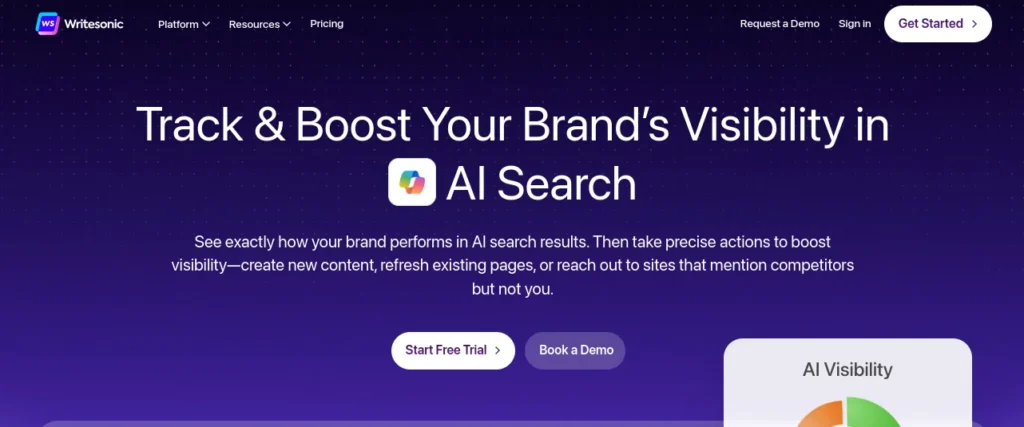
Writesonic has evolved well beyond its origins as a content generation tool. Its GEO tracking features now let you monitor how often your brand appears in AI-generated answers across ChatGPT, Perplexity, and Google’s AI Overviews the three platforms that currently drive the most AI search traffic.
The feature I find most valuable is the share of voice measurement. It shows what percentage of relevant AI answers mention your brand compared to competitors. Watching that number change as I implement optimizations gives me concrete evidence of what’s working.
Writesonic also identifies sources that mention your competitors but not you. This is citation gap analysis, and it’s genuinely useful for finding outreach opportunities and content topics that could earn you new mentions.
It also refreshes existing content to improve both traditional SEO rankings and GEO performance at the same time. For anyone managing a content library that needs updating, this dual optimization approach saves significant time.
Best for: Content publishers and brands wanting to track AI citation performance and identify growth opportunities.
Pricing: Starts around $19 per month for basic plans with GEO features on higher tiers.
Profound
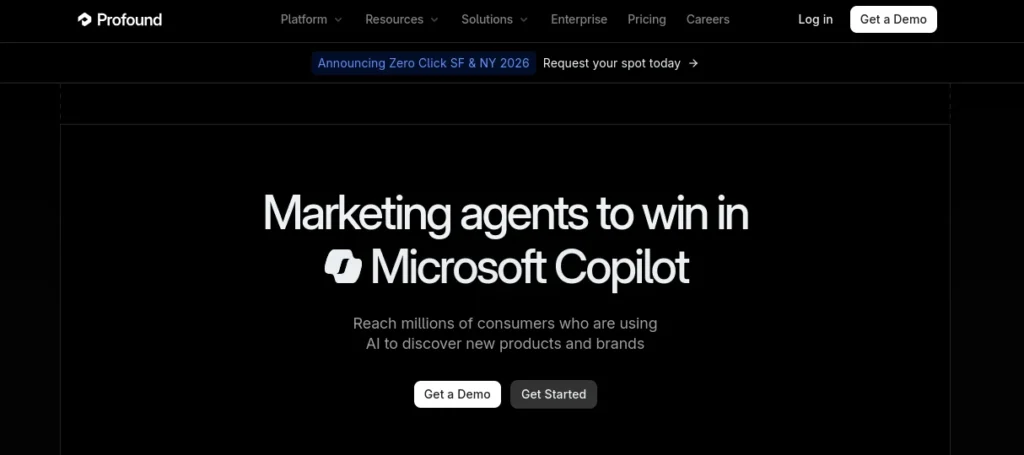
Profound describes itself as helping brands “see what AI sees about them.” That framing captures what makes it different from other tracking tools.
Where most analytics tools show you website traffic and rankings, Profound uses marketing language familiar to anyone with a traditional analytics background. It shows AI referrals, attribution data, and how users who arrive via AI recommendations behave differently from other visitors.
The feature that stands out to me is Reddit monitoring. Profound tracks your brand’s visibility on Reddit specifically because Reddit content gets cited heavily by AI engines. Many brands ignore Reddit entirely, not realizing that conversations happening there directly influence whether AI systems recommend them.
Profound also optimizes product listings for AI shopping recommendations, which makes it particularly relevant for e-commerce businesses targeting younger demographics who increasingly use AI assistants for purchasing decisions.
Best for: Brands wanting deep attribution data and businesses with e-commerce or product visibility goals.
Rankscale.ai
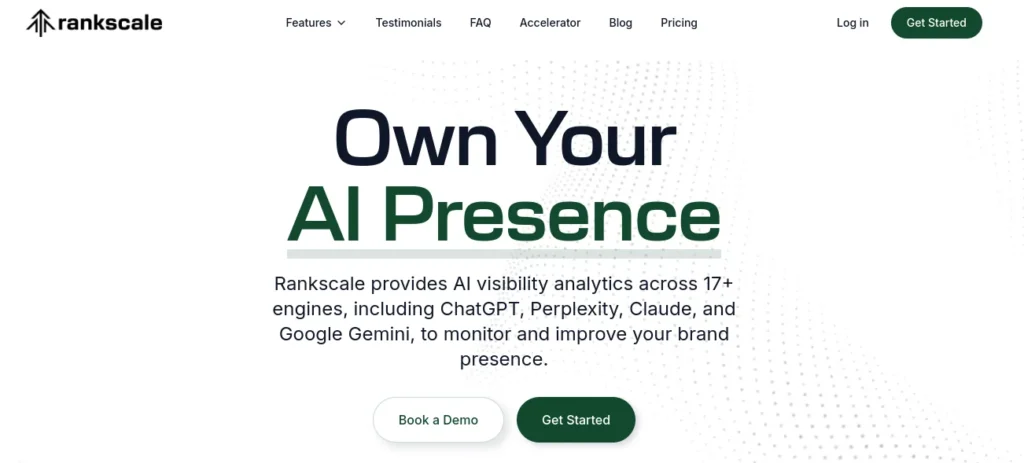
Rankscale.ai focuses on granular rank tracking specifically for AI search visibility. Unlike broader platforms, it lets you track your visibility across specific AI engines, specific keywords, and specific regions separately.
This granularity matters more than it sounds. Your content might get cited regularly by Perplexity but rarely by ChatGPT, or perform well for informational queries but poorly for commercial ones. Generic tracking tools average everything together and hide those distinctions.
Best for: Businesses that need detailed AI search performance data broken down by platform and query type.
Peec AI
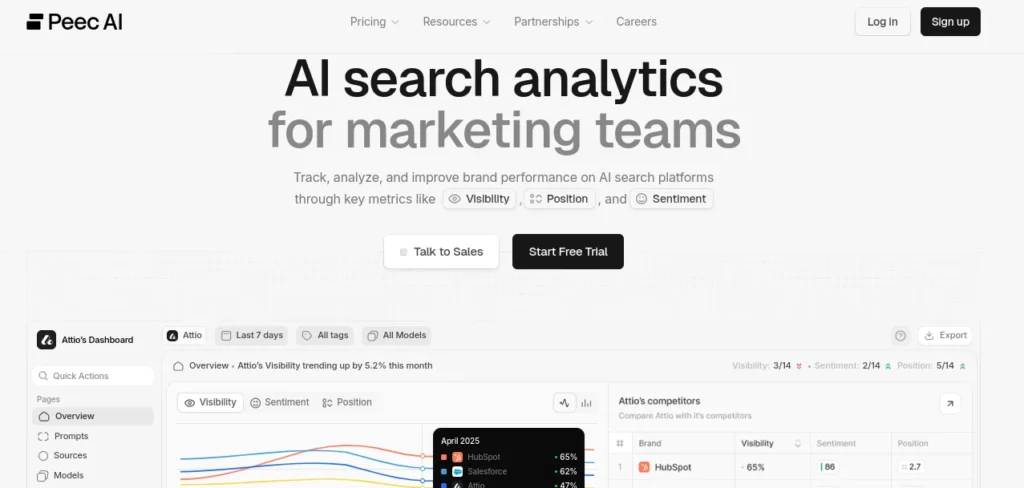
Peec AI focuses specifically on brand mention and citation tracking inside AI-generated answers. Unlike broader analytics platforms, it monitors how AI engines reference your brand, tracks the sentiment of those mentions, and sends alerts when your citation patterns shift useful for brands that want to protect visibility they’ve already built. It’s particularly valuable for established brands that risk losing AI citations to faster-moving competitors.
Best for: Brands with established market presence that want to protect and grow their AI mention frequency
Content Optimization and AI Writing Tools: Create Content AI Engines Will Actually Cite
These content generation tools help you create and improve content that AI engines will actually cite. The distinction I’ve found is that the best tools in this category optimize for AI readability, not just keyword placement.
Frase.io
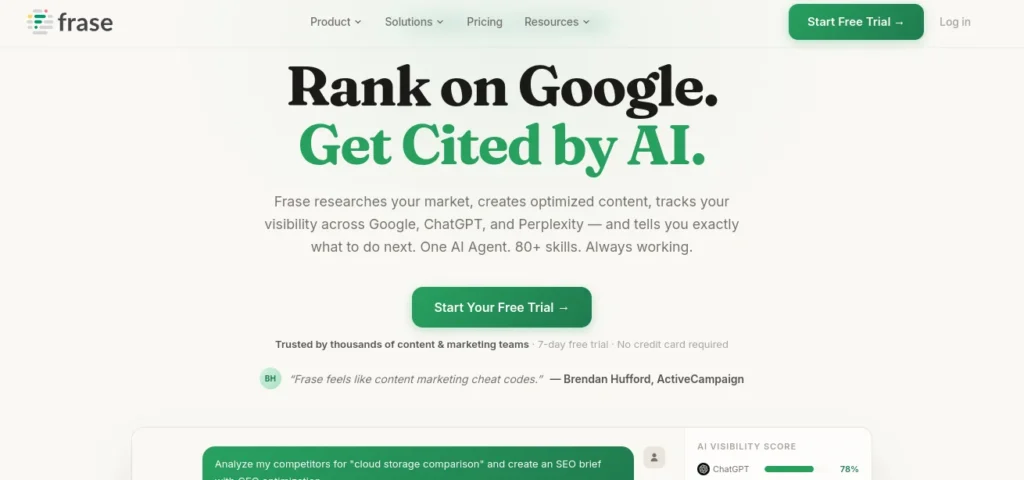
Frase.io has become my most used content optimization tool over the past eighteen months. What separates it from traditional SEO writing tools is how it analyzes content for AI comprehension rather than just keyword density.
When I put a target topic into Frase, it analyzes the top-ranking and top-cited content for that topic and shows me a comprehensive picture: the headings and questions that appear in authoritative sources, word count and header usage patterns, and most usefully the specific questions that successful content answers. That last point is what lets me structure articles to genuinely address what people want to know, rather than what I assume they want.
The internal linking suggestions are practical and specific. Rather than general advice to add more internal links, Frase tells me exactly which pages to link to and where in my content those links make sense.
For anyone just starting with AI content optimization, Frase provides enough guidance to significantly improve content quality without requiring deep technical SEO knowledge.
Best for: Content publishers and bloggers who want AI assisted content research and optimization guidance.
Pricing: Starts around $15 per month with a free trial available.
Surfer SEO
Surfer SEO provides real-time content scoring as you write. The Content Score feature evaluates your article against top-ranking content and gives you a numerical score that updates dynamically as you add or remove content elements think of it as a live grade for your SEO
I use Surfer primarily for articles where I want to ensure comprehensive topical coverage. It’s particularly good at surfacing semantic terms and related concepts that should appear in a thorough article. The visual interface makes it easy to see what’s missing without breaking your writing flow.
Surfer has also added AI search optimization features that evaluate how well your content structure aligns with what AI engines prefer, not just traditional search signals.
Best for: Writers who want real time optimization feedback during the writing process.
Claude 4.6 Sonnet (Anthropic)
I want to be direct about something. I’ve tried multiple AI writing models for content creation, and Claude 4.6 Sonnet produces noticeably more natural long form content than alternatives I’ve tested.
The reason matters for our purposes. Content that reads naturally gets cited more often because AI engines evaluate readability and coherence as quality signals. Stiff robotic writing, even if technically accurate, scores lower on the quality assessments AI engines make.
I use Claude specifically for drafting longer explanatory content where natural flow and logical progression matter. The output still requires human editing and expertise addition, but the baseline quality is high enough that the revision process is far more efficient.
Best for: Anyone using AI assistance for content drafting who wants natural sounding output that passes AI quality assessments.
Jasper AI
Jasper AI offers a comprehensive platform combining content generation with SEO optimization guidance. It includes brand voice settings that help maintain consistency across large content libraries, which matters for authority building.
Best for: Teams producing high volume content who need consistency and built in SEO guidance.
Research and Keyword Tools
These keyword research tools have evolved to address the prompt based nature of AI search. The best ones now help you understand not just what people search for but what they ask AI assistants.
Perplexity AI
I want to share what Craig Campbell, a well respected SEO authority with years of industry experience, said about his tool preferences. When asked which AI tool he found most valuable for SEO work, he named Perplexity AI without hesitation.
His reason was specific and compelling. Perplexity was the first major AI platform to clearly show every source it used when constructing an answer. While ChatGPT has since added source citation features, Perplexity’s implementation remains the clearest and most useful for research purposes.
I use Perplexity as both a research tool and a testing environment. For research, it lets me quickly understand how information from across the web synthesizes into coherent answers on my target topics. I can see which sources get cited, analyze what makes those sources trustworthy, and identify patterns I can apply to my own content.
For testing, I type in the prompts my target audience uses and observe whether my content appears in the cited sources. When it doesn’t, I analyze what the cited sources are doing differently.
The deep analysis capability that Campbell highlighted is what makes Perplexity genuinely useful rather than just another search interface. It doesn’t just find information. It reasons through it, contextualizes it, and presents it in ways that reveal how AI engines think about topics.
Best for: Researchers and SEO professionals who want to understand AI search behavior from the inside.
Pricing: Free tier available. Perplexity Pro costs around $20 per month and includes additional research capabilities.
Semrush AI Toolkit
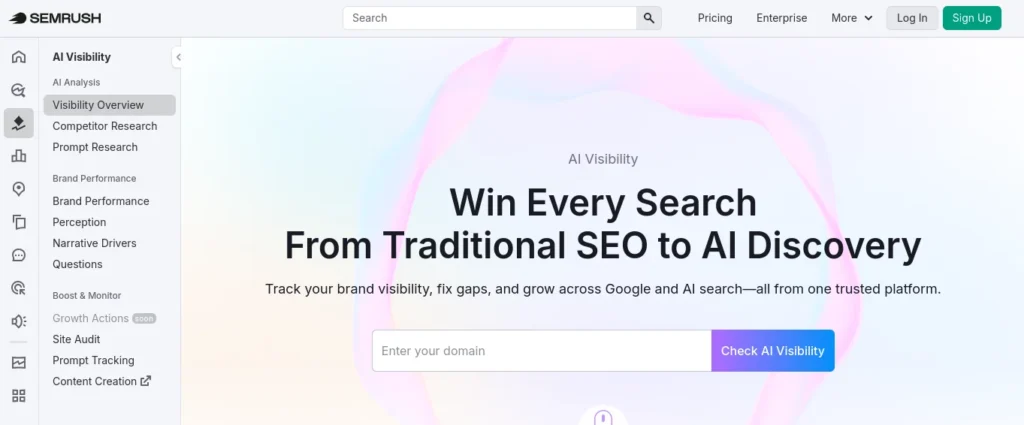
Semrush has integrated AI search optimization directly into its existing platform, which makes it valuable for anyone already using Semrush for traditional SEO. Rather than switching between separate tools, you can track both traditional rankings and AI visibility from one dashboard.
The Prompt Research Tab is the feature I find most distinctive. It shows you exactly what users are asking AI about specific topics, which directly informs your content strategy. Instead of guessing what prompts to optimize for, you see actual query data.
The Share of Intent analysis categorizes your search visibility by intent type, informational, navigational, commercial, and transactional. This matters because your AI optimization strategy should differ depending on which intent types you’re targeting.
Best for: Existing Semrush users who want AI search tracking without adopting an entirely separate tool.
CanIRank.com
CanIRank does something most competitor analysis tools don’t. It doesn’t just show you problems with your SEO and AI visibility. It provides specific solutions rather than leaving you to figure out what to do with the diagnostic data.
You add your website and target keywords, and it crawls your site alongside competitor sites. It identifies content opportunities, link building possibilities, and technical issues. The key difference is that it pairs each issue with actionable recommendations rather than just flagging problems.
For anyone who finds traditional SEO audit tools overwhelming because of the gap between diagnosis and action, CanIRank’s solution focused approach makes optimization genuinely manageable.
Best for: Small business owners and solopreneurs who want specific guidance rather than just data.
Technical Audit and Schema Tools
Technical issues are often the invisible barrier between good content and AI citations. These tools surface and fix the structural problems that prevent AI engines from understanding and trusting your site.
Serpsling
Serpsling focuses specifically on Answer Engine Optimization audits. When you run a site through Serpsling, it produces a comprehensive AI visibility score along with specific technical issues affecting your performance.
The real world example that convinced me of Serpsling’s value involved a dental practice website that received a score of 59 out of 100. The audit identified missing schema markup and NAP inconsistencies as the primary issues. Neither of these problems would have appeared critical in a traditional SEO audit, but both were significantly limiting the site’s AI search visibility.
What I appreciate about Serpsling is the practical output format. You can export audit results as branded PDF reports, which creates a clear deliverable showing exactly what needs to be fixed and why. For agencies, this serves as both a client deliverable and a prospecting tool.
Serpsling also generates missing content directly within the platform. When the audit identifies questions your website doesn’t answer, you can create that content and add appropriate FAQ schema without leaving the tool.
Best for: Agencies using AI visibility audits as client deliverables, and local businesses needing comprehensive technical fixes.
Search Atlas Auto
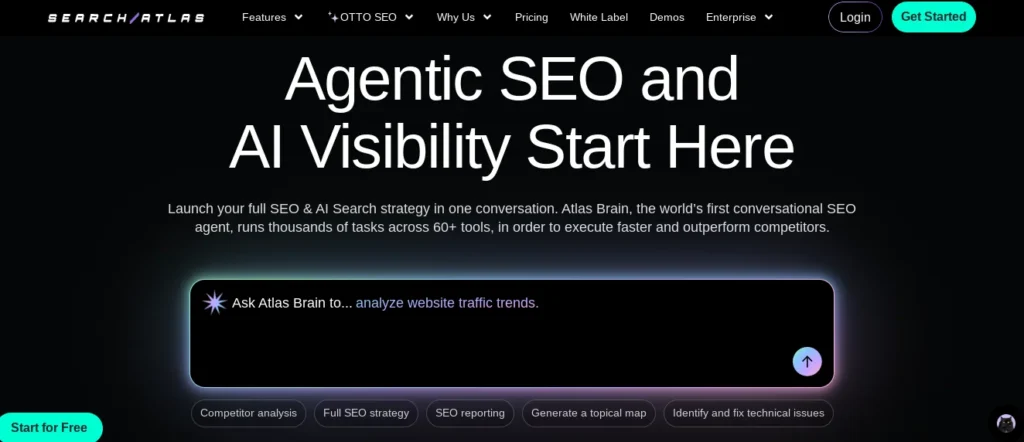
Search Atlas Auto takes a different approach to technical SEO. Instead of auditing and suggesting fixes, it deploys a single line of JavaScript code to your website that automatically implements on-page optimization continuously.
The way it works is genuinely impressive. Once the code is installed through Google Tag Manager or directly in your site’s head section, it starts analyzing and optimizing your pages. It generates improved title tags for pages lacking them. It reads your images and writes descriptive alt text. It adjusts heading structures and improves keyword alignment automatically.
The automation focuses on backend technical elements that are invisible to visitors. Your website design and user experience stay exactly the same. What changes is how search engines and AI crawlers read and understand your content.
Pricing runs from $99 per month for a single site up to $1,999 per month for fifty sites, making it accessible for individual sites and scalable for agencies managing large client portfolios.
Best for: Agencies and businesses wanting continuous automated technical optimization without manual implementation work.
Google Search Console
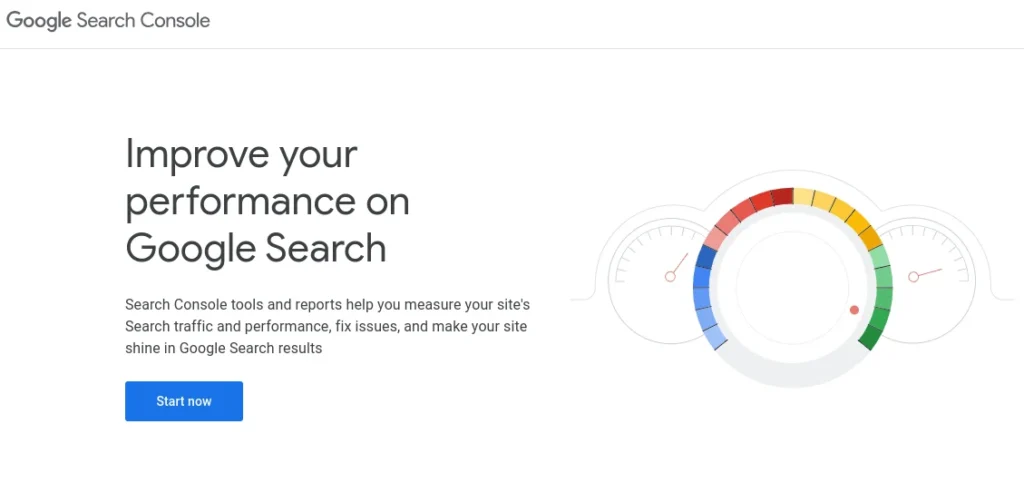
I always mention Google Search Console when discussing technical SEO tools because it provides foundational data that every other tool builds on. It’s completely free and shows you exactly how Google crawls, indexes, and understands your site.
For AI search optimization specifically, Search Console helps you identify indexing issues that would prevent any search engine, including AI crawlers, from accessing your content. It also shows performance data that informs which content deserves optimization priority.
On-page optimization decisions become much clearer when you understand which pages Google already values and which ones struggle to get crawled properly.
Best for: Every website owner regardless of size or budget. This is the non-negotiable starting point.
Automation and Workflow Tools
These tools handle repetitive optimization tasks automatically, freeing you to focus on strategy and content quality rather than mechanical execution.
N8N (Workflow Automation)
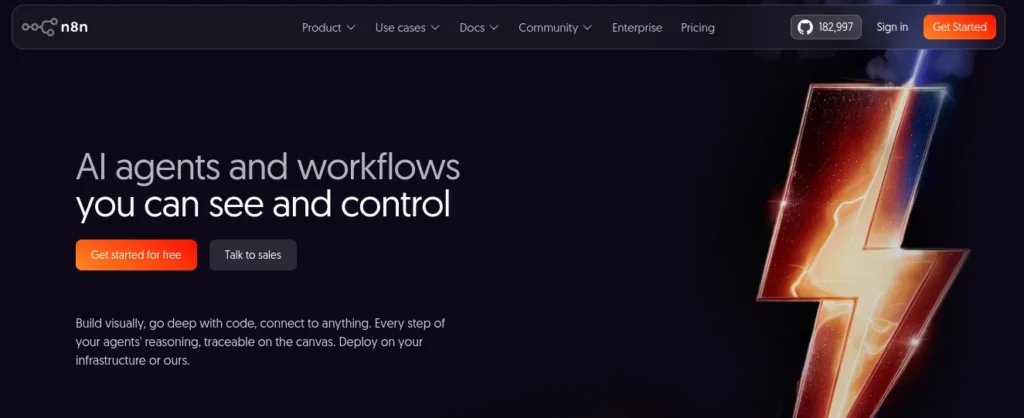
N8N is workflow automation software that lets you build SEO automation systems connecting multiple tools and AI models. The system I’ve seen work most impressively for SEO automation costs less than one dollar per week to run while replacing processes that previously required thousands of dollars in agency fees.
Here’s how a complete content automation workflow functions with N8N. The system pulls content topics from a planning spreadsheet, uses one AI model for research planning, a second for finding accurate facts from live web sources, and a third specifically for writing natural sounding content. It generates relevant images, formats everything properly, and publishes directly to WordPress.
The multi-model approach matters. Using GPT-5 for planning, Perplexity for research, and Claude for writing takes advantage of each model’s specific strengths rather than relying on one model for everything.
For anyone comfortable with a moderate learning curve, N8N offers workflow integration capabilities that no single purpose SEO tool can match. The flexibility to connect any combination of tools creates optimization systems customized to your exact needs.
Best for: Technical users and agency owners wanting to build scalable automated SEO workflows.
Link Robot (WordPress)
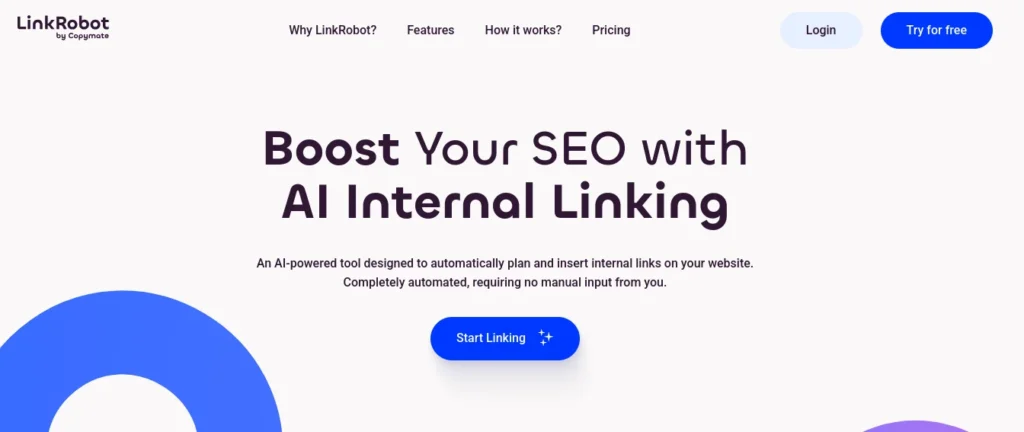
Internal linking is one of those SEO tasks that matters significantly but gets neglected because it’s tedious to do manually. Link Robot automates the identification of internal linking opportunities on WordPress sites.
You add your website, it crawls your content, and it surfaces specific places where you could add links to other pages on your site. The suggestions include the specific pages to link to and the anchor text that makes sense in context.
The limitation worth knowing is that Link Robot works exclusively with WordPress. If your site runs on a different platform, this tool won’t be usable for you.
Best for: WordPress site owners who want systematic internal linking without manual audit work.
Vercel (Hosting for AI Crawl Optimization)
Vercel isn’t an SEO tool in the traditional sense. It’s a hosting platform. I include it here because hosting speed has a direct impact on how often and how deeply AI crawlers visit your site.
AI crawlers, like GPTBot and PerplexityBot, prioritize sites that respond quickly and reliably. Vercel’s built-in content delivery network and speed optimizations make your site more accessible to these crawlers, which increases the frequency of AI indexing.
For anyone building new content projects or considering a hosting migration, Vercel’s performance characteristics make it worth considering specifically from an AI crawl frequency perspective.
Best for: Developers and technical site owners who want infrastructure that supports AI crawler accessibility.
Visual and Engagement Tools
Visual content increasingly influences AI search visibility, especially as AI engines become better at processing images. These tools help you create visual content that improves engagement and supports AI comprehension.
Napkin.ai
Napkin.ai does something surprisingly useful for content publishers. It converts plain text into visual formats like flowcharts, pie charts, mind maps, and process diagrams automatically.
The SEO value comes from two directions. First, visual content increases time on page and reduces bounce rates, which are engagement signals that both traditional search engines and AI engines factor into quality assessments. Second, unique visual content earns backlinks in ways that text alone rarely achieves.
My workflow with Napkin.ai involves taking complex explanatory content that I’ve already written and running it through to generate visual versions. The resulting diagrams often communicate the same information more clearly than paragraphs could. I screenshot the visuals and embed them in the article alongside the text, giving readers multiple ways to absorb the information.
Best for: Content publishers who want to increase article engagement and earn links through distinctive visual assets.
Design Kit
Design Kit uses AI to generate professional lifestyle product images from simple text descriptions. You provide a product image and a descriptive prompt, and it generates multiple scene variations showing your product in realistic settings.
For e-commerce businesses, this capability addresses a genuine operational challenge. Professional lifestyle photography is expensive and time consuming. Waiting weeks for photography results creates delays in launching new products or refreshing existing listings.
The ability to generate consistent brand imagery across different scenes matters for AI search specifically because visual consistency is one signal AI engines use when evaluating brand authority and authenticity. A product catalog with coherent visual style reads as more established and trustworthy than one with inconsistent imagery.
Best for: E-commerce businesses that need professional product imagery at scale without photography costs.
Each tool category I’ve described addresses a specific optimization need. The most effective AI search optimization setups I’ve seen combine tools from multiple categories rather than relying on any single platform to do everything. Start with citation tracking to establish a baseline, add content optimization to improve what you publish, implement technical fixes to remove barriers, and consider automation once you’ve validated what works manually.
Free AI SEO Tools That Actually Work (The Budget-Friendly Stack)
I want to be honest with you about something before diving into this section. When I first started exploring AI search optimization, I assumed I needed to spend hundreds of dollars per month on premium tools to see any meaningful results. That assumption cost me time because I kept delaying action while waiting until I could “afford the right tools.”
The truth is more encouraging. A well chosen stack of free ai tools for seo optimization can deliver roughly 70% of the results that paid tools provide. I’ve tested this personally across multiple websites. The free stack has real limitations, and I’ll be transparent about those. But for anyone starting out or working with a tight budget, the free options available today are genuinely capable.
The key is knowing which free tools are worth your time and how to combine them effectively. Using five mediocre free tools creates confusion. Using four excellent free tools in the right sequence creates a real optimization workflow.
The Free Starter Stack (Get 70% of Results at $0)
Here’s the combination I recommend to anyone who asks me where to start with AI search optimization on a zero budget. Each tool covers a specific need, and together they create a foundation solid enough to produce real improvements in both traditional rankings and AI search visibility.
Google Search Console
Google Search Console is the non-negotiable starting point for any SEO work, including AI optimization. It’s completely free, it connects directly to Google’s own data about your site, and it surfaces information no third party tool can replicate.
I use Google Search Console for three things in my AI optimization workflow. First, I check which pages Google is successfully crawling and indexing. If Google struggles to access your content, AI crawlers will too. Any indexing issues you find here deserve immediate attention before you optimize anything else.
Second, I review the search queries bringing traffic to each page. This reveals gaps between what people search for and what your pages currently address. Those gaps often correspond exactly to the prompts people use when asking AI engines similar questions.
Third, I monitor Core Web Vitals and page experience signals. Page speed and technical health affect how frequently AI crawlers visit your site. Slow pages get crawled less often, which means your updates take longer to be recognized by AI search engines.
Setting up Google Search Console takes about ten minutes if you haven’t done it already. If your site is already connected, spend thirty minutes reviewing the Coverage report, the Performance report, and the Core Web Vitals section. What you find there will shape every optimization decision that follows.
Semrush Free Tier
Semrush offers a meaningful free tier that provides keyword data, basic competitor analysis, and site auditing for up to ten queries per day. That limit sounds restrictive, but for someone just starting with AI search optimization, ten focused daily queries produce more actionable insight than unlimited access to a tool you don’t know how to use yet.
The features I use most on the Semrush free tier are keyword overview for understanding search volume and difficulty, the site audit for flagging technical issues, and the organic research tool for analyzing what keywords competitor pages rank for.
For AI search optimization specifically, Semrush’s free tier helps you understand the traditional search landscape that AI engines use as a starting point when deciding which sources to cite. Knowing which competitors rank traditionally for your target topics tells you whose content AI engines are most likely already familiar with.
Google Gemini (Formerly Bard)
Here’s something I learned that genuinely surprised me. Neil Patel shared a specific keyword research prompt that works extremely well for identifying additional optimization opportunities, and it works on the free version of Google Gemini without needing any paid subscription.
The prompt is straightforward. You ask Gemini to analyze the content on a specific page and recommend other keywords you should target that are related to the ones you’re already pursuing but not currently ranking for. Then you follow up with a second prompt asking Gemini to categorize those keyword suggestions by informational, navigational, and transactional intent.
The reason for using two sequential prompts instead of one combined prompt matters. Giving the AI time to complete one task before moving to the next produces more thoughtful and complete responses. I’ve tested this and the two prompt approach consistently generates better keyword lists than asking everything at once.
This technique turns Gemini into a free keyword research tool that considers your actual content rather than just general topic data. The resulting keyword suggestions are genuinely tailored to your page, which makes them more relevant and actionable than generic keyword tool outputs.
Beyond keyword research, I use Gemini regularly to test how AI engines respond to prompts related to my content topics. When I ask Gemini a question that my articles answer and my content doesn’t appear in the response, that tells me something specific needs to change about how I’ve structured or positioned that content.
AlsoAsked
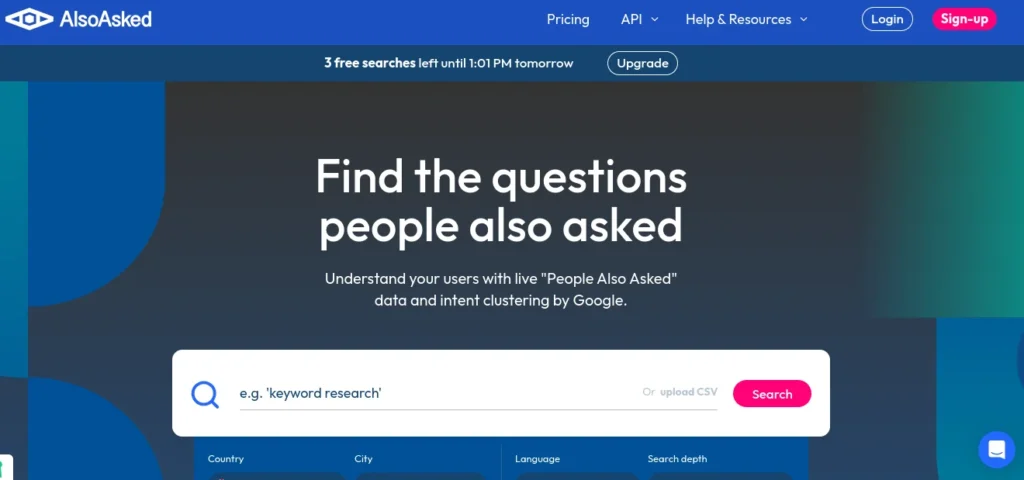
AlsoAsked visualizes the “People Also Ask” questions that appear in Google search results and maps the relationships between related questions. The free tier provides three searches per day, which is enough to research the question landscape around your most important topics.
For AI search optimization, AlsoAsked is valuable because the questions it surfaces closely resemble the prompts people type into AI assistants. When Google shows “People Also Ask” questions, those questions reflect real patterns in how people think and communicate about a topic. Those same thought patterns show up in AI search queries.
I use AlsoAsked to find questions my content should answer but currently doesn’t. Each unanswered question represents both an FAQ section opportunity and a potential AI citation if I answer it clearly and completely.
The visual map that AlsoAsked creates also helps me understand the scope of a topic. Seeing how questions branch from a central topic into related subtopics reveals content gaps that neither keyword tools nor competitor analysis always surfaces.
HubSpot Blog Topic Generator

HubSpot’s free Blog Topic Generator helps when you need content ideas beyond what keyword tools suggest. You enter a general subject, and it returns specific article topic variations you might not have considered.
I use it specifically for finding angles that align with conversational AI queries. The topic suggestions often have a natural, question answering quality that maps well onto how people phrase prompts in ChatGPT or Perplexity.
It’s also useful for breaking out of optimization tunnel vision. After spending time focused on specific keywords, I sometimes lose sight of adjacent topics my audience cares about. Running a few subjects through HubSpot’s generator quickly surfaces ideas that expand my content planning in productive directions.
When to Upgrade to Paid (The ROI Tipping Point)
I promised honesty about the limitations of free tools, and here it is. The free stack I’ve described works well up to a certain scale. Beyond that scale, paid tools stop being a luxury and start being a practical necessity.
Let me explain where the real boundaries are, so you can make a clear eyed decision about when upgrading makes sense for your situation.
The citation tracking gap
The most significant limitation of the free stack is that it can’t directly monitor your AI search citations. You can test manually by typing prompts into Gemini or Perplexity and seeing whether your content appears. But that’s not systematic tracking.
If you’re actively working on AI search optimization, not knowing how often you get cited makes it very difficult to measure whether your efforts are working. You might be making all the right changes and getting significantly more citations without knowing it. Or you might be working hard with no improvement and not realizing it until months have passed.
Paid tools like Writesonic’s GEO tracker, Profound, or Rankscale.ai solve this problem by monitoring citations systematically across multiple AI platforms. Once you’re publishing ten or more articles per month and actively working on AI visibility, the time cost of manual citation checking almost certainly exceeds the monthly cost of a tracking tool.
The query limit problem
Both Semrush’s free tier and AlsoAsked’s free tier impose daily query limits that become genuinely restrictive as you scale content production. If you’re researching keywords for twenty articles per month, ten free Semrush queries per day creates a constant bottleneck that slows down your planning.
The ROI calculation is straightforward at that point. If your time is worth $50 per hour and query limits cause you to spend an extra five hours per month working around them, you’re losing $250 in productive time to avoid a $130 tool subscription. That math doesn’t favor the free option anymore.
The automation threshold
Free tools require manual execution of every task. You manually check keywords. You manually test prompts. You manually audit pages. You manually review citations. That’s completely manageable when you’re managing one or two websites at a small scale.
As soon as you’re managing multiple sites, producing content regularly, or trying to track optimization progress across a meaningful number of pages, manual execution becomes the bottleneck that limits everything else. This is where budget optimization thinking shifts from “how do I avoid paying” to “what’s the minimum I need to spend to remove the bottleneck.”
Paid automation tools like Search Atlas Auto or workflow systems built in N8N handle recurring technical optimization tasks continuously. The scaling strategy changes from “do more work” to “build systems that do the work.” That shift is only possible with tools that go beyond what free tiers provide.
My honest recommendation
Start with the free stack and use it seriously for at least sixty days. Document your starting point by taking screenshots of your AI visibility, your traditional rankings, and your content structure. Then implement optimizations using the free tools and track your progress manually.
After sixty days, assess what’s limiting you most. If it’s citation tracking, invest first in a monitoring tool. If it’s research speed, invest in expanded Semrush access. If it’s content production speed, consider a content optimization or automation tool.
This approach ensures that when you do invest in paid tools, you understand specifically what problem each one solves for your situation. That understanding makes paid tools far more valuable than they would be if you subscribed before knowing what you actually need.
The free stack isn’t permanent for most serious content publishers. But it’s a genuinely productive starting point that builds the knowledge and results you need to make smart paid tool decisions later.
Automated Tools for AI Search Engine Optimization (Set It and Forget It)
Automation changed everything about how I approach SEO. Not because I’m lazy, but because the volume of optimization tasks required to compete in both traditional search and AI search simultaneously is genuinely impossible to handle manually at scale.
When I first mapped out everything that needs to happen for a single article to perform well, I counted over forty individual tasks. Keyword research, content structuring, schema implementation, image alt text, internal linking, citation tracking, performance monitoring, and regular content updates. Multiply that by publishing two articles per week and you have a full time job just in execution, before you even think about strategy.
Automated tools for AI search engine optimization solve this problem by handling the repetitive mechanical tasks while you focus on the thinking work that actually requires human judgment.
I want to share what genuinely works based on real examples, not theoretical possibilities. The automation approaches I’ll describe here are being used by real content publishers and agency owners producing measurable results right now.
The $1 Per Week Full-Stack Automation (N8N Workflow Breakdown)
The most impressive SEO automation system I’ve seen in practice uses N8N as its foundation. N8N is workflow automation software that connects different tools and services through visual logic flows. You don’t need to write code to use it, though coding knowledge lets you customize it further.
The workflow I’ll describe handles the complete content production cycle from topic idea to published article with tracking, and it runs continuously in the background for under one dollar per week in operating costs. Compare that to the $2,000 to $5,000 per month that SEO agencies charge for comparable output, and the value proposition becomes immediately clear.
Here’s exactly how the workflow operates step by step.
Step one: The trigger
The workflow begins with one of two triggers. A manual trigger lets you start it on demand when you want to publish something specific. A schedule trigger runs it automatically at set intervals, publishing new content consistently without any human action required.
I recommend starting with the manual trigger while you’re learning the system. Once you’re confident in the output quality, switching to a scheduled trigger creates truly hands off content production.
Step two: Topic selection from Google Sheets
The workflow connects to a Google Sheet where you maintain your content calendar. Each row contains a topic idea, target keywords, and notes. The automation pulls rows where the status column shows “Not Started,” processes them, and marks them as “Completed” when the article goes live.
This simple tracking system prevents duplicate content and maintains a clear record of what has been published. The Google Sheets integration means your editorial planning lives in a familiar tool you already use, not buried inside the automation platform.
Step three: Planning with GPT-5
The first AI agent in this multi-agent system uses GPT-5 to create a content blueprint. It takes the topic and target keywords from your spreadsheet and generates a rough outline covering the main sections, key points to address, and structural recommendations.
Using GPT-5 specifically for planning takes advantage of its strong logical reasoning and ability to think through complex topic structures. The planning output is a roadmap that guides every subsequent step without locking in final content prematurely.
Step four: Research with Perplexity
The second agent uses Perplexity to find real-time facts, current statistics, and credible sources related to the content plan. This step is critical for accuracy and for avoiding a common problem with fully automated content: AI hallucination.
AI hallucination happens when a language model generates plausible sounding but factually incorrect information. By having a dedicated research agent pull verified information from live web sources before the writing begins, the system grounds the final content in facts that can be independently verified.
Perplexity’s source transparency feature means the research agent doesn’t just find information. It identifies which sources contain that information, which becomes the basis for citations in the final article.
Step five: Writing with Claude 3.5 Sonnet
The writing agent uses Claude 3.5 Sonnet to turn the content plan and research data into a complete article. Claude is specifically chosen for this step because its long form writing produces noticeably more natural and conversational output than other models tested for the same task.
The writing agent receives the full plan from GPT-5 and the research findings from Perplexity, then synthesizes them into coherent, readable content. It also automatically pulls in the titles and URLs of previously published articles from the Google Sheet and weaves relevant internal links throughout the new content.
This internal linking automation alone saves substantial time. Identifying internal linking opportunities manually across a growing content library becomes increasingly time consuming. Having the system handle it automatically keeps every new article well connected to the existing site structure from the moment it publishes.
Step six: Image generation
Once the written content is ready, the workflow sends the article title and summary to an AI image generation service called Google Nano Banana. This service creates realistic featured images relevant to the article topic without requiring stock photo subscriptions or custom photography.
The image generation process includes an error handling loop that checks the generation status every thirty seconds until the image is confirmed complete. This prevents the workflow from breaking if image generation takes longer than expected, which happens occasionally with AI image services.
Step seven: Publishing and tracking
The final steps push everything to WordPress through an API connection. The article content, metadata including title and URL slug, and the generated image all publish together as a complete, formatted post.
The workflow then updates the Google Sheet automatically, marking the topic as completed and logging the published article’s title, summary, and live URL in a separate tracking sheet.
This complete record of published content serves the internal linking function for future articles. Every new article the system writes can reference the library of already-published pieces and add contextually relevant links.
The workflow integration between all these components creates a content operation that runs continuously without daily management. You spend time on strategy, topic selection, and quality review. The system handles execution.
One-Click JavaScript Deployment (Search Atlas Method)
Not everyone wants to build custom workflow automation from scratch. Search Atlas Auto offers a different approach to automation that achieves significant technical SEO improvements through a single line of JavaScript code.
Here’s how it works in practice. After setting up a Search Atlas account and running an initial site audit, you receive a unique JavaScript snippet. You paste this snippet into your website’s head section, either directly or through Google Tag Manager. That’s the complete installation process.
Once installed, the system continuously analyzes your pages and implements technical optimizations automatically. The improvements happen in the background without any manual work after the initial setup.
The JavaScript automation handles several specific technical SEO tasks that are tedious to manage manually at scale.
For title tags, the system identifies pages with missing or weak titles and generates optimized replacements based on the page content and target keywords. This addresses one of the most common technical SEO issues on growing websites where new pages get published without fully optimized titles.
For image alt text, the system reads your images and writes descriptive alt text that accurately describes the visual content. This matters both for accessibility and for how search engines understand your images. The system is reportedly accurate enough to identify specific details in images including, in one demonstrated case, correctly naming specific team members in photographs.
For heading structure, the system evaluates your H1 and H2 tags and suggests improvements where the heading hierarchy is weak or where primary keywords are underrepresented in important positions.
The key advantage of this approach is that the optimization focuses on backend elements that are invisible to your visitors. Your website design stays exactly as you built it. What changes is the technical layer that search engines and AI crawlers evaluate. Users see no difference. Search engines see a significantly more optimized site.
Pricing for Search Atlas Auto starts at $99 per month for a single website and scales to $1,999 per month for fifty websites. The per-site cost decreases substantially at agency scale, making it viable for managing multiple client sites under one subscription.
For websites where you don’t have the technical knowledge or developer resources to implement schema and on-page optimization manually, this JavaScript automation approach provides professional level technical SEO without requiring technical expertise.
WordPress-Specific Automation (Schema and Internal Links)
WordPress users have access to a category of tools that don’t exist for other platforms. Direct WordPress integrations let automation work at a deeper level, connecting with your content management system rather than working around it.
Schema deployment through direct WordPress integration
Several AI SEO tools offer direct WordPress connections that let you implement and update schema markup without touching code. The workflow is straightforward. You connect the tool to your WordPress site using API credentials, select the pages you want to optimize, preview the JSON-LD schema the tool generates, and publish it directly to those pages with one click.
This matters because schema implementation is one of the most technically intimidating parts of AI search optimization. Many site owners understand that schema helps AI engines understand their content but feel uncertain about writing JSON-LD code correctly. Direct WordPress integration removes that barrier entirely.
The schema types most important for AI search visibility are FAQ schema for question and answer content, Organization schema for establishing your entity identity, and Article schema for blog posts and editorial content. A good WordPress integration tool handles all three without requiring you to understand the underlying code structure.
Link Robot for internal linking automation
Link Robot is a WordPress specific tool that automates the identification and suggestion of internal linking opportunities. You add your website or specific pages to the tool, and it crawls your content to find places where you could add links to other pages on your site.
The suggestions come with specific context. The tool shows you exactly which anchor text to use and which pages to link to, not just a general suggestion to add more internal links. This specificity makes implementation fast because you’re not making judgment calls about every individual link.
For content publishers with libraries of fifty or more articles, manual internal linking audits become a serious time investment. Finding every relevant opportunity to link article A to article B to article C across dozens of posts takes hours. Link Robot compresses that work into minutes.
The limitation worth knowing clearly is that Link Robot works exclusively with WordPress. If your website runs on Squarespace, Wix, Webflow, or a custom platform, this particular tool isn’t available to you.
Social posting automation for AI trust signals
One aspect of AI optimization that most people overlook is the role social platforms play in building the trust signals AI engines look for. AI systems evaluate your credibility partly based on how much genuine activity and discussion surrounds your brand across the internet.
Some WordPress connected tools include social campaign management features that create and schedule posts for platforms like Twitter, Pinterest, and other networks. Consistent social activity signals ongoing engagement and brand health, which contributes to the overall trust picture AI engines construct about your site.
I view social automation as a supporting element rather than a primary strategy. It maintains a consistent brand presence without requiring daily manual posting, which is valuable but secondary to the core content and schema optimizations.
The principle connecting all three automation approaches in this section is the same. Identify the tasks that follow predictable patterns and require no unique human judgment, then build or adopt systems that handle those tasks automatically. Reserve your time and attention for the strategic decisions that actually benefit from human experience and expertise.
Workflow automation at this level isn’t about replacing your role in the SEO process. It’s about ensuring the mechanical execution happens consistently and at scale, while your contribution focuses where it genuinely matters most.
The Technical Implementation Guide (What Tools Actually Fix)
Most articles about AI search optimization talk about strategy in broad strokes. Improve your E-E-A-T. Add schema markup. Create better content. That advice is accurate but not particularly useful without knowing exactly what to change and how to change it.
This section is different. I want to show you the specific technical fixes that AI SEO tools identify and implement, so you understand what’s actually happening under the hood when these tools do their work. Whether you implement these manually or use tools to automate them, knowing what needs to change helps you make better decisions.
I’ve spent considerable time studying which technical factors most consistently improve AI search visibility. The patterns are clear. The same issues appear repeatedly across sites that struggle in AI search, and fixing them produces similar improvements across very different types of businesses.
Let me walk through each technical area in detail.
The FAQ Schema Priority (Why This Matters Most)
If I could only make one technical change to improve AI search visibility, I would implement FAQ schema on every important page. The evidence for this is strong and consistent across multiple sources I’ve studied.
Here is why FAQ schema matters so much specifically for AI search. When a user asks ChatGPT, Perplexity, or Google’s AI Overview a question, the AI engine needs to find content that directly answers that question. FAQ schema tells the engine exactly where questions and answers live within your page, in a format it can extract and use without interpreting surrounding text.
Without FAQ schema, an AI engine has to read your entire page, identify which parts look like questions and answers, and decide whether to trust its interpretation. With FAQ schema, you’re handing the engine exactly what it needs in a structured format it reads perfectly every time.
The format that works is JSON-LD, which stands for JavaScript Object Notation for Linked Data. It sounds technical but the structure is actually straightforward. Here is what a basic FAQ schema block looks like in practice:
<script type="application/ld+json">
{
  "@context": "https://schema.org",
  "@type": "FAQPage",
  "mainEntity": [
    {
      "@type": "Question",
      "name": "What is AI search engine optimization?",
      "acceptedAnswer": {
        "@type": "Answer",
        "text": "AI search engine optimization is the process of optimizing your content and website so that AI powered search engines like ChatGPT, Perplexity, and Google Gemini can understand, trust, and cite your content in their responses."
      }
    }
  ]
}
</script>
You add this in the head section of your page or through a schema plugin if you use WordPress. Each question and answer pair from your FAQ section should have a corresponding entry in this structured data block.
One critical implementation detail that many people miss involves JavaScript collapsed content. Many websites use expandable FAQ sections where answers are hidden until a user clicks to reveal them. That design looks clean to human visitors. But AI crawlers often cannot read content that starts collapsed and requires JavaScript interaction to display.
The fix is simple but important. Either keep your FAQ answers visible by default in the HTML, or ensure your FAQ schema contains the complete answer text even if the visual design collapses it on screen. The schema version is what AI crawlers read, so it must contain the full content regardless of how the page looks visually.
I’ve seen sites go from zero AI citations to regular citations simply by adding proper FAQ schema to their main content pages. The content itself didn’t change. The structured data packaging changed, and AI engines suddenly had a reliable way to extract and reference the information.
For WordPress users, several plugins handle FAQ schema automatically. You create FAQ content within the plugin interface and it generates the JSON-LD in the background. For non-WordPress sites, you can either add schema code manually or use tools that inject it through a script in your page header.
llms.txt Files (Explicit AI Permissions)
This is one of the most underused technical optimizations available, and it costs nothing but a few minutes to implement. Most website owners have never heard of llms.txt files, which means creating them gives you an immediate advantage over competitors who don’t know about them.
Here’s what these files are and why they matter for your AI crawl permissions.
You’re probably familiar with robots.txt, the file that tells search engine crawlers which parts of your site they can and cannot access. The llms.txt files serve a similar purpose specifically for AI crawlers like GPTBot from OpenAI, PerplexityBot, ClaudeBot from Anthropic, and other AI systems that crawl the web.
When AI crawlers visit a website, some of them check for these permission files before deciding how deeply to crawl and how they can use the content they find. A site with explicit permission files signals cooperation with AI indexing. A site without them may receive less thorough crawling because the crawler has less clarity about what it’s allowed to do.
The llms.txt file specifically addresses Large Language Model training and indexing permissions. It can include links to your sitemap, specify which content sections are most important, and provide metadata that helps AI systems understand your site’s purpose and content categories.
Creating these files is straightforward. You create plain text files and place them in your website’s root directory, accessible at yourdomain.com/ai.txt and yourdomain.com/llms.txt.
A basic llms.txt file contains sections like this:
# Site information
> Your site name and description

# Important pages
- [Page Title](URL): Brief description of what this page covers
- [Page Title](URL): Brief description of what this page covers

# Sitemap
- [sitemap.xml](https://yourdomain.com/sitemap.xml)
The exact format continues to evolve as these standards develop, but the core principle is providing AI crawlers with clear information about your site and explicit permission for indexing and citation.
I want to be transparent about something here. These files are relatively new and their impact on AI search visibility is still being measured by the broader SEO community. However, the logic behind them is sound and creating them requires minimal effort. The potential upside of increased crawl frequency and clearer AI indexing permission is worth the few minutes it takes to implement them.
Think of it this way. If a delivery driver is trying to decide between two similar packages to deliver first and one has clear labeling while the other has none, they’ll default to the clearly labeled one. These permission files are clear labeling for AI crawlers.
E-E-A-T Implementation Checklist (Author Bios and Trust Signals)
Understanding E-E-A-T as a concept is straightforward. Actually implementing the signals that demonstrate Experience, Expertise, Authoritativeness, and Trustworthiness requires specific concrete actions.
I put together this checklist based on what AI engines actually look for when evaluating whether a source is trustworthy enough to cite. Work through it systematically rather than trying to do everything at once.
Author bio requirements
Every article on your site should have an author bio that includes specific verifiable information. A generic “Written by the team” attribution does nothing for AI trust signals.
Your author bio needs:
A full real name connected to the article. Anonymous or pseudonymous content receives lower trust signals from AI engines.
A brief description of relevant experience and credentials. Not a vague “expert in digital marketing” statement but specific information like “ten years managing SEO for software companies” or “certified Google Analytics professional since 2018.”
Links to professional profiles. A LinkedIn profile, Twitter account, or personal website where the author’s identity can be independently verified.
A photograph if possible. Visual confirmation that a real person wrote the content contributes to authenticity signals.
For sites where one person writes most content, this is simple to set up once and maintain. For sites with multiple contributors, each author needs their own profile page with this information rather than a shared generic bio.
Business information signals
AI engines verify business legitimacy through multiple data points, and inconsistencies between those data points lower your trust score.
Your business information requirements include:
Founding date or years in operation. AI engines use this to assess how established your entity is. A business that has operated for seven years carries more inherent trust than one without any age information.
Physical address if applicable. Not every online business has a location, but for those that do, consistent address information across your website and business directories matters significantly.
Phone number in consistent format across all platforms. The NAP consistency issue I mentioned in earlier sections applies directly here. Check your main website, your Google Business Profile, Yelp, and any industry directories where your business appears.
License numbers, certifications, or professional memberships if relevant to your field. An accountant listing their CPA credentials, a contractor listing their license number, or a medical professional listing their certifications all provide AI engines with verifiable authority markers.
Contact information that actually works. A visible contact page with a real email address or phone number demonstrates accountability.
On-page trust signals
Beyond author and business information, your individual pages need signals that demonstrate the content is accurate and current.
Include publication dates and last updated dates on every article. AI engines prioritize fresh information, and showing when content was last reviewed demonstrates ongoing maintenance.
Cite your sources. When you reference statistics, studies, or specific claims, link to the original source. AI engines cross-reference information and content that cites verifiable sources receives higher confidence scores.
Be transparent about your perspective and potential limitations. Content that acknowledges what it doesn’t cover or where expert consultation is advisable reads as more honest and trustworthy than content that presents itself as the complete answer to every question.
Content Structure AI Engines Prefer
The way you organize and present information affects how easily AI engines can extract and cite it. Structure isn’t just about readability for human visitors. It directly impacts how AI systems process and use your content.
Quick Answer sections at the top
Place a direct answer to your main topic question within the first two to three paragraphs of every article. Don’t make readers or AI crawlers scroll to find the core information.
This Quick Answer section should be concise, typically two to four sentences, and should directly address the primary query your article targets. Think of it as the answer you’d give if someone asked you the question in an elevator and you had thirty seconds to respond.
I started adding explicit Quick Answer boxes to my articles about eight months ago. The improvement in AI citation frequency was noticeable within about six weeks. The content below the Quick Answer section provides depth and context, but the Quick Answer gives AI engines an immediately extractable response.
Key Takeaways sections
Including a Key Takeaways section, either near the top after your introduction or at the end of longer articles, gives AI engines a structured summary of your main points.
Format this as a simple bulleted list of three to five concrete statements. Each bullet should stand alone as a meaningful piece of information. Avoid vague points that only make sense in the context of reading the full article.
Expanded FAQ sections
As discussed in the schema section, your FAQ content should be visible in the HTML by default. The semantic relevance of question and answer formatting extends beyond schema. AI engines recognize question patterns and prioritize content that directly addresses questions in a clear structured format.
Write your FAQ questions the way real people actually phrase them when talking to an AI assistant. Conversational and specific is better than formal and general. “How long does it take to see results from AI SEO?” performs better as an FAQ question than “What is the timeline for AI search optimization results?”
Conversational heading structure
Your H2 and H3 headings should sound like questions or statements a real person would make, not like formal document section titles.
Instead of “Schema Implementation Methodology,” write “How to Add FAQ Schema to Your Website in 10 Minutes.” Instead of “E-E-A-T Signal Analysis,” write “Why AI Engines Trust Some Sites More Than Others.”
Conversational headings serve two purposes simultaneously. They match the natural language patterns that users type into AI assistants, which improves the chance of your specific headings being referenced in AI responses. They also make your content more readable and engaging for human visitors, which improves the behavioral signals that both traditional and AI search engines track.
The combined effect of all these technical implementations compounds over time. Each individual fix produces modest improvement. Implementing them together creates a site that AI engines can read clearly, trust fully, and cite confidently.
I’d suggest working through these changes in priority order. Start with FAQ schema since it has the most direct impact on AI citations. Add ai.txt and llms.txt files next since they take five minutes and cost nothing. Then work through the E-E-A-T checklist systematically. Finally, audit your content structure and update headings and answer sections as you publish new content and refresh existing articles.
Beyond Your Website: The Omni-Channel AI Visibility Strategy
Here’s something that took me a long time to fully accept. Having a well optimized website with excellent content and proper schema markup is necessary but no longer sufficient for AI search visibility.
I spent the first several months of my AI search optimization journey focused almost entirely on my own website. Better content structure, improved schema, stronger author bios, faster page speed. All of those things helped. But I kept noticing that certain competitors with weaker websites appeared in AI responses more consistently than my more technically polished site.
When I investigated why, the answer was uncomfortable but clear. Those competitors existed beyond their own websites in ways I didn’t. They had Reddit threads discussing their work. They had Quora answers that referenced their content. They had customer reviews on multiple platforms. They appeared in podcast conversations and YouTube discussions.
AI engines don’t evaluate your website in isolation. They evaluate your presence across the entire internet and use that broader picture to determine how trustworthy and authoritative you are. Cross-platform optimization isn’t a bonus strategy. It’s a core requirement for serious AI search visibility.
The insight that crystallized this for me was understanding how AI engines actually construct trust. They don’t just read your website and decide whether to trust you based on what you say about yourself. They research you the same way an intelligent person would research an unfamiliar brand before trusting a recommendation. They look for what other people say about you in places you don’t control.
Why Reddit and Quora Matter More Than You Think
Reddit and Quora have become disproportionately important for AI search visibility, and most content publishers underestimate just how much.
AI engines treat user generated content differently from brand owned content. When your own website says you’re an expert, that’s expected and carries limited weight. When an independent person on Reddit recommends your tool or cites your research in a thread where they have no financial stake in promoting you, that’s a trust signal of a completely different quality.
I’ve observed this pattern repeatedly. Articles I’ve written get cited by AI engines much more consistently when those same topics have active Reddit discussions that reference my work. The correlation is strong enough that I now treat Reddit thread engagement as a meaningful indicator of AI search performance.
The important distinction here is between genuine community participation and promotional activity. Reddit users are perceptive and the moderation culture on most subreddits actively discourages self-promotion. Showing up on Reddit with the goal of promoting your content usually backfires and can damage your reputation.
The approach that actually works is authentic participation. Find subreddits where your target audience discusses topics you cover. Contribute genuinely helpful answers to questions even when you can’t reference your own content. Build a presence as a knowledgeable community member first. Over time, as you establish credibility in a community, occasional references to your own work become natural and accepted rather than promotional.
Quora operates similarly but with a different community culture. Questions on Quora tend to stay relevant longer than Reddit posts, and a well written Quora answer can accumulate views and engagement over months or years. I’ve had Quora answers that I wrote a year ago still driving engagement today, and those answers include contextually appropriate references to related content on my site.
The user generated content value extends beyond what you contribute yourself. When others mention your brand, cite your research, or recommend your content on these platforms without your involvement, the trust signal is even stronger. Earning those organic mentions happens through producing content good enough that people want to share it, not through any optimization tactic.
To encourage this kind of organic mention, I make my content genuinely shareable and easy to reference. Clear statistics that people can cite in their own discussions. Unique perspectives or original research that gives people something new to share. Specific examples that illustrate points in ways that feel natural to quote.
Building omni-channel presence on Reddit and Quora also gives you valuable intelligence. Seeing what questions your target audience asks in these communities, what frustrations they express, and what solutions they’re looking for directly informs better content creation on your own site.
Multi-Format Content Strategy (Text + Video + Audio)
One of the most significant shifts I made in my content approach was stopping the practice of creating content in one format and calling it done. A blog post is not finished when the text is published. It becomes fully developed when it exists in multiple formats that different audiences and different AI indexing systems can discover.
AI engines increasingly index content across formats, not just text. YouTube videos appear in AI responses. Podcast episodes get cited. Infographics get referenced. If your expertise only exists in written form, you’re limiting your discoverability across a growing portion of how AI engines gather information.
The good news is that content repurposing doesn’t require creating everything from scratch. A thorough blog article contains enough material to generate multiple other formats without duplicating your research effort.
Here’s how I approach multi-format content creation from a single piece of research.
From article to video
A 2,500 word article typically contains enough substance for a 10 to 15 minute YouTube video. I don’t read the article on camera. I use it as a research foundation and speak conversationally about the same topic. The video often covers the same core ideas but with different examples and a more conversational flow.
YouTube videos matter specifically because YouTube content gets indexed by AI engines as authoritative sources, particularly for tutorial and explanatory content. When someone asks an AI assistant how to do something, YouTube tutorials frequently appear in the cited sources alongside written articles.
From article to podcast or audio
Many content publishers overlook audio entirely, but podcast content and audio summaries serve an audience that prefers listening over reading. Converting your main article points into a 10 to 20 minute audio discussion, either solo or as a conversation with someone else in your field, creates a format that AI systems trained on podcast transcripts can discover.
The podcast ecosystem is also a source of citation opportunities. Other podcasters researching topics in your niche may discover your audio content and reference it, creating the kind of third party mention that strengthens your overall authority profile.
From article to visual formats
Infographics, data visualizations, and illustrated explanations attract shares and links in ways that text rarely does. When your infographic gets shared in a Reddit thread or embedded in another website’s article, it creates brand visibility mentions and backlinks that support your authority with both traditional and AI search engines.
Tools like Napkin.ai make this more accessible than it used to be. You can convert text summaries into charts, flowcharts, and mind maps without design skills. The resulting visuals are genuinely useful and shareable, not just decorative.
The cumulative effect of existing across multiple formats is that AI engines encounter your expertise from multiple directions. They see your written articles. They find your YouTube explanations. They encounter your insights referenced in podcast discussions. Each format reinforces the same authority signals and increases the overall data density around your brand.
The Review and Social Proof System
Reviews are one of the most powerful forms of user generated content for AI search authority, and most businesses leave enormous value uncaptured by not actively building their review presence.
When AI engines research your brand’s trustworthiness, they look at what real customers say about you. Not just on your own website where you control the narrative, but on independent review platforms where customers speak freely. Google reviews, Trustpilot, G2, Capterra, industry specific review sites, and social media testimonials all factor into the trust picture AI engines construct.
I’ve noticed that businesses with strong, detailed, and recent reviews appear in AI recommendations more consistently than technically superior businesses with sparse or generic review profiles. The quantity and quality of customer voices talking about you matters.
The type of reviews that carry most weight are specific and detailed. A review that says “Great service, highly recommend” doesn’t give AI engines much to work with. A review that says “I used their keyword research tool for three months and my AI search citations increased by 40%” provides specific, verifiable, useful information that AI engines can actually reference.
Photo and video reviews carry even more authority than text reviews alone. When a customer photographs the results they achieved or records a short video talking about their experience, that multi-modal content gives AI engines richer information to work with. Encourage customers to include photos or screenshots with their reviews when it makes sense to do so.
Building a review system that generates quality responses regularly requires more than just asking customers to leave a review. The timing, the ask, and the simplicity of the process all affect response rates.
I’ve found that the most effective approach is reaching out to customers at the moment they’ve just had a positive experience. That might be right after they achieve a specific result using your product, shortly after a successful project completion, or following a support interaction that resolved their issue well.
Make the review process as simple as possible. Provide a direct link to your review profile rather than expecting people to find it themselves. Mention that honest feedback helps other customers make good decisions, which frames the request as genuinely helpful rather than promotional.
Responding to existing reviews also signals to AI engines that your business is actively engaged. A business that responds thoughtfully to feedback, including critical feedback, demonstrates accountability and genuine customer focus. Those responses become part of your overall content presence and contribute to the trust signals AI systems evaluate.
The goal of your social proof system isn’t just star ratings. It’s building a body of authentic customer voices that collectively demonstrate real people with real experiences choosing and benefiting from your product or service. That body of evidence, distributed across platforms you don’t control, creates the kind of independent validation that AI engines weight heavily when deciding whether to recommend you.
Putting this all together, brand visibility in AI search is not a solo effort centered on your website. It’s a network effect. The more authentic presence you build across platforms, formats, and third party references, the more data points AI engines have to confirm your authority and trustworthiness.
Each new format you produce creates another discovery path. Each genuine community contribution creates another trust signal. Each customer review adds another independent voice to your reputation. Together these signals build a profile of your brand that AI engines recognize as genuinely established and worthy of recommendation
The 5 Biggest Mistakes When Using AI SEO Tools (Avoid These)
I’ve made most of these mistakes myself. Some cost me weeks of wasted effort. Others quietly limited my AI search visibility for months before I figured out what was wrong.
The frustrating thing about common mistakes in AI search optimization is that they’re often invisible. Your website looks fine. Your content reads well. Your traditional SEO metrics might even be strong. But something beneath the surface is preventing AI engines from crawling, trusting, or citing your content.
I want to share these mistakes directly and honestly because most articles about AI SEO tools focus entirely on what to do and skip the equally important question of what not to do. Avoiding these pitfalls will save you significant time and protect you from building optimization efforts on a flawed foundation.
Technical Mistake Number 1: JavaScript-Collapsed Content
This is the mistake I see most frequently and the one that surprises people most when I explain why it’s a problem.
Many websites use expandable content sections for FAQs, pricing tables, product details, and long form explanations. The design logic makes sense from a user experience perspective. Collapsible sections keep pages cleaner and less overwhelming. Visitors can expand the sections they want to read and ignore the rest.
The problem is how AI crawlers interact with JavaScript dependent content. When a crawler visits your page, it reads the HTML that loads immediately. Content that requires a user to click a button before it appears is often invisible to crawlers because they don’t simulate the click interaction.
I tested this directly on one of my own sites. I had a detailed FAQ section with twelve questions and thorough answers. All twelve questions were collapsed by default using a common accordion JavaScript design. I had FAQ schema implemented correctly and was confident the section would help with AI search visibility.
When I checked my AI citation tracking tool, I noticed that none of my FAQ answers were appearing in AI responses even for questions my FAQs answered perfectly. After investigating, I discovered that the collapsed format meant AI crawlers were reading the question headings but not the answer content hidden inside the collapsed sections.
The fix is straightforward. Either set your FAQ content to be visible by default in the HTML, meaning answers display openly without requiring any click, or ensure your FAQ schema contains the complete answer text even when the visual design collapses it on screen.
The schema approach works because AI crawlers read your structured data separately from the visual HTML. If your JSON-LD FAQ schema contains the full question and answer text, crawlers can extract it regardless of how the page looks visually.
I now test every important page by viewing the page source and confirming that key content appears in the raw HTML rather than being injected by JavaScript after the page loads. If crucial content only exists in JavaScript dependent elements, it needs to be restructured for proper crawlability.
Related to this same category of technical implementation errors is failing to create ai.txt and llms.txt files. As I covered in the technical implementation section, these files signal explicit permission to AI crawlers and can influence how frequently and thoroughly they visit your site.
Not having these files doesn’t prevent AI crawling entirely. But in a competitive environment where small advantages compound over time, giving AI crawlers a clear signal of cooperation costs nothing and potentially improves your crawl frequency.
Trust Mistake Number 2: Missing External Validation
This is the mistake that comes from a completely understandable place. You’ve built a website. You’ve created content. You’ve optimized your pages. Of course you talk about yourself on your own platform. Where else would you share your expertise?
The problem is that AI engines fundamentally distrust self-referential authority. When you say on your own website that you’re an expert, an AI engine essentially registers that as expected behavior rather than evidence. Every website claims to be authoritative. That claim means very little without external confirmation.
The external validation that AI engines actually weight heavily comes from places you don’t control. Reddit threads where someone recommends your article without you being involved in the conversation. Quora answers that cite your research. Industry newsletters that feature your content. Podcast hosts who mention your work. Customer reviews on platforms where you can’t edit or curate responses.
I noticed this pattern when I analyzed which of my articles got cited most consistently by AI engines. The articles that performed best in traditional SEO weren’t always the ones getting cited in AI responses. The articles getting cited were the ones that had attracted organic mentions in third party discussions.
One article I wrote about content automation had been shared in three separate Reddit threads by readers I’d never interacted with. Those organic community shares apparently gave that article significantly more AI credibility than others on my site with stronger traditional SEO metrics.
The implication is that building external validation needs to become part of your content strategy, not an afterthought. This doesn’t mean manufacturing fake mentions or spamming forums with links to your content. It means creating content genuinely worth sharing, participating authentically in communities where your audience gathers, and making it easy for satisfied customers and readers to discuss your work publicly.
Actively gathering and encouraging detailed customer reviews on independent platforms builds the kind of third party evidence base that AI engines look for. When multiple independent voices describe similar experiences with your product or service, that consistency creates confidence for AI systems evaluating your trustworthiness.
The shift in mindset required here is moving from “how do I tell people I’m credible” to “how do I create enough genuine value that others tell people I’m credible on my behalf.”
Content Mistake Number 3: Ignoring Multi-Format Distribution
Most content publishers create one format per idea and consider the work complete. An article gets written, published, and promoted. Maybe it gets a social media post. Then attention moves to the next article.
This approach severely limits your AI search discoverability because AI engines index content across multiple formats and platforms, not just blog posts and web pages.
When someone asks an AI assistant about a topic you cover, the AI might draw on YouTube videos, podcast transcripts, Reddit discussions, Quora answers, and industry forum posts in addition to traditional articles. If your expertise only exists in written articles on your own domain, you’re absent from a significant portion of the sources AI engines consult.
I started tracking which content formats appeared in AI responses for topics relevant to my niche. The pattern showed consistent multi-format representation. AI answers regularly cited YouTube explanations, included perspectives from Reddit discussions, and referenced podcast conversations alongside written articles. Text-only content strategies limit content distribution to a fraction of the available discovery paths.
The practical fix doesn’t require starting from scratch with every piece of content. Most well researched articles contain enough substance to generate two or three additional format variations without repeating your research process.
A 2,000 word article on a technical topic can become a 12 minute YouTube explanation where you talk through the same concepts conversationally. That same article can become a podcast episode where you discuss the topic with a colleague or simply narrate your key points in audio form. Key statistics and frameworks from the article can become shareable visual content that gets embedded in other websites and shared in community discussions.
Each format creates an additional entry point for AI engines to encounter your expertise. The cumulative effect of appearing across multiple formats is that AI engines develop a more complete picture of your authority on a topic, which increases their confidence in citing you as a reliable source.
Multi-format content distribution also protects your visibility against changes in any single platform’s behavior. If your strategy depends entirely on written articles ranking in traditional search, algorithm changes create significant vulnerability. Diversifying across formats means changes to one channel don’t eliminate your discoverability.
The Misconception Mistake Number 4: Believing AI Content Automatically Won’t Rank
This mistake doesn’t show up in analytics. It shows up in the decisions people make before they even start creating content.
I’ve spoken with content publishers who completely avoid AI writing assistance because they’re convinced Google penalizes anything AI touches. They spend three times as long producing content manually, publish less frequently than competitors, and cover fewer topics as a result. Meanwhile, competitors using AI assistance thoughtfully are outproducing them on every metric that matters.
The fear comes from a real place. When Google first started talking seriously about AI-generated content, the messaging felt cautionary. Many SEO professionals interpreted early guidance as a warning against using AI for content at all.
Google’s actual position is more nuanced and more practical than that interpretation. What Google penalizes is low quality content that fails to help users, regardless of how it was created. A human written article full of vague generalities and inaccurate information performs worse than a carefully reviewed AI assisted article that provides specific, accurate, and genuinely useful information.
The framework Google introduced to evaluate content asks three questions. Who created or reviewed the content and do they have relevant knowledge? How was the content produced, meaning was there a quality process involved? Why was the content created, to genuinely help readers or purely to generate search traffic without caring about reader value?
I apply those three questions to every piece of content I publish, whether I wrote it entirely myself, used AI assistance for drafts, or combined both approaches. When I can answer all three questions honestly and positively, the content performs well regardless of the production method.
The practical implication is straightforward. Use AI writing tools as productivity aids that help you produce more thorough content more efficiently. Add your own expertise, verify facts independently, include specific examples from real experience, and review everything before publishing. The output should reflect genuine knowledge and provide real value. How it got there matters far less than whether it achieves that goal.
Letting unfounded fear of AI content penalties limit your production capacity is a mistake that compounds over time. While you publish one article per week entirely by hand, a competitor using AI assistance thoughtfully publishes four. After six months, they have comprehensive topical coverage while you have gaps that leave entire audience questions unanswered.
The Impatience Mistake Number 5: Optimizing Once and Moving On
This is the mistake I see most often among people who understand AI search optimization intellectually but don’t see results and eventually give up.
They implement schema markup, update their author bios, create ai.txt files, improve their FAQ structure, and then check their AI citation tracking tool two weeks later. The numbers haven’t changed dramatically. They conclude that AI search optimization doesn’t work for their site and redirect their energy elsewhere.
AI search visibility builds through a compounding process that operates on a longer timeline than most people expect. The initial technical fixes remove barriers. The content improvements increase quality signals. The external mention building takes months of consistent community participation. The multi-format distribution requires producing and distributing content across channels that take time to gain traction.
None of these changes produce dramatic overnight results. Each one moves the needle incrementally, and the combination of all of them working together creates cumulative improvement that becomes significant over a three to six month timeline.
I track my AI search visibility monthly rather than weekly for exactly this reason. Weekly snapshots create misleading signals because AI search citation patterns fluctuate based on query volume, content freshness in the broader index, and what competitors are publishing. Monthly comparisons reveal genuine trends rather than noise.
The businesses I’ve seen succeed consistently with AI search optimization share one characteristic. They implement changes methodically, track results patiently, and continue building their presence regardless of whether short term metrics move immediately.
Content freshness also plays a specific role in AI search that creates an ongoing requirement for attention. AI engines favor current information and regularly update their sources as new content appears. An article that earns strong AI citations in January might lose ground by July if competitors publish fresher, more thoroughly updated versions and you’ve made no improvements to your original piece.
I build content review cycles into my publishing calendar. Every article gets a review at the six month mark where I check whether statistics are still current, whether new tools or developments deserve mention, and whether the structure still matches what AI engines prefer for that topic. This regular maintenance keeps content competitive in AI search over time rather than letting it decay.
The mistake isn’t failing to see immediate results. The mistake is interpreting the absence of immediate results as evidence that the strategy isn’t working and abandoning it before the compounding effect has time to develop.
Patience combined with consistent execution is genuinely the competitive advantage in AI search optimization right now. Most people try a few things, see modest early results, and move on. The people who build real AI search visibility are the ones who treat it as a long term investment requiring sustained attention rather than a one time technical project.
Your 4-Week AI SEO Implementation Roadmap (Start Here)
Everything I’ve covered in this article can feel overwhelming when you try to think about it all at once. Schema markup, ai.txt files, citation tracking, multi-format content, Reddit presence, automation workflows, author bios, NAP consistency. The list of things to potentially do is long enough to cause paralysis.
I’ve been there. I remember staring at my initial AI visibility audit results and feeling genuinely uncertain where to start. Every item on the list felt urgent. Every tool seemed essential. Every strategy looked like it deserved immediate attention.
The solution isn’t working harder or moving faster. It’s working in the right sequence. Some optimizations only produce results after other foundations are in place. Implementing things in the wrong order wastes effort and delays results. The implementation roadmap I’m sharing here reflects the sequence that consistently produces the clearest results in the shortest time.
This is a realistic four-week plan designed for someone with limited time who needs to make meaningful progress without quitting their day job. Each week has a focused set of actions with a clear purpose. You’ll know exactly what to do, why it comes first, and what you’re trying to accomplish before moving to the next phase.
Getting started with this roadmap requires no paid tools in the first week. You can begin right now with what you already have access to.
Week 1: Audit Your Current AI Visibility
Before you change anything, you need to understand where you actually stand. Most people skip the audit phase because they’re eager to start implementing. That’s a mistake. Optimizing without a baseline is like trying to improve your fitness without knowing your starting point. You can’t measure progress, and you risk focusing on problems that don’t actually exist while missing the ones that do.
Your Week 1 goal is simple. Run a complete AI visibility audit, document your current state, and identify your top three specific fixes.
Day 1 and 2: Run your AI visibility audit
Start with Google Search Console if you haven’t already set it up. Connect your site, verify ownership, and check the Coverage report to identify any indexing errors. Pages with crawl errors are invisible to both traditional search engines and AI crawlers. Fix any critical indexing issues before doing anything else.
Next, manually test your AI search visibility. Open ChatGPT, Perplexity, and Google Gemini. Type in the questions your target audience would ask that your content answers. Note which of your articles appear in citations and which don’t. This manual baseline takes about thirty minutes but gives you concrete before data to compare against in week four.
If you have access to a dedicated AI audit tool like Serpsling, run your site through it and save the results document. The score itself is less important than the specific issues it surfaces. A site scoring 59 out of 100 has specific named problems you can address. Focus on understanding what those problems are rather than fixating on the number.
Day 3 and 4: Analyze your competitors’ AI presence
Run the same manual AI search tests for your top three competitors. Ask the same questions you asked for your own site and note which competitors appear regularly in AI responses. Study their content structure. Look at their FAQ sections. Check whether they have author bios. Note the types of questions their content answers directly.
This competitive intelligence reveals what AI engines in your space already recognize as authoritative. You’re not copying competitors. You’re identifying the standards you need to meet and where you have opportunities to do things they don’t.
Day 5, 6, and 7: Create your priority fix list
Compile everything you found into a simple priority list. Order items by impact versus effort. High impact fixes that require minimal technical knowledge go to the top of your Week 2 list. Complex technical changes that require developer involvement go lower.
The three issues that almost always appear at the top of this list for sites new to AI search optimization are missing or incomplete FAQ schema, missing author bio information, and NAP inconsistencies across platforms. Check specifically for all three during your audit week so you arrive at Week 2 knowing exactly what to fix first.
Week 2: Fix Critical Technical Issues
Week 2 is execution week. You have your audit findings. Now you implement the fixes that remove the biggest barriers between your content and AI search citations.
Don’t try to fix everything this week. That approach leads to half-implemented changes across ten different areas, which produces less improvement than fully completing the three highest priority fixes. Depth over breadth is the right philosophy for Week 2.
Schema markup implementation
Start with FAQ schema because it has the most direct and measurable impact on AI citation frequency. Go through your five most important articles and identify the natural questions and answers within each one. For each article, create JSON-LD FAQ schema containing those question and answer pairs.
If you use WordPress, a schema plugin simplifies this significantly. You enter your FAQ content through the plugin interface and it generates the correct JSON-LD automatically. For non-WordPress sites, you can write the JSON-LD manually following the format I described in Section 8 and paste it into your page head section.
After implementing FAQ schema, validate it using Google’s Rich Results Test tool. This free tool checks whether your schema is correctly formatted and shows you exactly how it will appear to crawlers. Fix any validation errors before moving on.
NAP consistency audit and correction
Search for your business name across Google Business Profile, Yelp, local directories, and any industry platforms where your business appears. Create a simple spreadsheet listing your business name, address, and phone number exactly as they appear on each platform.
Identify every inconsistency. Different phone number formats count as inconsistencies even if the digits are the same. Address abbreviations that differ between platforms count as inconsistencies. Correct every variation until all platforms show identical information.
This takes longer than it sounds but the trust signal improvement is significant, particularly for local businesses trying to appear in AI recommendations for location-specific queries.
Author bio implementation
Add detailed author bios to every article on your site. Each bio needs a full name, specific credentials or experience relevant to the topic, and links to professional profiles where the author’s identity can be independently verified.
If one person writes most of your content, create a dedicated author page with comprehensive information and link every article to that page. If you have multiple contributors, each needs their own author page with information specific to their expertise.
Create your llms.txt files
At some point during Week 2, spend twenty minutes creating file and uploading them to your site’s root directory. Follow the format I described in Section 8. The effort is minimal and the potential crawl frequency benefit makes it worth doing during this foundational week.
By the end of Week 2, you should have FAQ schema on your key pages, consistent business information across all platforms, complete author bios on every article, and AI permission files in place. These four changes address the most common technical barriers to AI search visibility.
Week 3: Build Your Omni-Channel Footprint
With your technical foundation solid, Week 3 shifts focus outward. You’ve made your website as readable and trustworthy as possible for AI engines. Now you start building the external presence that tells AI engines other people trust you too.
This week feels different from the previous two because the results are less immediately measurable. Technical fixes produce changes you can verify within days. Building external presence takes weeks and months to show up in AI citation patterns. That’s normal and expected. Start the process now so it has time to compound.
Day 1 and 2: Platform profile setup
Create or complete profiles on Reddit, Quora, LinkedIn, and any industry specific forums or communities where your target audience spends time. These profiles should be complete with real information, genuine profile photos, and bios that establish your relevant background.
The quality of these profiles matters because AI engines evaluate the credibility of sources that mention you. A mention from an established community member with a complete profile carries more weight than a mention from an account created yesterday with no history.
If you already have profiles on these platforms, spend time completing any missing information and ensuring your bio accurately reflects your current expertise and focus areas.
Day 3 and 4: Initial community contribution
Spend one to two hours on Reddit finding three to five subreddits where your target audience discusses topics related to your content. Read recent posts and identify questions you can answer from genuine experience.
Write helpful, specific answers to two or three questions. Don’t reference your own content yet. The goal in Week 3 is establishing a presence as a genuine community contributor, not promoting your work. Trust comes first.
Do the same on Quora. Search for questions related to your core topics and write thorough, helpful answers. Quora answers have longer shelf lives than Reddit posts, so prioritize questions with ongoing search traffic rather than very recent trending discussions.
Day 5, 6, and 7: Content seeding strategy
Review your existing content and identify two or three pieces that provide specific, citable information. Statistics, original research, unique frameworks, or particularly thorough explanations make content most naturally reference worthy.
Find existing discussions on Reddit or Quora where your citable content would genuinely add value. Contribute to those discussions with helpful context. When it fits naturally and adds genuine value to the conversation, mention that you’ve written about this topic in more detail. The reference should serve the community member asking the question, not primarily serve your promotional goals.
Also reach out to two or three of your most satisfied customers or readers this week. Ask whether they’d be willing to leave a detailed review sharing their specific experience. Personalized requests with context about why their feedback matters produce better response rates than generic review request emails.
Week 4: Deploy Automation or Monitoring
You’ve built a solid technical foundation in Week 2 and started building your external presence in Week 3. Week 4 is about setting up systems that maintain and extend your progress without requiring the same intensity of manual effort indefinitely.
Choose one primary focus for Week 4 based on your specific situation and resources.
Option A: Set up citation monitoring
If you’re not yet tracking your AI search citations systematically, Week 4 is the time to start. Choose one citation tracking tool that fits your budget and set it up to monitor your brand across ChatGPT, Perplexity, and Google’s AI Overviews.
Configure alerts for new citations so you know immediately when AI engines mention your content. This real time awareness lets you identify which content pieces and which optimization changes are producing citation improvements, which tells you where to focus future effort.
Set up a simple monthly reporting template during Week 4. Record your current citation counts, the specific queries triggering citations, and which competitors appear alongside you in AI responses. This baseline document becomes invaluable in three months when you want to measure how much your AI search presence has grown.
Option B: Deploy technical automation
If your primary bottleneck is the ongoing technical maintenance of your site’s optimization, Week 4 is the time to set up automation that handles those tasks continuously.
For WordPress users, explore direct integration tools that automate schema updates, monitor for new internal linking opportunities, and flag technical issues as they arise. The goal is removing the manual monitoring burden so optimization happens in the background rather than requiring dedicated attention every week.
For those comfortable with more advanced workflow automation, Week 4 is when you might begin exploring N8N workflows for content production automation. Start simple with a basic research and drafting workflow before attempting the full end-to-end publishing automation I described in Section 7.
Option C: Launch your multi-format content production
If your main gap is content format diversity, use Week 4 to establish your first alternative format production process.
Record a simple video version of your most important article. The production doesn’t need to be professional. A clear explanation recorded on a decent smartphone or laptop camera with good lighting is enough to start. Upload it to YouTube with a title and description optimized for the same topic your article covers.
This single action creates a second discovery path for AI engines to find your expertise on that topic. Over the following weeks, adding video versions of your best articles gradually builds the multi-format presence that improves your overall AI search authority.
Maintaining momentum beyond Week 4
The four-week roadmap gets your foundation in place and your key systems running. But AI search optimization is ongoing work, not a one-time project.
After completing the roadmap, I’d suggest settling into a sustainable monthly rhythm. Each month, publish your regular content with proper schema and structure. Contribute to your chosen communities two or three times per week. Review your citation tracking data and identify one or two optimization improvements suggested by the data. Update one older article with fresh information.
This maintenance rhythm keeps your optimization compounding without requiring the intensive focus of the initial four weeks. The competitive advantage builds through consistency over time, and the systems you set up in Week 4 make that consistency achievable alongside your other responsibilities.
The implementation roadmap exists to remove the paralysis that comes from knowing too much at once. You don’t need to do everything immediately. You need to do the right things in the right order and give each phase time to produce results before adding complexity. That’s how sustainable AI search visibility gets built.
Frequently Asked Questions About AI Search Engine Optimization Tools
How do AI search engines like ChatGPT and Perplexity actually work differently from Google?
Google ranks web pages in a list and sends users to those pages via clicks. AI search engines work differently. They combine pre-trained knowledge with live web browsing to synthesize direct answers from multiple sources. Instead of showing you ten links, they read, analyze, and summarize information for you, then cite the sources they trusted most. They prioritize authority signals and structured content over keyword density, which means the optimization approach is fundamentally different.
Will AI SEO tools break my website design or change how it looks to visitors?
No. Quality AI SEO tools only touch backend elements that regular visitors never see. Things like meta tags, Schema markup, alt text, and heading code all live in the technical layer beneath your visual design. Your website looks identical to every visitor before and after optimization. What changes is how search engines and AI crawlers read and understand your site.
Can I use AI-generated content without getting penalized by Google?
Yes, provided the content is genuinely helpful and factually accurate. Google updated its position to judge content on quality rather than origin. The key questions Google asks are who created or reviewed it, how it was produced, and why it exists. Content created to help readers and reviewed by someone with relevant knowledge performs well regardless of whether AI assisted in writing it. Content created purely to manipulate rankings performs poorly regardless of how it was written.
Do I need different tools for ChatGPT optimization versus Google SEO?
Not entirely. Some tools like Semrush AI Toolkit and Frase handle both traditional SEO and AI search optimization from one platform. Specialized GEO tools like Writesonic focus specifically on AI citation tracking and prompt research that traditional SEO tools don’t offer. The core principles overlap, specifically E-E-A-T, content quality, and structured data, but if AI citation tracking and visibility monitoring matter to you, dedicated AI tools add genuine value that traditional SEO platforms currently lack.
What are llms.txt file and do I really need them?
These are simple text files you place in your website’s root directory that tell AI crawlers like GPTBot and PerplexityBot that your site explicitly welcomes crawling, indexing, and training use. They function similarly to robots.txt but specifically for AI systems. They are not required, and not having them won’t block AI crawlers entirely. However, creating them sends a clear cooperation signal that can increase crawl frequency. They take about twenty minutes to create and cost nothing, so the effort-to-benefit ratio makes them worth doing.
Should I start with free AI SEO tools or invest in paid ones right away?
Start free. Google Search Console, Semrush’s free tier, Google Gemini, and AlsoAsked together provide roughly 70% of what paid tools offer. Upgrade to paid tools when free tier limits slow you down, specifically when you’re tracking more than ten keywords regularly, publishing ten or more articles per month, or spending significant time on tasks a paid tool would automate. The honest ROI question is whether the monthly tool cost is less than the time you spend working around its absence.
Why is FAQ Schema more important than other Schema types for AI SEO?
Because it directly matches how people talk to AI engines. When someone asks ChatGPT a question, the AI looks for content that explicitly answers questions in a structured format. FAQ Schema packages your questions and answers in a way AI engines can extract and cite with confidence. Organization and LocalBusiness Schema help AI engines recognize your entity and verify your legitimacy, but FAQ Schema is the type that most directly feeds into AI generated responses.
How long does it take to see results from AI SEO tools?
Faster than traditional SEO in some ways, slower in others. If your content is fresh, properly structured, and has correct Schema markup, you can start appearing in AI citations within days to a few weeks. That’s genuinely faster than the three to six months traditional Google rankings typically require. However, building consistent authority across multiple AI platforms, meaning getting cited regularly rather than occasionally, takes two to three months of sustained optimization and external mention building. Expect early signals quickly and meaningful consistent results after about ninety days.