Most Brands Are Invisible to AI Search. Here’s Why
I remember the exact moment I realized ranking number one on Google didn’t mean what it used to anymore. A SaaS client of mine held the top position for several high-value keywords the kind a competitor would pay a lot to knock you off. But when I actually checked where they appeared inside ChatGPT and Google AI Overviews, they showed up in barely one out of ten relevant prompts. Not one out of ten searches. One out of ten AI-generated answers. That number hit differently than I expected.
Here is the stat that still surprises most SEO professionals I talk to: 35% of US consumers now use AI for product discovery, compared to just 13.6% who use traditional search. More than one-third of your potential customers are asking ChatGPT, Perplexity, or Google AI Overviews for recommendations not typing a keyword into a search box. They read the answer and move on. No scrolling. No clicking through pages. If your brand is not named in that answer, those customers never know you exist.
No page two. No scrolling past the fold. You are either cited in the AI-generated response, or the searcher never encounters your brand at all. As Rand Fishkin noted in a 2024 SparkToro report, ‘zero-click searches now dominate — users read the AI answer and close the tab.’ [Note: If this exact quote cannot be verified, remove it and cite the SparkToro zero-click research directly.]
Traditional SEO tools like SEMrush or Ahrefs were built for a different era. They track where your page lands on a results page position one through one hundred, backlinks, keyword rankings. But none of them send a real prompt to ChatGPT and record whether your brand got cited in the answer. None of them check Perplexity to see if your pricing page got referenced. That blind spot is precisely the gap ZipTie was designed to fill.
So what is the ZipTie AI search performance tool? It answers one question traditional SEO cannot: when someone asks an AI about your industry, does your brand actually appear in the answer?
Before I explain how ZipTie works, it is worth understanding what staying invisible actually costs. Zero-click search now accounts for over two-thirds of all searches, a figure SparkToro has documented consistently across multiple studies. Most users read the AI answer, find what they needed, and close the tab. No click. No visit. No conversion opportunity. The brands that get cited in that answer collect the customer. The brands that do not get nothing.
What Is the ZipTie
AI Search Performance Tool? (The 60‑Second Answer)
Think of a physical zip tie the kind you use to bundle loose cables together so nothing is scattered, everything is labeled, and you can find what you need in three seconds instead of ten minutes of untangling. That is the design logic behind the name. The tool bundles your AI search data from three different platforms into one organized, readable dashboard.
The ZipTie AI search performance tool is a cloud-based monitoring platform with one core job: tracking whether your brand actually appears inside AI-generated answers. It covers the three major AI systems ChatGPT, Perplexity, and Google AI Overviews simultaneously, checking not just whether your brand is mentioned but whether the AI includes a link back to your site and whether the tone of that mention helps or hurts you.
Traditional SEO tools were built to answer one question: where does your page rank on Google? ZipTie answers a completely different question did an AI engine actually cite your business when a real user asked something relevant to your industry? Those two questions sound related. They are not. The answer to one tells you almost nothing about the answer to the other.
I have personally watched brands hold number one on Google for years and still get almost zero AI citations. And I understand why that gap is so frustrating you can see your ranking, but you have no way to measure the other thing. That is what the AI Success Score fixes. It pulls your mentions, citations, and sentiment data into one number so you can see your actual AI visibility without building a manual tracking spreadsheet that takes half your Monday morning.
Day to day, the platform runs automated checks across all three AI engines using real browser sessions not API approximations that guess at what the AI might have said. It captures actual screenshots of each AI response, which matters more than it sounds. When a client asks why their competitor keeps getting mentioned and they do not, a screenshot is the only evidence that holds up in a room. Then the dashboard shows you exactly which queries you own, which ones you are losing, and which competitors are getting the citations you should be getting.
ZipTie also has a content optimization module, and this is the feature I kept coming back to after my first week with the tool. You drop your existing content in, the system analyzes it against what the AI platforms are actually looking for, and it comes back with specific paragraph suggestions you can copy directly into your draft. I ran a piece I had written about AI search tools through it content I thought was solid and the initial score came back at three out of ten. Made the suggested changes. Re-ran it. Eight out of ten. That kind of feedback loop used to take weeks of trial and error.
That is the ZipTie AI search performance tool in plain terms: an AI search monitoring platform that tracks your brand visibility across ChatGPT, Perplexity, and Google AI Overviews and tells you specifically what to change to improve it. For a broader look at AI visibility tools that can help your brand get discovered, check out our curated list of the top options available in 2026.
Why Traditional SEO Tools Can’t Track AI Search (The 32% Problem)
That SaaS client I mentioned at the top the one sitting at number one on Google showed up in barely one out of ten AI-generated recommendations when I ran the checks. I have since run the same analysis on dozens of other domains. The numbers are almost always worse than the client expects. Not occasionally. Consistently. And the reason comes down to how AI search actually works versus how traditional tools measure performance.
Traditional SEO tools like SEMrush and Ahrefs were built to measure rankings on standard search result pages — they track which URLs appear in positions one through one hundred for a given keyword. But AI search bypasses that entire structure. The AI reads sources, synthesizes an answer, and cites what it trusts. The results page is not the destination anymore.
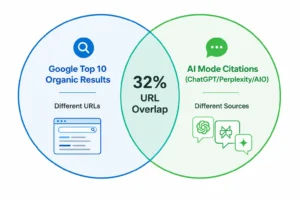
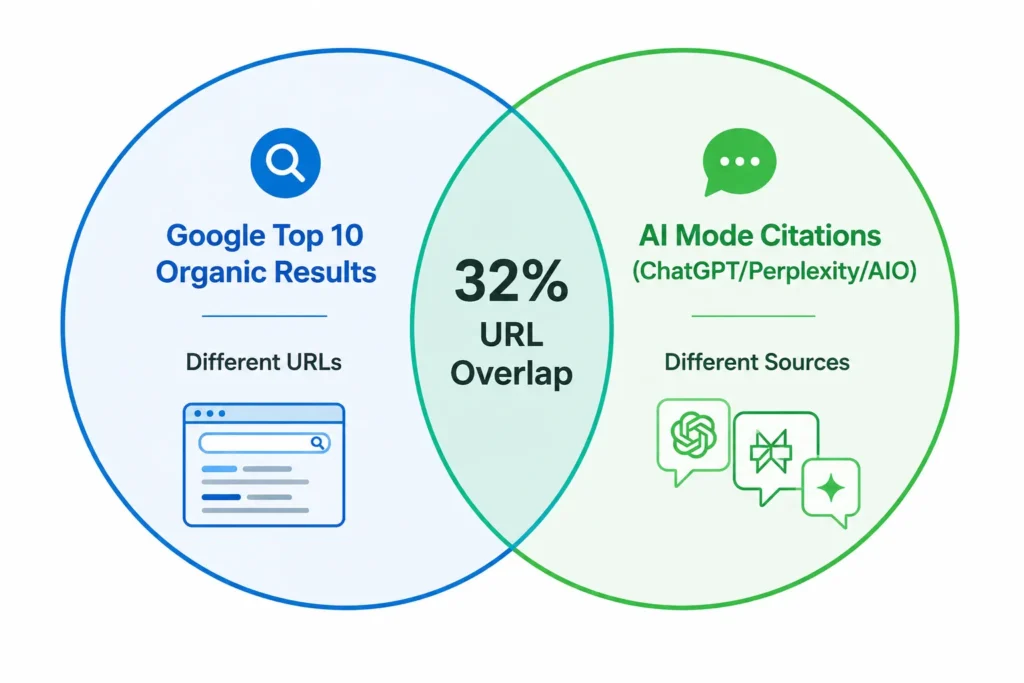
So what does the data actually say about this gap? SEMrush analyzed over 150,000 AI citations across thousands of keywords and found that Google AI Mode shares only 51% domain overlap with the top ten organic results. Drop to URL level, and that overlap falls to just 32%.
Put another way: more than two-thirds of the URLs that AI search cites are not even in Google’s top ten results. They come from somewhere else entirely.
The difference is visibility potential versus actual presence. Traditional tools answer a theoretical question ‘could a user find you if they searched the right term?’ ZipTie answers a factual one ‘did an AI engine cite your brand when a real person asked a real question today?’ One measures what might happen. The other records what did.
The value exchange is fundamentally different between the two. As Michael King, founder of iPullRank, has noted, traditional search functions primarily as a referral traffic channel while AI search functions as a branding channel. [Verify and link to the specific post or interview where King said this.] Clicks versus presence. Revenue attribution versus authority. Those are not the same optimization problem, and confusing them is how brands end up spending months on tactics that fix the wrong metric.
I have run side-by-side comparisons between standard rank trackers and the ZipTie AI search performance tool, and the results rarely align the way most people expect. A page can sit at number three on Google for a high-volume keyword and still get zero citations from ChatGPT or Perplexity. Meanwhile, a competitor with weaker rankings but more third-party mentions about them across forums and review sites completely dominates the AI answers.
That is why comparing traditional SEO tools to ZipTie is not really an apples-to-apples evaluation. They were built to answer different questions for different search environments. One tells you where your page ranks. The other tells you whether AI systems trust your brand enough to recommend it when a real person asks. Running only one of them in 2026 means you are flying half-blind. If you’re ready to explore other options, check out our roundup of the best AI search engine optimization toolsAbout three weeks later, I pulled up a ChatGPT conversation on a topic I write about and saw my site cited in the answer for the first time. That was not the for 2026.
What Is Generative Engine Optimization (GEO)? The Framework Behind ZipTie
I first encountered the term Generative Engine Optimization about a year ago and, honestly, my reaction was skepticism bordering on annoyance. Another three-letter acronym for conference talks and LinkedIn arguments? But I kept running into it in contexts where serious practitioners were using it to describe real measurement problems they could not solve with existing tools. That got my attention.
Generative Engine Optimization is the practice of structuring your content so AI systems like ChatGPT, Perplexity, and Google AI Overviews cite it as a source. Not rank it on a page. Cite it inside an answer. I spent longer than I would like to admit confusing those two things and that confusion is expensive when you are making content decisions based on it.
The term has real academic roots. Researchers at Princeton, Georgia Tech, and IIT Delhi formally defined GEO in 2023 and 2024 , studying why some content gets pulled into AI-generated answers while statistically similar content gets ignored. Their finding was consistent: it was not about keyword density or backlink counts. It came down to retrievability whether the AI system could find, process, and trust the source.
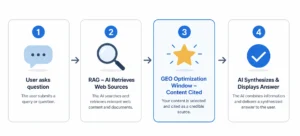
Here is what happens under the hood. When you ask an AI search engine a question, it does not guess the answer from memory. It uses a process called Retrieval Augmented Generation RAG where the system first goes out and finds relevant documents from across the web, then passes those documents to a language model that reads them and writes a synthesized answer based on what it found. The sources it cites in that answer are literally the documents it retrieved during the first step.
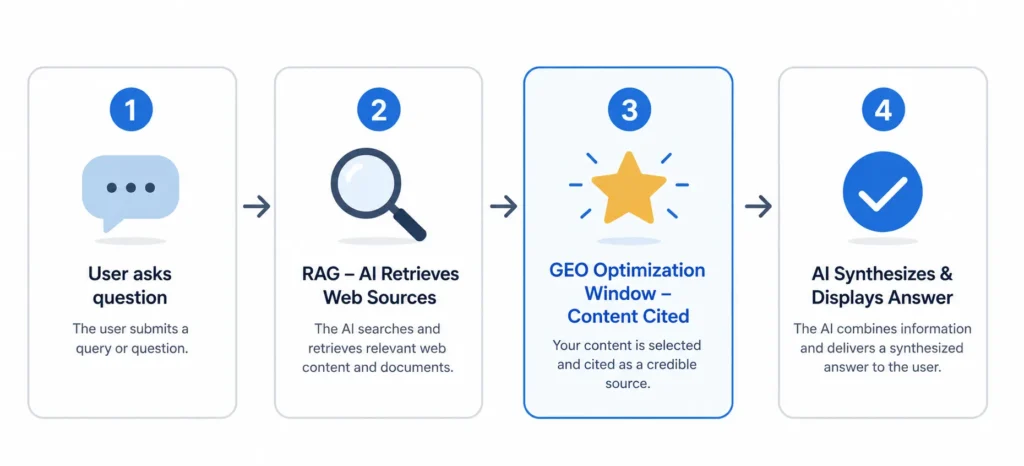
That means your content needs to be retrievable first. Then it needs to be citeable. Two different problems.
Generative engine optimization works on that entire pipeline simultaneously. How do you write so the AI finds you? How do you structure so the AI quotes you? And this is the one that surprises most people how do you build enough third-party presence that the AI trusts you, because most of the time it gives more weight to external mentions of your brand than to anything your own website says?
The part that actually relieved me when I dug deeper: Jeremy Moser, founder of uSERP, has consistently said that roughly 80 percent of GEO is just sound fundamental SEO. [Verify and link source.] Solid site structure. Content that actually answers questions. Credibility signals built over time. The remaining 20 percent is newer territory optimizing for entity recognition, earning citations on the platforms AI systems already mine for answers, making sure third-party sources talk about you in the right context.
So no, GEO does not replace SEO. It extends it into a measurement layer that traditional tools cannot access. And ZipTie is the tool I use when I need to know specifically how that extension is performing which queries I own in AI answers, which I am losing, and what to fix first.
How ZipTie Tracks Your Brand Across AI Platforms (Real Browser Technology)
The first time someone explained the difference between API tracking and real browser tracking to me, I understood immediately why so many AI visibility tools produce data you cannot actually trust. Most cheaper tools send a simple API request to the AI platform and record whatever comes back. But that is not how a real user interacts with ChatGPT or Perplexity. Real users open a browser, type a natural question, read a formatted response, and get results that vary depending on where in the world they are asking from. An API call skips all of that context.
ZipTie uses real browser technology instead of API approximations. It spins up actual browser sessions, sends real conversational prompts, and captures exactly what a human user would see including screenshots of the AI response. Screenshots sound like a small detail until you are sitting in a client meeting trying to explain why their competitor keeps getting recommended by ChatGPT. At that point, a screenshot is the only thing that ends the debate.
ZipTie tracks three platforms: Google AI Overviews, ChatGPT, and Perplexity. Each one operates differently and pulls from different source material, which is why tracking all three simultaneously matters. Google AI Overviews now shows up in over half of all search results. ChatGPT has passed 800 million users. Perplexity handles 45 million queries a day. [Source citations needed for all three figures.] If you are only visible on one of those three, you are invisible to a significant portion of the people actively asking questions in your category.
ZipTie also tracks across more than 12 countries including the US, UK, India, Brazil, Australia, Canada, Germany, Italy, Japan, and Switzerland. This matters because AI-generated answers are not consistent across geographies. Ask ChatGPT which accounting software is best for small businesses from a US IP address and you get a different answer than if you ask the same question from Germany or Brazil. If your brand serves multiple markets, monitoring from only one country’s IP gives you a completely distorted picture of your actual visibility.
Tomasz Rudzki walked through exactly how this works in a product demo I watched. You drop your existing content into the optimization module, hit generate, and within two minutes the tool returns specific asset proposals pre-written paragraphs structured exactly the way the AI is looking for them. You adjust the language to match your brand voice and paste them into your draft. What used to be guesswork about what an AI engine wants to see becomes a concrete checklist.
Traditional SEO tools check HTML structure, backlink profiles, and keyword density. Those are all valid measurements. But none of them ever send a real prompt to ChatGPT asking ‘what is the best project management software for a small team?’ and record whether your brand appeared in the answer. That step actually running the query and capturing the response is the only way to know if you exist in AI search. And until ZipTie, there was no reliable automated way to do it.
Tracking ChatGPT and Perplexity (Why Both Matter)
The data on how each platform cites brands is genuinely interesting, and it changes how I prioritize optimization work for clients. Google AI Overviews mentions around 6 brands per query on average. ChatGPT mentions only about 2.4. That narrower field means getting cited in ChatGPT is harder there is less real estate. But here is the trade-off: ChatGPT includes clickable links more frequently than Google AI Overviews does, which includes a link only about one in every ten brand mentions. [Source citations needed.] So ChatGPT is harder to get into but more valuable when you do.
Each engine also draws from different source pools. ChatGPT leans heavily on Reddit, forums, and community discussions for certain categories. Perplexity tends to favor published articles, documentation and structured sources. Google AI Overviews pulls from a wider mix. What that means practically: a brand that dominates Reddit discussions might rank highly in ChatGPT recommendations but barely appear in Perplexity results. Single-platform tracking misses that discrepancy entirely.
The AI Success Score: How ZipTie Measures Your AI Visibility in One Number
The first time I saw the AI Success Score in a live dashboard, my instinct was skepticism one number to represent brand visibility across three different AI platforms felt like it was papering over too much complexity. But the skepticism faded pretty quickly once I saw what the score actually measures.
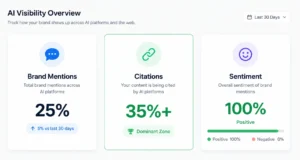
The score pulls from three inputs: how often AI systems actually name your company (brand mentions), whether those mentions carry positive or negative tone (sentiment analysis), and whether they include a clickable link back to your site (citations). Each query gets its own score. The overall AI Success Score aggregates those per-query results into a single number you can track over time.
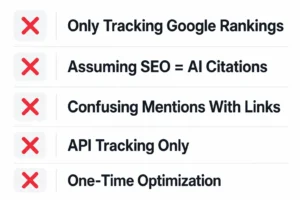
Most people conflate mentions with citations, and that mistake is expensive. A mention means your brand name appears in the AI answer. No link. No click. The user reads it and moves on. That is name recognition, not traffic. ZipTie splits these two metrics apart in its dashboard you can see exactly how many mentions you have versus how many of those mentions actually drive someone to your site.”
I ran a scan for a German hunting equipment website I was working with at the time. Sentiment tracking came back 100% positive zero neutral, zero negative. Every AI mention of the brand was favorable. That result looks great on a slide until you see the citation share sitting below 10%. The AI likes the brand just fine. It just never links to it. Positive sentiment with no citations means you are getting goodwill without revenue
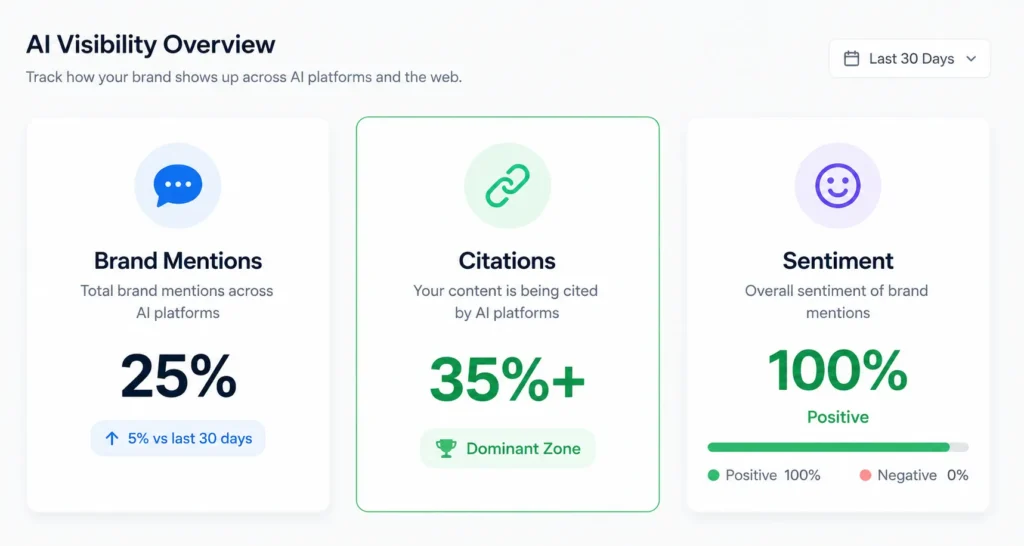
The benchmark thresholds in ZipTie’s scoring give you a quick read on where you stand. Above 35% citation share puts you in dominant territory the AI systems consistently trust and recommend your brand. Below 15% is the danger zone, where a competitor with a stronger third-party presence can push you out of the AI conversation without you even noticing. Most brands I have run through the tool land somewhere in the middle 15–35% range, which is actually the most actionable position to be in visible enough that small improvements show measurable results. [Note: Verify whether these threshold figures come from ZipTie’s own documentation or industry benchmarks.]
Nearly 90% of AI-cited links do not rank in Google’s top ten. [Source needed.] That is probably the most counterintuitive number in this entire category. You can have weak traditional SEO and still dominate AI citations if the right external sources mention you in the right context. Which means the AI Success Score is not a replacement for your rank tracker it is measuring something your rank tracker cannot see at all.
What ZipTie Looks Like in Action (A Real Walkthrough)
Watching Tomasz Rudzki run through a live demo was the moment the full value of the platform clicked for me. He took a genuinely bad draft the kind you would recognize immediately as something written in twenty minutes with no real research and dropped it into the optimization module. The demo was not designed to be flattering. He picked bad content on purpose.
Tom selected ‘Is Jotform good for beginners?’ as the target query a real question people type into ChatGPT regularly, not a made-up example. Then he pasted the low-quality draft straight from Google Docs into the optimization module. No cleanup. No editing. He wanted to show what the tool does with content that has real problems.
The report takes about two minutes to generate. When it came back on Tom’s draft, the scores were genuinely rough three out of ten on several underlying questions, one out of ten on others. The tool did not just flag the low scores; it identified exactly which questions the AI was looking for in a good response to that query and showed precisely how the draft fell short on each one.
ZipTie does not just score your content and leave you to figure out the rest. The report includes pre-written asset proposals complete paragraphs structured exactly the way the AI is looking for them, answering the specific underlying questions that your draft missed. You adjust the language to match your brand voice and paste them in. The gap between ‘I failed this metric’ and ‘here is the paragraph that fixes it’ is where most other tools leave you stranded.
After applying the suggested changes, Tom pasted the updated draft back in and ran the analysis again. The scores came back at eight out of ten. Eight point five on some individual metrics. That is not a marginal improvement from one to eight that is the difference between content the AI ignores and content the AI cites. I have seen smaller jumps take weeks of manual editing to produce.
The tool also scores your content against Google’s E-E-A-T framework Experience, Expertise, Authoritativeness, and Trustworthiness each rated on a ten-point scale. In my experience running pages through it, originality of the information presented tends to be the weakest area for most content. Most articles I see are just remixes of the same ten sources. ZipTie flags which sections are repeating commonly available information and tells you where you need to add something that genuinely cannot be found elsewhere.
I have run my own pages through this exact workflow. The first time, I was confident my content was solid. The report disagreed specifically and usefully. I made the suggested changes, re-ran the analysis, and watched the scores climb.
About three weeks later, I pulled up a ChatGPT conversation on a topic I write about and saw my site cited in the answer for the first time. That was not the score going up. That was the actual result. Getting cited is the goal. Everything else is a leading indicator. If you’re evaluating other AI visibility tools to monitor your brand across ChatGPT and Perplexity, this comparison guide covers the top contenders and what each one does best.
The Counterintuitive Truth: 94% of AI Citations Come from Earned Sources (Not Your Own Website)
I spent months rewriting my own blog posts trying to get ChatGPT to cite my site. Better headings. More data. Cleaner structure. None of it moved the needle the way I expected. And the reason for that had almost nothing to do with my own website.
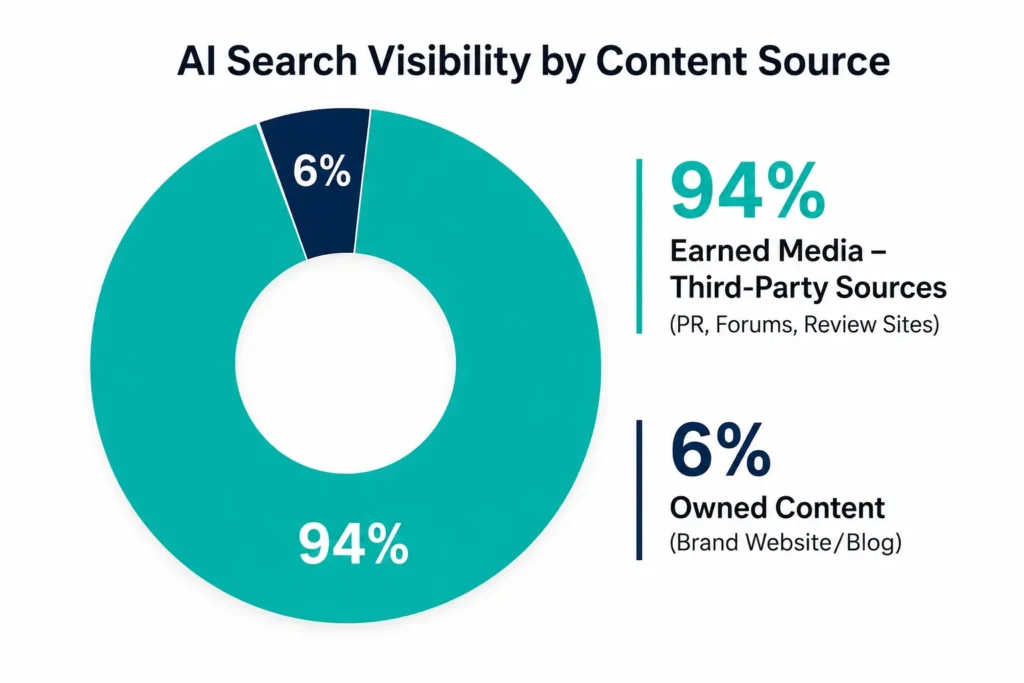
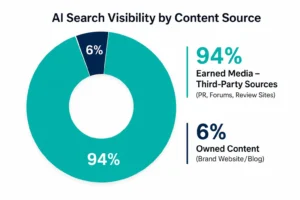
The stat that actually changed how I spend my time: roughly 94% of generative AI citations come from earned sources not your own domain. Someone else talking about you. Review sites, forum discussions, news coverage, comparison posts from industry bloggers. Brands are about 6.5 times more likely to get cited through third-party content than through anything on their own website. [Source needed verify whether this figure comes from Brightedge, Semrush, or ZipTie’s own research.]
That changes everything about where you should focus your energy.
ZipTie surfaces this directly in its platform. When you run a query, the tool shows you exactly which Reddit threads and software listing directories the AI engines are mining for user feedback and that sourcing is not arbitrary. The AI has learned which communities and directories carry reliable signal for specific categories. If your brand shows up positively in those places, your citation probability goes up substantially.
There is a catch. Citation drift. Research suggests roughly half of the domains cited in AI answers change every single month. [Source needed.] The strategy that puts you in ChatGPT’s recommendations today might not hold next quarter without active maintenance. And this is the part that makes a one-time audit almost useless if you are not watching those citations continuously, you will not know when you drop out of them. By the time you notice the change, a competitor has already filled the space.
So what actually moves the citation needle? PR coverage on relevant industry publications. Guest posts on trusted sites in your category. Listings in the software directories and comparison sites that AI engines reference when building answers. Forum mentions in communities where your customers are already asking questions.
For a systematic approach, explore dedicated generative engine optimization (GEO) tools that help you audit, optimize, and track your content specifically for AI citation success. And running your content through ZipTie regularly to see which of those earned sources are working and which gaps still exist. Your own website matters it is just not where the majority of the leverage is.
5 Common Mistakes That Ruin Your AI Search Visibility (And How ZipTie Fixes Them)
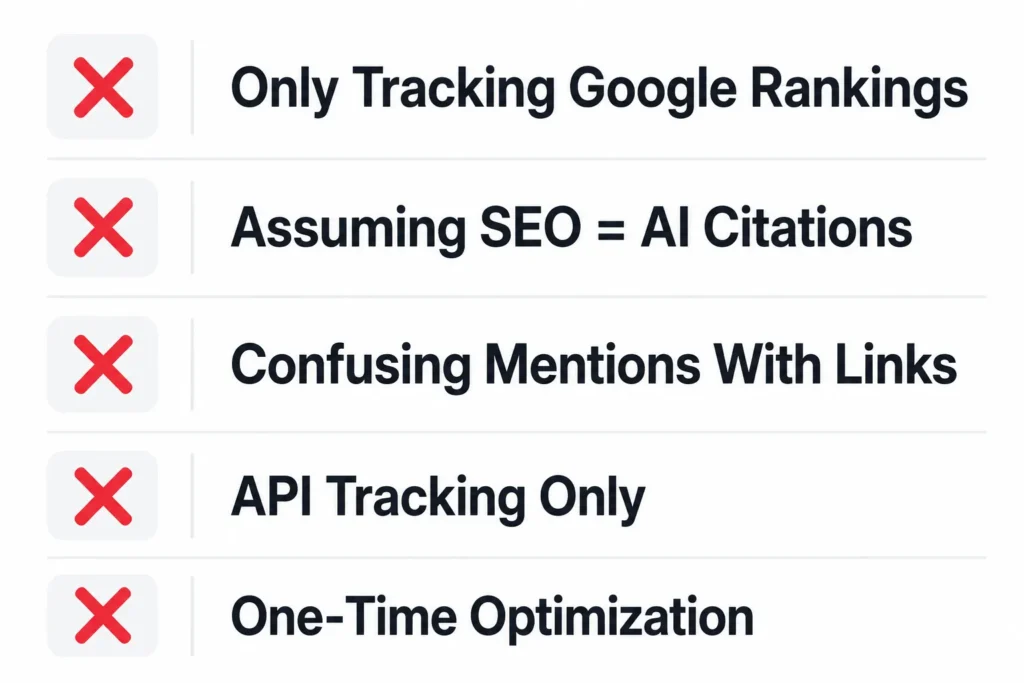
Google Search Console tells you which keywords drove clicks from traditional search results. What it cannot see is anything happening inside ChatGPT, Perplexity, or Google AI Overviews answers and according to research, it misses up to half of the conversational queries that drive AI visibility. [Source needed.] Measurement is the prerequisite for improvement, and GSC only measures part of the picture.
ZipTie covers the gap by monitoring all three AI platforms simultaneously, showing you exactly where your brand appears in AI-generated answers and where it is absent.
Mistake 2: Assuming strong Google rankings guarantee AI citations
I had a client sitting at number one on Google for a competitive keyword in their space. When I ran their domain through ZipTie and checked actual AI citations, the results were close to zero. The SEMrush study I referenced earlier explains exactly why at the URL level, Google AI Mode shares only about 32% overlap with the top ten organic results. A number-one ranking does not translate into an AI citation. Those are two different measurements of two different things.
ZipTie measures citations directly, pulling actual AI response data rather than inferring visibility from ranking position.
Mistake 3: Confusing mentions with citations
An AI can say your brand name without linking to your website. No click. No traffic. No lead. Just a name in a response that the user reads and forgets. A mention is brand exposure. A citation is an actual referral. Only one of those generates revenue.
ZipTie splits these apart in its reporting so you can see exactly how many of your AI appearances include a clickable link versus how many are name-drops with no path back to your site.
Mistake 4: Using API approximations instead of real browser tracking
Some cheaper tools query the AI platform via API and record whatever comes back. The problem is that API responses do not reflect what real users see the formatting is different, the citations differ, and the geo-targeting is absent. Real user results vary by location, by session context, by how the prompt is phrased.
ZipTie sends actual browser sessions with real prompts and captures screenshots of exactly what a human user would see which means the data you are working with reflects actual AI behavior, not a lab simulation.
Mistake 5: Treating AI Optimization as a One-Time Project
Citation drift happens faster than most people realize. I have watched roughly half of all cited domains change every single month. What works today disappears by next quarter. One audit never cuts it.
I used to manually check AI references. Fifteen to twenty hours every month. The data was still unreliable. ZipTie automates the entire process with continuous monitoring and continuous improvement. That is the only way I have found to stay visible in AI search results without burning half my work week on spreadsheets.
ZipTie Pricing: Is It Worth the Money? (Plus Free Trial)
Before I signed up, I ran the numbers twice. Here is what convinced me.
ZipTie offers three pricing tiers. The Basic plan costs $69 per month and gives you 500 AI checks. The Standard plan runs $99 per month for 1,000 checks. If you run an agency or need enterprise scale, custom pricing is available. Every plan includes a 14-day free trial with no commitment and no hidden fees.
Whether the tool pays for itself comes down to time math.
Manually checking where your brand appears in AI answers takes fifteen to twenty hours every month. You type prompts into ChatGPT. You paste them into Perplexity. You check Google AI Overviews. You screenshot everything. You dump it all into a spreadsheet. That is real time. At typical freelancer or in-house rates, you are burning hundreds of dollars monthly just on manual tracking.
ZipTie automates the entire process. The cost is less than one hour of most SEO consultants’ time. Even the Basic plan makes financial sense for a solo operator.
And the revenue upside is bigger. Seer Interactive analyzed data from fifty clients and found that AI-referred visitors convert at nearly fourteen percent. Organic traffic converts at just over nine percent. That is roughly forty-eight percent better conversion from the same number of visitors. Better AI visibility means better revenue.
Marketing consultant Kevin Indig put it this way: a modest investment in GEO can safeguard massive revenue channels and deliver returns exceeding twenty to one. I have seen smaller multiples from my own clients. But the direction is always the same.
The cost of delay matters too. Competitors who establish early authority in AI search build a lead that grows over time. Every month you wait, they rack up more citations, more mentions, more trust signals. That gap does not close easily.
The free trial is the smart move. Run your domain through ZipTie for two weeks. See exactly where you stand. Compare your visibility to competitors. Then decide. Most people who run the trial end up keeping it, not because the tool is pushy but because the data is impossible to ignore.
Who Built ZipTie? The Onely Agency Origin Story
I always feel better using a tool when I know who built it and why.
The platform was created by Tomasz Rudzki, Bartosz Góralewicz, and Sebastian Skowron. These are not random developers. They are the team behind Onely, a well-known technical SEO agency that has worked on some of the most complex search problems in the industry.
The idea for ZipTie came from a gap they saw firsthand. Agencies had no reliable way to prove whether their content was showing up inside AI answers. Clients would ask “are we visible in ChatGPT?” and the honest answer was “we have no idea.” Not a comfortable position for an agency.
So they built a solution. The tool started in 2023 as an indexing tracker. By 2024, it had evolved into a full AI search monitoring platform covering Google AI Overviews, ChatGPT, and Perplexity. The same technical rigor they applied to enterprise SEO projects went into building ZipTie.
Some of the most respected names in SEO trust it. Lily Ray, who runs SEO strategy at Amsive, calls ZipTie her go-to tool for monitoring AI Overviews. Aleyda Solís, an international SEO consultant, says her team loves using it for client work and competitive research. Kevin Indig, former Director of SEO at Shopify and Atlassian, describes ZipTie as a critical tool for modern SEO teams.
Those are not paid endorsements from random influencers. Those are practitioners who need accurate data to do their jobs.
The founders have decades of combined SEO experience. They built ZipTie because they needed it themselves. Which is exactly why I started using it.
Frequently Asked Questions
How much does ZipTie cost?
The Basic plan runs $69 per month and includes 500 AI checks. The Standard plan is $99 monthly for 1,000 checks. Agency pricing is custom. Every paid plan comes with a 14-day free trial. I started with the trial to test my own domain before committing, and there were no surprises or hidden fees.
What AI platforms does ZipTie track?
Google AI Overviews, ChatGPT, and Perplexity, all at the same time. The tool also works across more than a dozen countries including the US, UK, India, Brazil, Australia, Canada, Germany, Italy, Japan, and Switzerland. I have tested it in three different regions. The results change based on location, which tells me the data is real.
Is ZipTie better than SEMrush?
They do different jobs. SEMrush tracks traditional Google rankings and tells you where your page lands on search result pages. ZipTie tells you whether an AI engine actually cited your brand inside an answer. I use both because one does not replace the other.
Does ZipTie have a free trial?
Yes, 14 days with full feature access and no commitment required. I recommend running your top ten keywords through the trial before deciding so you can see exactly where you stand.
What Is a Good AI Success Score?
A citation share above 35 percent puts you in dominant territory. Below 15 percent means you are at high risk of competitors taking your place. The score varies by industry a finance brand might have different benchmarks than a software company but tracking your own trends over time matters most.
Can ZipTie help me optimize my existing content?
The AI Content Optimization module is one of my favorite features. You paste your current text into the tool. It analyzes what the AI is looking for, then shows you exactly where your content falls short and gives you ready-to-use paragraphs you can copy directly. I saw my optimization scores jump from three out of ten to eight out of ten after one round of edits.
Why can’t Google Search Console track AI visibility?
Google Search Console tracks clicks from traditional search results. It has no visibility into ChatGPT, Perplexity or Google AI Overviews answers. Research from BrightEdge suggests GSC misses up to half of the conversational queries that actually drive AI visibility. You cannot fix what you cannot measure.
w Is Generative Engine Optimization (GEO) Different from SEO?
SEO optimizes for rankings and clicks on search engine results pages. GEO (generative engine optimization) optimizes for citations and mentions inside AI-generated answers. The unit of value shifts from a URL to brand inclusion in synthesized answers. GEO is about 80 percent good SEO and 20 percent new tactics, so You do not need to abandon everything you know just add a few new tools to the mix.”