GoPerfect AI Recruiting Tools: Complete Review, ROI Analysis & Honest Verdict
The Recruiting Bottleneck No One Talks About
Most recruiters spend 15 hours every week doing something that produces almost nothing useful. They read resumes manually, one at a time, looking for a reason to say yes to someone who usually does not deserve a callback.
I ran into this exact wall three years into running recruiting operations for a scaling tech company. We posted one mid-level product role and got 1,100 applications in 72 hours. My team of three spent the next three weeks locked in resume review before we surfaced 12 candidates worth calling. By the time we reached our top two choices, both had accepted offers at other companies. We lost them to teams that moved faster. That one hiring cycle cost us a full product quarter.
That is the ai recruiting tools goperfect sourcing problem hiding inside most recruiting departments right now. The best candidates do not wait three weeks.
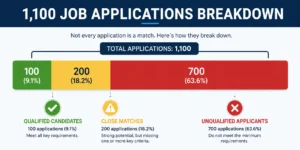
When a job posting goes live, roughly 100 of those 1,000 applicants are genuinely qualified for the role. Another 200 are close but missing something critical. The remaining 700 applied to everything available that week, often without reading past the job title. Nothing about that ratio is controversial. Every recruiter I have ever spoken with recognizes it immediately.
But you cannot identify which bucket anyone belongs to without reading their resume carefully and checking it against your actual requirements. That takes 2 to 3 minutes per candidate when you are doing it properly. Thirty seconds per resume, which is what most teams actually spend, produces garbage results. You advance weak candidates and miss good ones in equal measure.
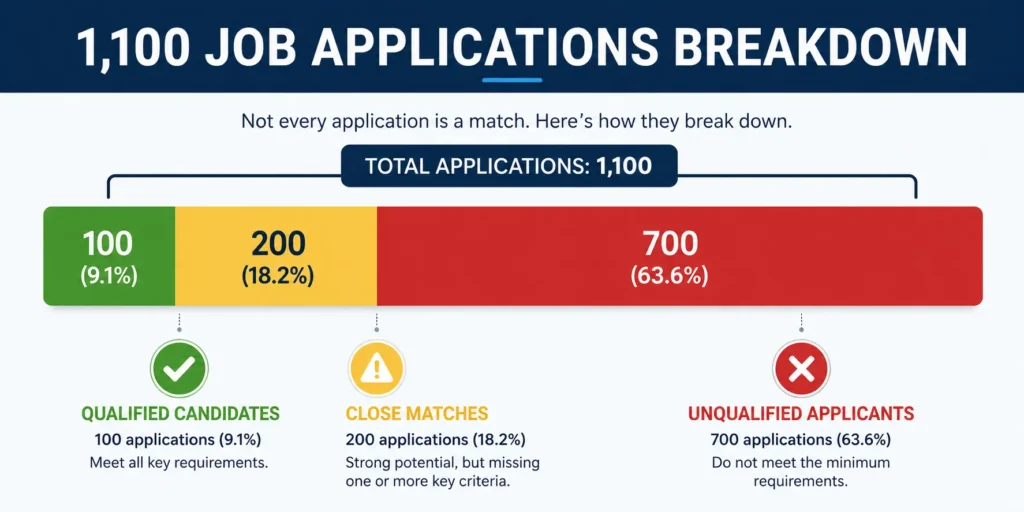
Do the math yourself. 1,000 candidates at 3 minutes each is 50 hours of pure screening time for a single position. Not onboarding. Not interviewing. Not offer negotiations. Just reading resumes.
Most recruiting teams cannot give 50 hours to one role. So they skim and guess and hope. Projects slip. Headcount gaps stretch from weeks to months. Revenue-generating roles stay open while the team runs understaffed and the business loses ground to competitors using AI talent sourcing to move three times faster.
Job boards generate the applications but filter nothing. Applicant tracking systems organize the pile but do not reduce it. The fundamental problem of too many unqualified candidates requiring manual review stays completely unsolved.
Automated recruiting software is supposed to fix this. Tools like GoPerfect claim they can screen every application immediately and deliver only the candidates worth your actual time. If you’re evaluating other AI recruiting tools to understand your options, you’ll find most claim similar benefits but deliver very different results.
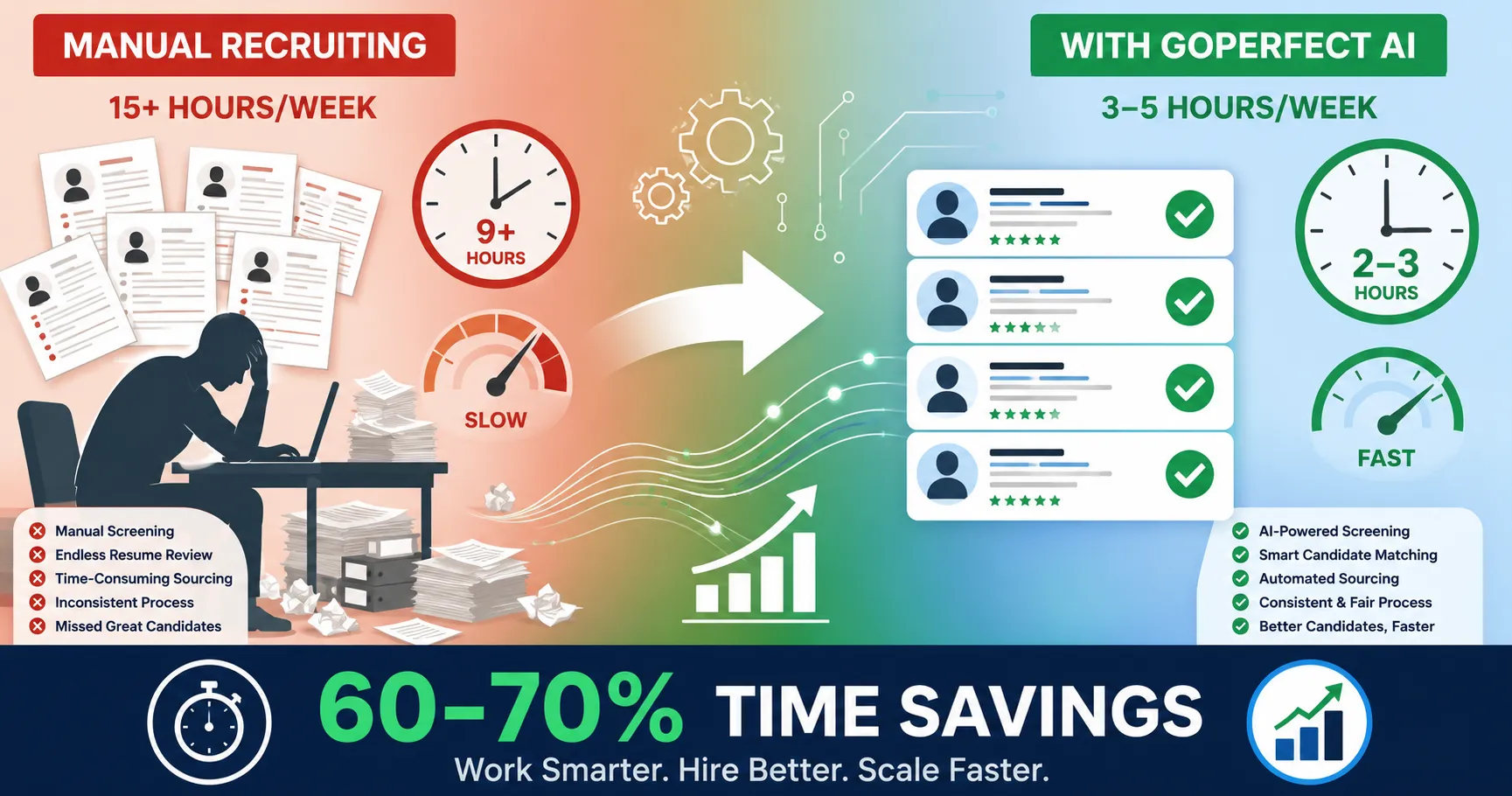
Some recruiting teams using these platforms report dropping their weekly screening time from 15 hours down to 2 or 3 hours.
So which AI recruiting tools actually hold up when you test them against real hiring workflows? And how do you figure out whether a specific platform solves your actual problem before you spend months integrating it?
That is what this review covers. GoPerfect has been getting consistent attention from recruiting teams who want to cut manual resume screening out of their process entirely. The question worth answering is whether the platform actually delivers what it promises.
What Is GoPerfect? (The Short Answer)
Most people who hear about GoPerfect assume it is just another LinkedIn alternative or a slicker version of an ATS. That assumption is wrong on both counts.
GoPerfect is an AI-powered hiring platform built to automate three specific recruiting tasks: finding passive candidates, scoring them against your actual criteria, and reaching out to qualified matches without waiting for you to do it manually. It is closer to an AI recruiter that handles the time-consuming mechanical work so your team can focus on real conversations with people worth talking to.
The defining characteristic is something called agentic recruiting. Most automated recruiting software produces a list and then stops. It hands the list to you and waits. GoPerfect is designed differently — the system takes action on your behalf rather than serving as a smarter search engine. That distinction matters more in practice than it sounds on paper.
So what does the platform actually do? It sources passive candidates from over 800 million profiles using semantic search technology instead of keyword matching. That means it finds people with the right experience even when they describe their background using completely different language than your job description uses.
It also screens every candidate automatically and assigns each one a transparency score with specific reasoning attached. You see exactly why someone rated 4 out of 5, or why the system filtered someone out at 2.8. No guessing at the logic.
The third piece is outreach. GoPerfect writes personalized messages based on each candidate’s individual background and sends them across multiple channels without requiring your approval on every send. Most recruiters spend two to three hours per week writing individual outreach emails. This platform handles that entire workflow.
What GoPerfect is not matters just as much. It does not replace your ATS, though it integrates with it. It is not competing with LinkedIn for professional networking. And it is not a black-box scoring system that gives you numbers without explanations.
The platform is built specifically for outbound recruiting targeting passive candidates. If your biggest problem is processing inbound applications from job boards, GoPerfect may not solve the right thing. This is a talent discovery platform designed for teams that actively hunt candidates who are not out there applying to anything.
How GoPerfect AI Sourcing Works: The Complete Workflow
The biggest mistake recruiters make with AI candidate sourcing is treating these platforms like a fancier version of LinkedIn search. You drop in some keywords, collect a list of names, and spend the next two hours manually figuring out what to do with them.
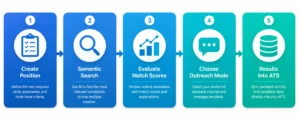
GoPerfect is built around a structured five-step workflow that moves candidates from discovery through to your ATS without requiring manual intervention at every stage. I pulled this breakdown directly from GoPerfect’s official product demonstration, not from their marketing page, because feature lists and actual workflow behavior are two very different things. Most competing platforms describe what they do. This section shows you how GoPerfect actually runs the process from beginning to end.
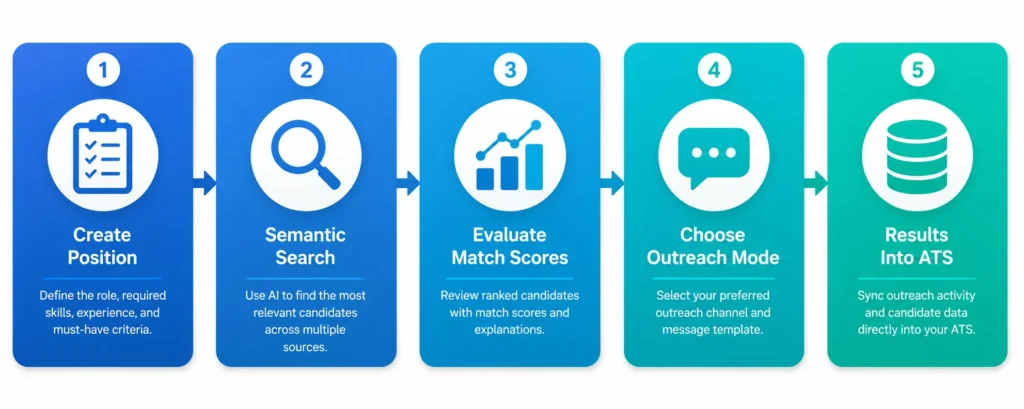
Step 1: Create a Position (Tell GoPerfect What You’re Looking For)
Setup starts with creating a new position. You can paste an existing job description directly into the system or manually enter your requirements from scratch. Either way works, and the platform does not ask you to structure the input in any particular format.
GoPerfect uses AI job matching to analyze whatever text you feed it. The system automatically separates must-have skills from nice-to-have qualifications, identifies preferred experience levels, and picks up on location requirements without you explicitly tagging each element.
The part most recruiters do not expect is contextual analysis. GoPerfect does not just read the words you typed — it reads the situation behind them. A Product Manager role at an early-stage startup carries completely different expectations than the same title at a Fortune 500 company, and the AI accounts for that distinction when it builds your candidate criteria.
You can layer in additional preferences from there: remote work flexibility, target salary ranges, the types of companies you want candidates coming from. The more context you build into this first step, the tighter the matches you get in step two. From blank screen to complete position setup typically runs under two minutes.
Step 2: Semantic Search (Find Candidates Beyond LinkedIn Keywords)
Step two is where the platform’s core technology actually shows up. GoPerfect runs semantic search recruiting instead of basic keyword matching, which means it reads the meaning behind your job requirements rather than scanning for literal word matches.
The system searches across more than 800 million candidate profiles using vector search technology built on skill relevance rather than exact phrase alignment. A candidate who describes their background as having ‘built cross-functional teams in scaling environments’ will surface when you search for ‘team leadership in fast-growing companies’ even though none of those specific words overlap. That is not a small improvement over traditional search. It is a fundamentally different kind of retrieval.
LinkedIn and most job boards miss this category of candidate entirely. They need the exact terminology to match. Semantic search recruiting finds the people those tools leave behind because they happened to describe their experience differently.
Beyond LinkedIn, GoPerfect pulls from GitHub repositories, professional portfolios, industry-specific databases, and public professional profiles. The database is built around sourcing passive candidates — people who are not actively applying anywhere but who might respond to the right opportunity from the right team. Understanding candidate mobility prediction patterns is part of how the platform identifies who is likely open to a conversation even without an active job search.
Results come back within 30 to 60 seconds. What you get is a ranked list sorted by relevance to your specific role, not a raw dump of everyone who matches a few keywords.
Step 3: Evaluate Match Scores (Review Ranked Candidates)
Every candidate the system returns comes with a numerical match score and the specific reasoning that produced it. This candidate matching technology does not just hand you a number it explains why someone scored 4.2 out of 5 and what gaps pulled another candidate down to 2.8.
The scoring weighs relevant experience, skill alignment, career trajectory, and contextual fit for your particular role and company type. You see a background summary for each person alongside the AI scoring recruiter analysis, so the number and the explanation sit together rather than making you click back and forth.
The contextual candidate scoring is the part that actually changes how you work with results. You can read the AI’s logic and decide whether it makes sense for your specific situation. A candidate with a lower overall score sometimes has exactly the niche background that matters most to your role — and because GoPerfect shows you its reasoning, you can catch that rather than automatically deferring to the ranking.
Drilling into individual profiles shows full work history, listed projects, and additional context beyond the score summary. From there you approve candidates for outreach, skip them, or save them for a later review queue. Most recruiters find they can move through 20 to 30 scored candidates in roughly 10 minutes work that takes 45 minutes to an hour when reviewing unscreened resumes manually.
Step 4: Choose Your Outreach Mode (Auto, Semi-Auto, or Manual)
Once you select candidates for outreach, GoPerfect offers three different approaches depending on how much control you want to keep over messaging.
Auto Mode runs the entire sequence without waiting for your input. The platform writes personalized messages using each candidate’s specific background details and sends them across LinkedIn, email, and SMS wherever it has valid contact information without requiring approval on individual sends. For high-volume sourcing campaigns, this is the mode that produces the biggest time savings.
The second option is what GoPerfect calls Effortless Messaging. You build your message templates and set your preferences once. The outreach personalization AI then adapts those templates to each individual candidate based on their actual experience, career moves, and background details. Your voice stays consistent across every send while the system handles the per-candidate customization work.
Team collaboration mode routes selected candidates to other team members before any message goes out. This option works well for organizations where legal, compliance, or senior leadership wants visibility over external candidate communication before it happens.
The automated modes use candidate engagement automation to time messages based on what produces the strongest response rates for different candidate profiles. The platform tracks what works and adjusts its timing accordingly not just sending everything at 9am Tuesday and calling it optimized.
Step 5: Watch Results Flow Into Your ATS
The final step requires nothing from you. Candidate responses, status updates, and full interaction history sync automatically into your existing applicant tracking system the moment they happen.
This ATS integration removes the manual data entry that makes most standalone sourcing tools frustrating to use long-term. You do not copy information between platforms, you do not check two different dashboards, and you do not lose track of where someone sits in your process. Everything centralizes in whatever system your team already lives in.
GoPerfect connects directly with Greenhouse, Lever, BambooHR, and most other major ATS platforms through standard API connections. The platform adds to your existing workflow rather than asking you to rebuild around something new.
The talent pipeline automation here eliminates the work that tends to pile up invisibly — candidate responses sitting unlogged, status changes that only one person knows about, interview confirmations that never made it into the system. All of that updates automatically.
From blank position setup to qualified candidates sitting in your ATS pipeline, the whole active working time typically runs 15 to 20 minutes. The sourcing and initial outreach happen behind the scenes while you are doing something else.
GoPerfect’s Core Features Explained
Most recruiting platforms hand you a feature list that sounds genuinely impressive right up until you try using those features in an actual hiring process. GoPerfect is built around three specific capabilities, each one targeting a different bottleneck in talent pipeline automation.
I am going to break down what each of these actually does in practice not what the sales page says they do, but what the day-to-day recruiting experience looks like when they are running. These are the functions that determine whether GoPerfect becomes a tool your team uses every single day or something that sits unused after the first three weeks.
Feature 1: Semantic Sourcing (Finding 800M+ Candidates Who Actually Fit)
The sourcing engine is where GoPerfect’s core technology runs. The platform uses semantic search recruiting to understand what you are actually looking for rather than pattern-matching your words against profile text.
When you search for a Go-to-Market leader, the system surfaces candidates with backgrounds in Revenue Operations, Business Development, GTM Strategy, Customer Success leadership, and Product Marketing people who have the actual combination of experience the role requires, regardless of what they call themselves professionally.
Traditional Boolean searches miss all of those people. Someone who spent five years building scalable customer acquisition systems does not show up when you search for marketing manager, even when their experience is precisely what you need. Semantic sourcing finds the gap between what candidates call themselves and what they actually know how to do.
GoPerfect searches across more than 800 million candidate profiles from sources that go well beyond LinkedIn professional portfolios, GitHub repositories, industry-specific databases, and public profiles from platforms that concentrate on particular skill categories.
The career pattern analysis underneath this is what makes the matching genuinely useful rather than just broader. The AI reads progression patterns, not just current titles. A junior developer who made meaningful contributions to major open-source projects can outrank candidates with more years of experience and less demonstrable impact — the system picks up on those signals in ways that keyword searches are structurally incapable of doing.
AI talent sourcing through this mechanism specifically targets passive candidates: people who are not applying to anything right now but whose background and career trajectory make them exactly right for your role. Results come back ranked by relevance within 60 seconds, regardless of how specific or niche the criteria are.
Feature 2: AI Candidate Screening (Solving the 15-Hour Problem)
Before a candidate profile ever reaches you, GoPerfect has already evaluated it. AI candidate screening runs automatically against your specific criteria the moment the system sources someone, which means the manual resume reading that eats 15 hours out of most recruiting weeks does not happen here.
The scoring logic is straightforward. Candidates scoring above 4.0 out of 5 get automatically moved to your review queue. Anyone below 3.0 gets filtered out without reaching your screen. The middle band everything between 3.0 and 4.0 gets flagged for manual evaluation because those candidates have potential but need a human read to make the call.
Every score comes with the reasoning that produced it. A 4.2 rating might read: Strong product management experience at scaling startups, relevant technical background in B2B SaaS, leadership experience matches the team size requirements. A 2.8 reads differently: Experience skews heavily toward enterprise environments, limited startup context, skill set does not align with early-stage scaling needs.
The contextual candidate scoring accounts for more than years of experience or job titles. Company types, team sizes, project scope, skill development patterns, and career progression patterns all factor into how the AI evaluates fit against your specific role and company context. Two candidates with identical job titles can score 1.5 points apart because of everything else in their background.
Screening happens in real time as sourcing runs, so by the time a candidate shortlist reaches you, it already contains only people who meet your baseline requirements. The AI scoring recruiter function handles the first pass. You handle the judgment calls that actually matter.
Feature 3: Automated Outreach with Personalization (Maintaining Candidate Experience)
The outreach system handles the writing, sending, and tracking of messages to qualified candidates. This is the part of recruiting that typically burns two to three hours per week on individual email drafts alone.
GoPerfect gives you three modes. Full auto runs the entire sequence without your input on each send — the outreach personalization AI writes messages tailored to each candidate’s specific background and pushes them across LinkedIn, email, and SMS simultaneously. Semi-automated mode lets you build the templates once and lets the system customize them per candidate from there. Team collaboration mode holds outreach for internal review before anything goes out. All three are covered in detail in the workflow section above. What matters here is that the three options exist because different organizations have different tolerance for automated external communication and GoPerfect does not assume you want full automation.
Candidate engagement automation tracks which outreach approaches generate the strongest response rates for different candidate types. The system distinguishes between passive candidates who need a very different message style than active job seekers, and it adjusts timing and framing accordingly. Everything syncs back to your ATS automatically, so no conversation gets lost between systems.
On response rates: GoPerfect’s passive candidate outreach model is built around per-candidate personalization using specific projects, career transitions, and background details from each profile. Personalized messages outperform template blasts in virtually every recruiting context the platform’s value is doing that personalization at scale rather than forcing you to choose between speed and quality.
Vector Search vs. Boolean Search: Why GoPerfect’s Matching Is Different
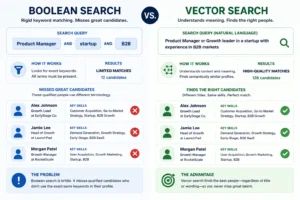
You have run this search before. LinkedIn: Product Manager AND 5+ years AND SaaS. Two thousand results. Half of them are account managers. A quarter mentioned SaaS once in a skills endorsement. The other quarter are project coordinators who handled one software product rollout three jobs ago.
So you tighten the search. More specific terms, more AND operators. Now you get 80 results and you know you have already missed the person who calls themselves a GTM leader, not a product manager, even though they have done exactly the job you need for the last four years.
This is the structural problem with Boolean search the technology most recruiting platforms still use today, including LinkedIn recruiting.
Boolean search was designed around exact keyword matching, which forces an impossible choice: cast wide and drown in irrelevant results, or go specific and miss qualified candidates who describe themselves differently. This challenge is widely documented in recruiting industry insights where talent acquisition experts regularly discuss the limitations of traditional keyword-based search approaches.
GoPerfect uses vector search candidate matching instead. Rather than looking for keyword overlap, the system converts candidate profiles into mathematical representations of meaning — skills, experience patterns, career context, company types, team dynamics. When you search for something, the system finds candidates whose vector representation is mathematically close to your requirements, regardless of whether the exact words match. That is how someone who built scalable customer acquisition systems shows up when you search for a growth-focused product leader. The meaning is close even when the words are not.
How Boolean Search Works (The Old Way LinkedIn Still Uses)
Boolean search runs on exact keyword matching. You use AND, OR, and NOT operators to combine or exclude terms. When you type Product Manager AND startup AND B2B, the system looks for profiles that contain all three of those specific phrases not the concepts behind them, just the literal character strings.
The practical consequence is an impossible choice. Run a specific Boolean search and you miss every qualified candidate who describes the same experience with different words. Broaden the search and you produce thousands of results that waste hours of screening time sorting out the irrelevant ones.
A candidate with Go-to-Market Strategy experience at early-stage companies selling to business customers has the exact background for many product roles. They will not appear in that Boolean search because their profile never used the words Product Manager, startup, or B2B. The experience is there. The matching is not.
To compensate, recruiters run the same search 15 different ways. Product Manager, then Product Lead, then GTM Manager, then Product Marketing Manager, then Head of Product, hoping they catch everyone who might fit by exhausting all the synonyms they can think of. It is tedious, it is slow, and it is still not complete.
Revenue Operations and Sales Operations are treated as completely unrelated terms despite the roles often requiring almost identical skills. Scaling fast-growing companies and startup experience mean the same thing to any experienced recruiter Boolean search cannot make that connection at all.
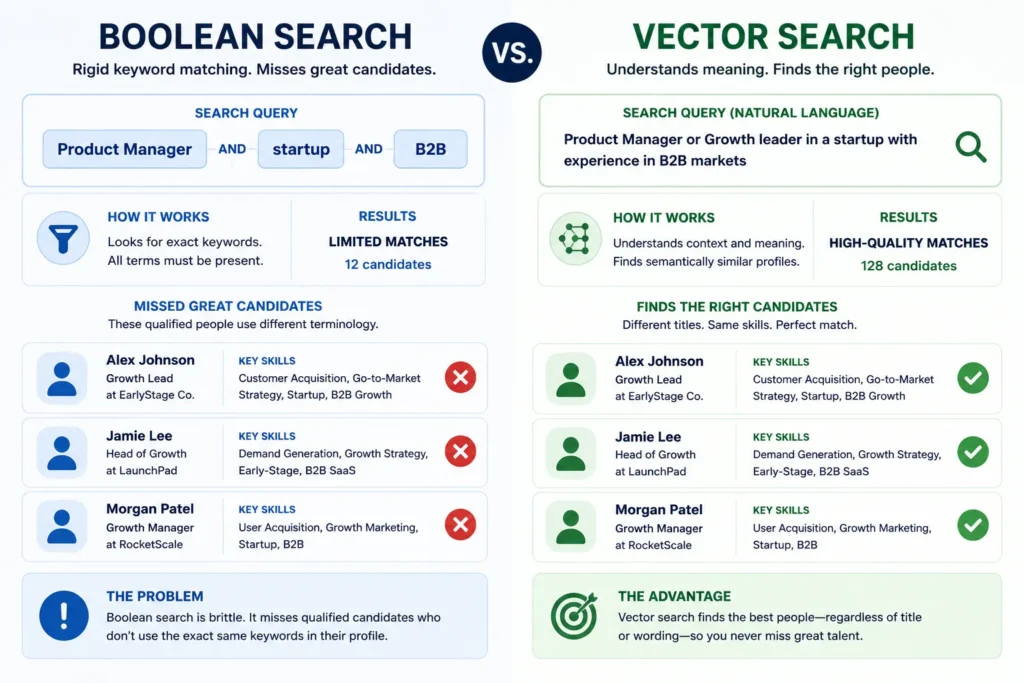
How Vector Search Works (The New Way GoPerfect Uses)
Vector search works differently at a fundamental level. Instead of looking for keyword matches, the technology converts candidate profiles into mathematical representations vectors that capture the meaning and context of someone’s experience rather than just the words they happen to use in their profile.
GoPerfect runs this on the Qdrant vector database, which processes candidate information as structured vector sets representing skills, experience patterns, company types, and career trajectories.
When you search for a Product Manager, the system does not look for that exact phrase. It finds candidates with product strategy backgrounds, feature development experience, cross-functional leadership history, and user research depth regardless of what their job titles actually say.
Someone who spent four years building customer acquisition systems for B2B SaaS companies has directly relevant experience for a growth-focused product role. The vector representation captures that underlying skill set and context. The candidate matching technology surfaces that person where Boolean search would leave them buried.
The decision intelligence layer goes further. It analyzes career progression patterns, project scope, team leadership depth, and technical background to separate candidates who genuinely match your requirements from candidates who simply use similar keywords in their profiles. A Revenue Operations Manager at a 50-person startup can score higher than a Senior Product Manager at a Fortune 500 company for the right early-stage role because the career context and company environment matter as much as the title.
This is the practical definition of agentic recruiting: a system that understands what you need at a contextual level, not just a keyword level, and makes matching decisions based on that understanding rather than waiting for you to run 20 search variations manually.
Real-World Impact: 30% Accuracy vs. Near-Perfect Accuracy
According to GoPerfect’s published Qdrant implementation case study, traditional recruiting tools that rely on Boolean keyword matching achieve roughly 30% accuracy in candidate recommendations — meaning 70 out of every 100 candidates you review do not actually fit your requirements well enough to advance. The case study documents how the shift to vector-based matching changed those numbers significantly. [Link to Qdrant case study when available.]
The practical arithmetic changes immediately. Instead of evaluating 100 candidates to identify 30 worth contacting, you evaluate 30 candidates and find 27 to 29 who genuinely match what you need. That is not a marginal improvement. It is a different kind of screening workflow entirely.
Fewer false positives means less pipeline clutter. Fewer false negatives means fewer qualified candidates getting missed because they described their experience in unexpected terms. The contextual candidate scoring system captures career pattern analysis that Boolean search structurally cannot — a candidate whose career is trending toward product leadership scores differently than someone moving away from it, even when both hold similar current titles.
The productivity impact reported by teams making this switch runs in the range of 60% to 70% reduction in initial screening time. Less time sorting irrelevant profiles means more time on the conversations that actually move hiring forward.
This technical innovation is why GoPerfect can source from 800 million candidate profiles without overwhelming recruiters with irrelevant results. The vector matching filters the database down to candidates who actually fit before you see their profiles.
GoPerfect vs. LinkedIn Recruiting: Which Tool Should You Choose?
Most recruiters already pay for LinkedIn Recruiter and face a reasonable question: does adding another platform make sense, or does it just add another login and another monthly cost?
The better question is not which tool is superior. It is which tool solves the specific bottleneck that is actually costing your team time and money right now. LinkedIn and GoPerfect address different parts of the recruiting workflow, and knowing that difference saves you from buying a solution to a problem you do not have.
LinkedIn Recruiting Strengths (Why It Still Wins in Some Cases)
LinkedIn Recruiter has real advantages for certain recruiting workflows. The platform connects you to professional profiles that people actively maintain updated career histories, current roles, recent accomplishments. When candidates are keeping their profile current, you are working with live information rather than stale data.
The interface is familiar if you already use LinkedIn daily for networking. Existing connections, messaging history, and past candidate conversations stay in one place rather than across three or four systems. For recruiters whose work is relationship-based, that continuity matters.
LinkedIn performs particularly well in industries where platform adoption is high and people actually check their messages. Tech professionals, finance specialists, sales leaders, and corporate executives typically maintain active LinkedIn presences and respond to recruiter outreach through the platform.
Direct messaging without routing through external tools is a genuine advantage for teams with compliance or security requirements around candidate communication. Every conversation stays inside one verified platform.
For maintaining long-term candidate relationships people who are not ready to move now but might be in six months LinkedIn provides continuity that is difficult to replicate in sourcing-focused tools. The conversation history and relationship context remain accessible across years, not just the current hiring cycle.
LinkedIn Recruiting Weaknesses (Where It Struggles)
Cost is a genuine barrier for smaller teams. Premium LinkedIn Recruiter licenses run several thousand dollars per seat per year, which means most small recruiting operations can only afford access for one or two people. When the whole team needs to source actively, that per-seat model gets expensive fast.
LinkedIn intentionally limits profile depth and contact information to keep users engaged inside the platform. Work histories are often incomplete. Extracting candidate data into your own tracking systems requires additional tools and workarounds rather than clean exports.
Despite whatever AI features LinkedIn has rolled out in recent iterations, the core search functionality still runs on Boolean keyword matching. All the limitations covered earlier in this article apply here missed candidates who use different terminology, irrelevant results when you broaden the search, dozens of search variations to catch everyone who might fit.
Account restriction risk becomes real the moment you try to scale outreach volume. LinkedIn flags accounts that send too many connection requests or messages in a short window as potential spam activity. Third-party automation tools that promise to bypass those limits carry even steeper risks permanent account restrictions that affect your personal profile, not just a company account.
The platform was built for relationship-based networking. High-volume passive candidate outreach at scale runs into those design assumptions quickly. That is not a criticism so much as a description of what the product was actually intended to do.
GoPerfect Advantages Over LinkedIn Recruiting
GoPerfect runs completely independently from your LinkedIn account. The platform accesses more than 800 million candidate profiles across multiple databases without ever touching your personal LinkedIn profile or triggering any account restrictions. That independence is not a minor convenience it removes the ceiling that most LinkedIn-based sourcing operations hit within a few months of scaling up.
You can run high-volume sourcing campaigns, reach hundreds of candidates per week across multiple positions, and test different outreach approaches without any exposure to LinkedIn’s spam detection or account restriction policies. The automation is native to the platform rather than built through third-party tools that operate in a legal gray area around platform terms of service.
The vector search candidate matching surfaces people who would never appear in LinkedIn’s Boolean searches. A candidate whose background includes building customer acquisition systems matches a search for growth marketing leader even when none of those specific words overlap between profile and query.
For teams sourcing at scale dozens or hundreds of candidates per week across multiple simultaneous openings GoPerfect handles volume that would flag a LinkedIn account inside a week. And because the pricing is based on positions or usage rather than per recruiter seat, smaller teams with multiple people needing access may find the cost structure works more favorably than LinkedIn’s per-seat model. That said, GoPerfect does not publish standard pricing, so that comparison requires a direct demo quote against your current LinkedIn Recruiter costs.
When You Should Still Use LinkedIn (Honest Assessment)
LinkedIn makes sense when relationship continuity matters more than sourcing volume. If you recruit in tight-knit industries where maintaining long-term candidate relationships drives your success, LinkedIn’s persistent conversation history provides value.
Industries with extremely high LinkedIn adoption rates still favor the platform. When 90% of your target candidates actively use LinkedIn and respond to messages there, you meet candidates where they already spend their professional time.
If you already have an active LinkedIn Recruiter license paid for and you are not hitting the platform’s volume limits, adding a second tool might create unnecessary complexity rather than solve a real problem.
Direct messaging without third-party tools matters to some recruiting teams for compliance or security reasons. LinkedIn keeps all communication within one verified platform rather than routing through external systems.
But if you are spending 15 hours per week manually screening candidates, hitting LinkedIn’s outreach limits, or missing qualified candidates who use different job titles and terminology, GoPerfect solves problems that LinkedIn cannot address. To understand how GoPerfect stacks up against other options in the market, review our guide to best AI recruiting tools which evaluates multiple platforms side-by-side.
Best Use Cases: When GoPerfect Is the Right Choice (And When It’s Not)
Every recruiting tool claims to solve your hiring problems. The question is whether GoPerfect solves YOUR specific bottleneck or just adds another login to your daily workflow.
I see recruiters make this mistake constantly. They adopt platforms that work great for high-volume hiring when their real problem is executive search quality. Or they invest in sourcing tools when their bottleneck is actually scheduling and coordination.
The right platform depends entirely on identifying your biggest recruiting bottleneck first. GoPerfect excels in specific scenarios and falls short in others. Being honest about both sides helps you make the right decision.
GoPerfect Works Great For: High-Volume Recruiting
Teams that receive 100 or more applications per opening will see immediate value from GoPerfect. The AI candidate screening eliminates the manual resume review that typically consumes 15 to 20 hours per week when you are managing high application volume.
The platform handles the multi-stage filtering that makes high-volume recruiting work. Start with 1,000 applications, the AI screens down to 500 viable candidates, contextual scoring narrows that to 200 worth reviewing, automated assessment filters to 50 qualified matches, deeper analysis identifies 15 strong candidates, and you interview the final 5.
This time-to-hire reduction matters most for recruiting agencies managing multiple client positions simultaneously. When you are juggling 10 open roles across different companies, spending 2 hours per position instead of 15 hours changes your entire operation.
Staffing firms with continuous hiring needs for similar roles benefit from the template workflows. Once you set up the screening criteria for a Customer Success Manager role, every new CSM position uses those same parameters without rebuilding the process from scratch.
Growing tech companies hiring across multiple departments at once see the biggest impact. Product, engineering, sales, marketing, and operations teams all hiring simultaneously creates volume that overwhelms traditional manual screening.
GoPerfect Works Great For: Passive Candidate Sourcing
When your main recruiting problem is finding enough qualified candidates rather than screening too many applications, GoPerfect’s database becomes the primary value.
Sourcing passive candidates who are not actively job hunting requires reaching beyond the usual channels. The platform searches over 800 million candidate profiles across databases that most recruiters never access manually.
This matters most when you are recruiting niche technical skills in tight labor markets. A backend engineer with specific cloud infrastructure experience might exist in your city but never posts on LinkedIn or responds to job board listings.
The semantic search finds people who describe their background using different terminology than your job posting. Someone calling themselves a “Revenue Operations Analyst” might be exactly the “Sales Operations Manager” you need, but traditional searches would miss them completely.
Passive candidate outreach at this scale means contacting dozens of qualified people per week rather than hoping the right person applies to your posting. You find candidates before your competitors do rather than competing for the same active job seekers everyone else contacts.
GoPerfect Works Great For: Scaling Your Recruiting Operation
Small recruiting teams that need to produce results comparable to much larger operations get the most leverage from talent acquisition automation. A team of 2 to 3 recruiters can handle the workload that traditionally required 5 to 7 people.
This is where AI recruiting tools for small teams create genuine competitive advantage. You maintain hiring quality while increasing volume without proportionally increasing headcount.
Startups building their recruiting function from scratch can implement automation from day one rather than developing manual processes that later need replacement. The platform grows with your hiring needs instead of requiring migration to enterprise systems as you scale.
The hiring team productivity gains come from eliminating repetitive work rather than cutting corners. Your recruiters spend time on actual conversations with qualified candidates instead of reading hundreds of resumes that do not match your requirements.
Which is exactly what the platform is designed to do.
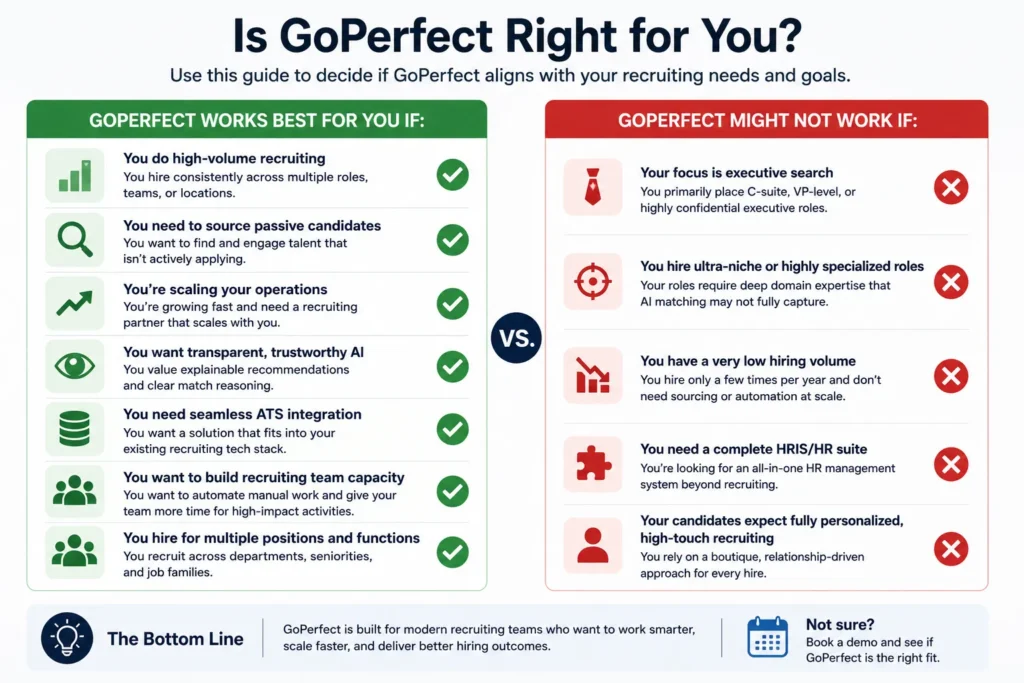
When GoPerfect Isn’t the Right Choice
Ultra-niche executive search requires a completely different approach. Recruiting C-suite positions, board members, or highly specialized technical fellows demands high-touch relationship building that automation cannot replace.
High-value candidates in extremely competitive markets often dislike automated screening. When you are recruiting senior engineering leaders who receive 20 recruiter messages per week, the automated outreach can hurt your candidate experience rather than help it.
If your main recruiting bottleneck is not sourcing or screening, GoPerfect will not solve your actual problem. Teams struggling with interview scheduling should look at Calendly or Paradox instead. Organizations with disorganized hiring processes need better ATS systems like Greenhouse or Lever before adding automation tools.
Companies requiring full recruiting suites that include HRIS integration, onboarding workflows, and employee lifecycle management will find GoPerfect too narrow in scope. The platform specializes in sourcing and screening, not complete talent management.
And if you are currently processing fewer than 50 applications per month across all open positions, the automation probably creates more complexity than it eliminates. Manual screening still works fine at that volume.
If you’ve determined GoPerfect doesn’t match your recruiting needs, explore other recruiting platforms that might offer a better fit for your specific workflow and budget. Different tools excel in different scenarios.
Integration & Your Existing Recruiting Stack
The fastest way to kill adoption of any new recruiting tool is forcing your team to abandon systems they already know and rebuild their entire workflow from scratch.
I see this pattern constantly. A team invests in a powerful sourcing platform, then realizes it does not sync with their ATS. Candidate data gets entered manually twice. Information lives in three different places. Within two months, the new tool gets abandoned because it created more work instead of less.
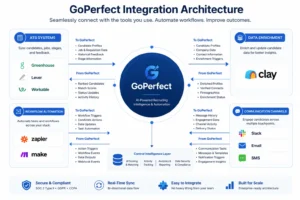
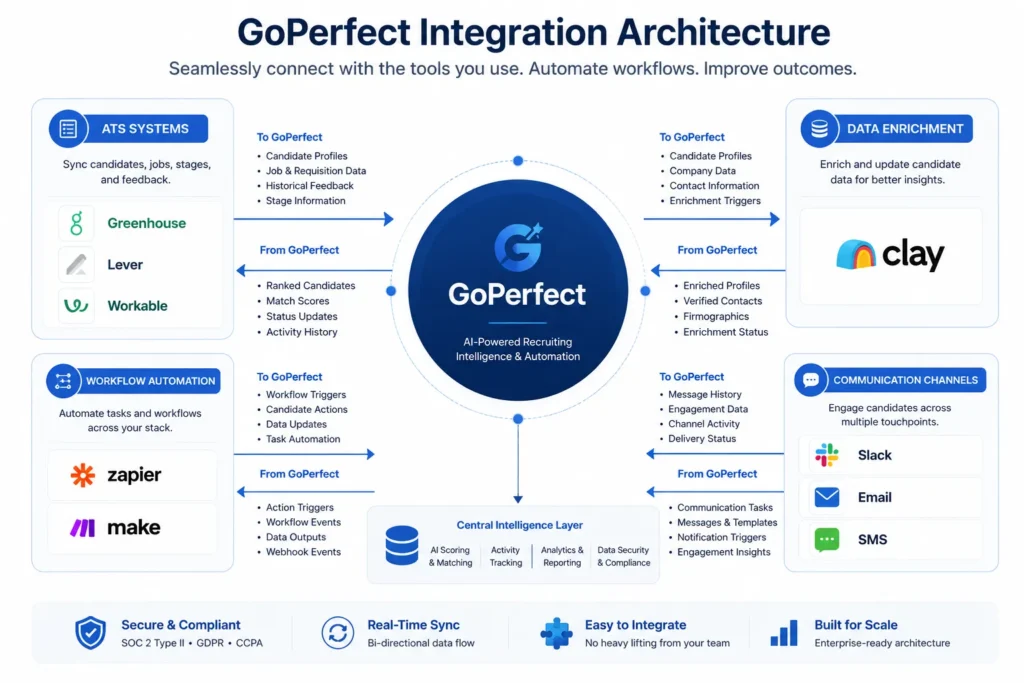
GoPerfect handles recruiting workflow automation by plugging into your existing systems rather than replacing them. The platform assumes you already have an ATS, probably use a CRM for pipeline management, and might run Slack for team communication.
The integration architecture determines whether GoPerfect enhances your current process or becomes another isolated tool that nobody uses consistently.
ATS Integration (Getting Candidates Into Your System)
GoPerfect connects directly with major applicant tracking systems without requiring custom development work. The platform supports Greenhouse, Workable, Lever, Pinpoint, Ashby, BreezyHR, iCIMS, and most other enterprise ATS platforms through standard API connections.
Candidates that GoPerfect sources and screens automatically appear in your ATS with complete profile information, screening scores, and initial interaction history. You see them in the same interface where you manage candidates from job board applications and employee referrals.
This eliminates the manual data entry work that kills productivity with standalone sourcing tools. No copying candidate information from one system into another. No duplicate records. No lost context about where each candidate came from or what screening they already passed.
The ATS integration works bidirectionally, meaning updates in either system sync automatically. When you move a candidate to the interview stage in your ATS, that status change reflects back in GoPerfect so the platform stops sending additional outreach to someone already in your active pipeline.
Talent pipeline automation only works when candidate data flows cleanly between systems. The moment you have to manually bridge gaps between platforms, the automation advantage disappears.
CRM and Recruiting Operations (Organizing Your Pipeline)
GoPerfect focuses specifically on sourcing and screening. Recruiting CRM systems like Recruiterflow, Bullhorn, or HubSpot handle the relationship management and long-term pipeline organization that happens after initial candidate discovery.
The workflow typically looks like this. GoPerfect finds and screens candidates who meet your criteria. Those qualified candidates flow into your recruiting CRM where you manage ongoing communications, track relationship history, and coordinate team collaboration around hiring decisions.
Recruiterflow works particularly well with GoPerfect because the CRM connects cleanly with workflow automation tools like Zapier and Make. All your outreach data, candidate interactions, and screening results centralize in one database even when the activities happen across multiple platforms.
This recruiting workflow automation separates the high-volume initial sourcing from the relationship-focused pipeline management. The AI handles finding and filtering candidates at scale. Your team handles the human relationship work that actually closes candidates.
Teams managing recruiting operations across multiple departments or client accounts need this separation. Sourcing 50 candidates per week requires different tools than maintaining relationships with 200 active prospects over several months.
Full-Stack Automation for Recruiting Agencies: How to Build Your Complete Talent Acquisition System with GoPerfect
Recruiting agencies managing dozens of client placements simultaneously can build complete talent acquisition automation using GoPerfect as the sourcing foundation. I’ve watched agencies scale from 5 to 50 placements per month by connecting GoPerfect to their existing tools instead of trying to do everything in-house.
This architecture connects five or six specialized tools, and the exact setup depends on your current system.
GoPerfect handles candidate sourcing and initial screening. Clay enriches candidate profiles with additional data from multiple sources. Zapier or Make routes candidates through conditional workflows based on their AI scores. Slack sends team notifications when high-value candidates appear. Smartlead or Lemlist manages multi-channel outreach across email and messaging platforms. Your ATS stores the final candidate records and tracks placement progress.
This stack matters for agencies because each tool handles one specific job. You don’t get bloated software trying to do everything poorly. You get specialized tools doing one thing extremely well, connected through automation so candidates move forward without anyone manually pushing them
How Candidates Move Through Your Workflow
Each candidate moves through this system automatically based on their screening scores and specific profile characteristics. Candidates above 4.0 get premium outreach with personalized messaging. 3.0-4.0 go to standard campaigns. Below 3.0 are filtered out without human review, which I know sounds harsh but actually saves your team hours every single week.
This only makes sense if you’re processing hundreds of candidates weekly across 20 or 30 active client positions. The system handles the repetitive filtering and routing work. Your recruiters focus exclusively on conversations with qualified candidates instead of wasting time on obvious mismatches.
In-house recruiting teams with lower volume don’t need this complexity. Direct ATS integration with basic Slack notifications handles most internal hiring needs without requiring a six-tool stack. The added cost and system complexity isn’t worth it when you’re only hiring for one or two roles monthly.
For agencies, this completely changes how you think about productivity. You stop paying by the hour. You pay by placement. Same recruiter. Three times the output. Same headcount. Three times the revenue. That’s the real shift.
The ROI Case: How Much Time and Money Does GoPerfect Actually Save?
CFOs and finance teams don’t care about semantic search. They care about one thing: does this save money or not?
I see recruiting teams struggle to justify these investments because they present features instead of financial impact. Your VP of HR doesn’t approve budget for ‘better candidate matching.’ They approve budget for ‘reducing cost per hire by 40% while maintaining quality.’ That’s a completely different conversation
The recruitment ROI case for GoPerfect comes down to three measurable improvements. First: recruiter time savings. Second: reduced cost per hire. Third: faster time-to-hire that keeps top candidates from accepting competitor offers. Let me show you the actual numbers using data from recruiting teams that track these metrics carefully.
Let me show you the actual numbers using data from recruiting teams that track these metrics carefully.
Time Savings Breakdown (Where the 25 Hours Go)
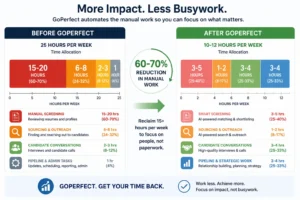
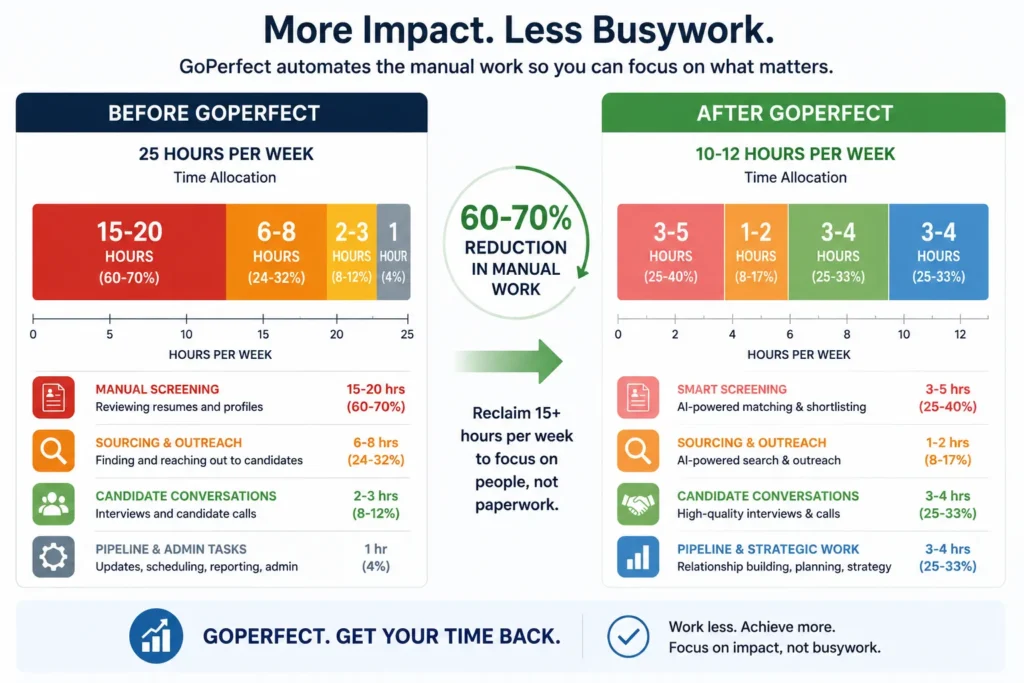
Manual resume screening kills a recruiter’s week. I’m talking 15 to 20 hours minimum. You’re reading 100 applications for one position. That’s 2 to 3 minutes per person when you’re actually paying attention instead of skimming. And you have to pay attention or you miss good candidates. That’s just the time spent reading. It doesn’t include copying information into your system, flagging candidates, or scheduling initial screens.
GoPerfect AI candidate screening cuts that workload down to 3 to 5 hours per week. The system filters out obviously unqualified candidates automatically. Candidates scoring above 4.0 get approved without manual review. Those scoring below 3.0 get filtered out. You only spend your time evaluating the middle range where your judgment actually matters.
That frees up 10 to 15 hours per week of pure screening work. LinkedIn sourcing is another hidden time drain. Manually building candidate lists for multiple positions eats 6 to 8 hours per week that you’re not even thinking about. You run searches. Review profiles. Track who you’ve contacted. Follow up on non-responses. That’s a lot of repetitive work that doesn’t directly produce placements.
GoPerfect handles this sourcing work in 1 to 2 hours per week. The semantic search finds qualified candidates immediately instead of requiring you to try dozens of keyword variations hoping you’ll catch everyone who might fit.
The realistic total time savings ranges from 12 to 18 hours per week per recruiter. When you combine extensive sourcing with high-volume screening, hitting that 25-hour savings mark becomes realistic.
Your recruiters actually spend their time talking to good candidates. Not reviewing resumes from people who barely read the job posting.
Cost Per Hire Calculation (Real Numbers)
Let’s talk about recruiter cost. Full salary including benefits, taxes, overhead—you’re looking at $60k to $80k annually. Breaks down to roughly $30 to $40 per hour of actual work they’re billing to your organization though this varies significantly by location and company size.
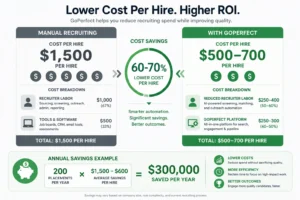
Manual recruiting typically requires 40 to 60 hours of total recruiter time per successful hire when you count sourcing, screening, interview coordination, and candidate relationship management. If I use 50 hours at $35 per hour, I get $1,750 in direct recruiter labor cost per hire. That’s before any software, job boards, or recruitment agency fees.
Add recruiting software licenses, job board fees, and other tools to that number, and your all-in cost per hire often reaches $2,000 to $2,500 for mid-level professional positions. For senior roles, the multiple increases significantly. For junior roles, you might see lower costs but also longer hiring cycles.
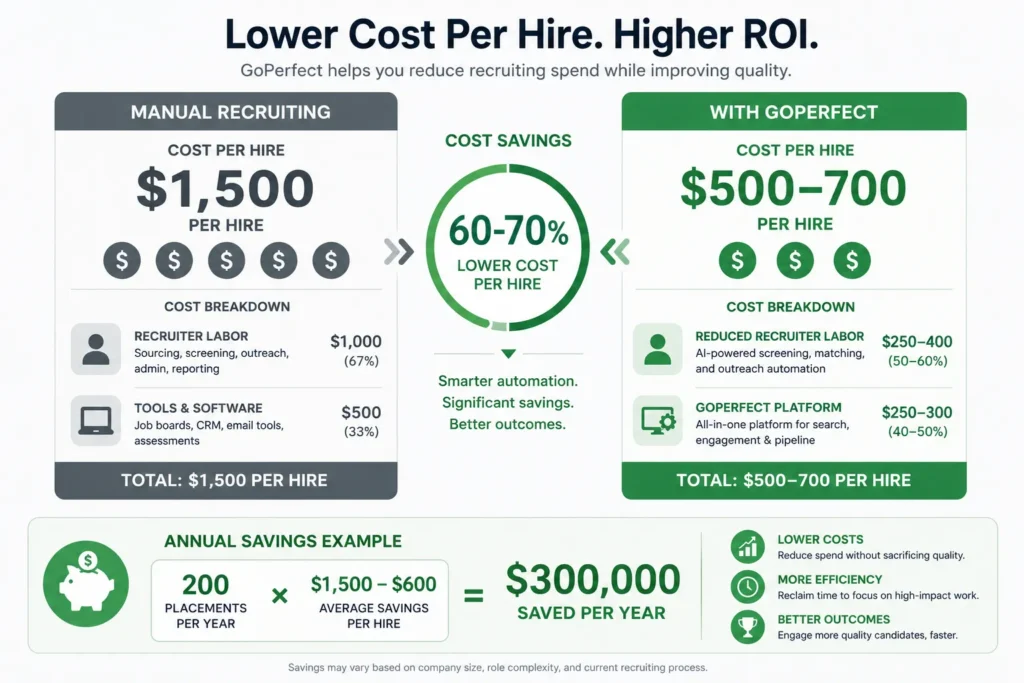
GoPerfect reduces the recruiter time investment to roughly 15 to 20 hours per hire through recruitment funnel optimization. The AI handles 30 to 35 hours of sourcing and screening work that previously required manual effort. Your actual recruiter cost per hire drops to $500 to $700.
That’s a 60% to 70% reduction in direct recruiting labor costs. I should mention this assumes you’re currently paying for LinkedIn Recruiter and job board credits. GoPerfect doesn’t eliminate all software costs, but it shifts spending from passive job posting toward active sourcing.
Here’s what this means for a staffing firm. Ten recruiters working manually can complete roughly 200 placements per year at $1,500 average cost per hire. That’s $300,000 in direct recruiting labor costs annually.
Those same ten recruiters using GoPerfect can handle 350 to 400 placements per year because they spend less time on each one. The firm generates significantly higher revenue with the same headcount while reducing cost per hire by more than half. And that’s before you factor in the faster time-to-hire reducing candidate dropout.
For internal recruiting teams, cost savings typically get reinvested into hiring more people or managing growth without adding recruiting headcount. You don’t get the revenue multiplier that agencies see, but you do get productivity multiplier.
Time to Hire Speedup (Competitive Advantage)
Manual recruiting takes 21 to 28 days from job open to shortlist. You spend most of that time sourcing and screening. Not scheduling interviews. Not anything else. Sourcing and screening. Not offer negotiation. Sourcing and screening.
GoPerfect compresses the candidate identification and screening phase down to 5 to 7 days. The semantic search finds qualified candidates within hours instead of days. Automated screening eliminates the backlog that creates week-long delays between application submission and first recruiter review.
This speed advantage matters most in competitive hiring markets. When you’re recruiting software engineers, product managers, or other in-demand roles, the best candidates receive multiple offers within two weeks of starting their job search. You have maybe 10 days to present an opportunity or they move on to someone else.
Cutting your screening time from three weeks to one week means you reach qualified candidates before they accept competing offers. And that’s the real competitive advantage. Not better resumes. Not fancier interviews. Speed.
Every day a revenue-generating role stays unfilled costs the company money in lost productivity and delayed projects. Reducing time to hire from 28 days to 7 days saves 21 days of opportunity cost per position. When you’re filling 20 or 30 positions simultaneously, that compounds fast.
Should You Try GoPerfect? The Honest Verdict
Most people finish reading about AI recruiting tools and still have no idea whether the platform actually solves their specific recruiting problem. Features lists don’t help you decide. Marketing claims don’t help either.
The decision comes down to one question: does GoPerfect solve your biggest recruiting bottleneck?
I want to give you a practical decision framework based on everything we’ve covered. This isn’t a sales pitch. It’s a realistic assessment of when GoPerfect makes sense and when it doesn’t.
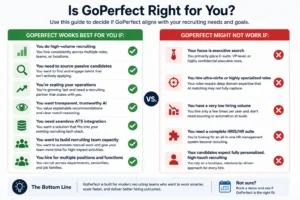
GoPerfect Is Right for You If:
✓ You spend 15+ hours per week on manual screening. This time consumption is your primary bottleneck. The AI screening feature eliminates most of this work, letting you focus on conversations with qualified candidates instead of reading resumes.
✓ Your challenge is evaluation, not just sourcing. You get plenty of applications but struggle to identify qualified candidates quickly. GoPerfect’s transparent AI scoring handles the filtering that currently consumes your entire week.
✓ You want to reach passive candidates. The platform searches over 800 million profiles using semantic matching — finding people traditional keyword searches miss entirely.
✓ You’re building or scaling high-volume hiring. Recruiting agencies, staffing firms, and growing companies handling multiple simultaneous positions see the biggest productivity gains.
✓ You want transparency in AI decisions. GoPerfect shows exactly why it scored each candidate, letting you understand and adjust the logic. No mysterious black-box recommendations.
✓ You already have an ATS. You want enhancement, not replacement. GoPerfect integrates with your existing workflow instead of forcing you to abandon systems that already work.
✓ You need to scale without adding headcount. The time savings let smaller teams handle workloads that traditionally required much larger recruiting departments.
GoPerfect Might Not Work for You If:
✗ Your bottleneck is interview scheduling or relationship management. GoPerfect won’t solve those problems. If you struggle with hiring decision coordination or managing candidate relationships, you need a different tool.
✗ You focus on executive search or ultra-niche recruiting. Senior-level candidates often prefer personalized outreach and may react negatively to automated screening. High-touch relationship building is your real value, not AI sourcing.
✗ You’re a solo recruiter handling under 20 positions annually. The platform overhead might exceed the time savings when your volume is low. Better to stay manual at that scale.
✗ You need a complete recruiting suite. You want onboarding workflows, HRIS integration, and everything else in one system. GoPerfect handles sourcing and screening specifically. Workable or Greenhouse is a better fit if you want broader functionality.
✗ Your candidates strongly dislike automation. Very high-value talent in competitive markets sometimes prefer traditional recruiting approaches and will opt out of automated processes. You’ll lose your best prospects.
Next Steps If You’re Interested
Start here: identify your actual recruiting bottleneck. Track how many hours you spend on sourcing versus screening versus interviewing versus administrative work. The area consuming most of your time should match what GoPerfect optimizes. This data point matters more than anything else. Write it down.
Next, request a demo from GoPerfect to see the platform in action with your specific requirements. Ask them to walk through a real job opening instead of generic examples. Use your data about current time spend to guide the conversation.
Before committing, test the platform on one actual position. Use real candidate data. Measure actual time savings versus your current manual process. Most platforms offer trial periods. Use them to validate the productivity improvement claims.
Then evaluate the ROI. Take your measured time savings. Compare against their quoted cost. Factor in your current cost per hire. Calculate the value of faster time to hire. Make the financial decision based on numbers, not gut feeling.
Your final choice should be based on demonstrated value and process fit, not feature comparisons. The right platform is the one that solves your specific bottleneck profitably.
If GoPerfect matches your needs based on this framework, visit goperfect.com to request a demo and evaluate the platform with your actual recruiting workflow data.
Common Questions About GoPerfect
Every recruiter asks the same questions. I’m going to answer them honestly. Not the marketing version. The real answer based on what I’ve seen.
These are the questions that actually matter when you’re deciding whether GoPerfect solves your specific recruiting bottleneck or just adds another tool to your already crowded stack.
How Much Does GoPerfect Cost?
GoPerfect doesn’t publish standard pricing on their website. Pricing is custom based on your team size, monthly candidate volume, and which features you need. This is actually smart for them because a three-person recruiting team has completely different needs and budget constraints than a 30-person enterprise talent acquisition department.
You’ll need to book a sales demo to get an actual quote. But that’s worth doing because you can come prepared with the right information.
Start by calculating your current cost per hire. Track how many hours per week you spend on manual screening and sourcing. Bring those numbers to your demo conversation. That gives you a real baseline to evaluate whether the platform ROI justifies the investment for your specific situation.
Can I Use GoPerfect Without a Premium LinkedIn Recruiter License?
Yes. GoPerfect operates completely independently from LinkedIn recruiting.
The platform accesses over 800 million candidate profiles from multiple databases without requiring a Recruiter license or touching your personal account. This eliminates the account restriction risks that come with LinkedIn automation tools.
You can use GoPerfect as your only sourcing tool or run it alongside LinkedIn if you want both platforms. The choice is yours. But you don’t need to pay for premium access to make GoPerfect work.
That independence also means no risk of getting your personal profile banned or restricted for aggressive outreach that violates platform terms of service.
Will GoPerfect Actually Save Me 25 Hours Per Week?
The 25 hours per week savings is achievable if you’re currently spending 15 or more hours manually screening resumes AND another 8 to 10 hours sourcing passive candidates across multiple platforms. Most recruiters handling high-volume hiring hit both of those numbers.
If your primary bottleneck is screening specifically, expect realistic time savings of 10 to 15 hours per week. The AI handles the bulk of resume evaluation work. You only review candidates in the middle scoring range where your judgment actually matters.
If your bottleneck is something other than sourcing or screening like interview scheduling or candidate relationship management the time savings will be less. Maybe 4 to 6 hours per week instead of 25.
The real question isn’t “Will this save me 25 hours?” It’s “Will this tool solve the specific task consuming most of my week right now?” If the answer is yes, the time savings follow automatically.
Is GoPerfect’s AI Screening Transparent or a Black Box?
GoPerfect shows its work. When the AI scores a candidate at 4.2 out of 5, you see the specific reasoning behind that score. You see which criteria the candidate met. What experience aligns with your role requirements. What gaps exist in their background.
That transparency matters because you can override decisions that don’t make sense. And you can understand exactly why the AI weights certain factors the way it does.
Most AI systems are black boxes. You get a score. No explanation. No way to audit the logic. GoPerfect isn’t like that. You can adjust the scoring criteria when the AI weights factors differently than you would. You can improve the system over time as you refine what good candidates actually look like for your specific roles.
Should I Use GoPerfect Instead of an ATS or CRM?
No. GoPerfect is not an ATS replacement. And you shouldn’t try to use it that way.
The platform handles sourcing and screening specifically. It finds candidates. Evaluates them. That’s it. Your ATS like Greenhouse, Workable, or Lever does the heavy lifting: tracking candidates through your complete hiring workflow from application through offer acceptance. Use GoPerfect with your ATS through direct integration, not instead of your existing system.
Best practice for most recruiting teams looks like this. GoPerfect finds and evaluates candidates. Those qualified candidates flow into your ATS where you manage interview scheduling and hiring decisions. If you manage large pipelines with long sales cycles, add a recruiting CRM to handle relationship tracking over months or years.
It’s not complicated. Different tools. Different jobs. Different value.
Does GoPerfect Work for Recruiting Agencies or Just In-House Teams?
Both work well, but recruiting agencies often see bigger impact.
In-house recruiting teams benefit from the time savings and better candidate matching. Agencies benefit from those same advantages plus the ability to source qualified candidates quickly across multiple client positions that require completely different skill sets.
When you’re managing 15 different open roles for 8 different clients simultaneously, the ability to source 100 qualified candidates per week across all those positions changes your entire operation. The sourcing speed and screening accuracy let smaller agency teams handle client loads that would normally require twice the headcount. Two recruiters can produce what used to take four. That’s revenue-positive growth without adding salary expense.
Will AI Tools Like GoPerfect Eliminate HR and Recruiting Jobs?
AI tools eliminate specific tasks, not entire jobs. The tasks that disappear are the low-value manual work like reading hundreds of resumes, copying candidate data between systems, and tracking down contact information. Nobody’s career was built on resume reading.
Recruiters who master these tools have higher demand and better job security than recruiters who refuse to adapt. I’ve watched this exact pattern in software development over the last two years. Developers who adopted AI coding assistance are in extremely high demand. Developers who insisted on purely manual coding are struggling.
Recruiting is following the same path. HR professionals who learn to work alongside AI recruiting tools become more valuable to their employers. Those who resist the technology end up competing against teams that move significantly faster with the same headcount. You can’t win a productivity war by refusing to use faster tools.
The job changes from doing repetitive work to managing systems that handle repetitive work. You focus on relationship building. You focus on candidate experience. You focus on decisions that only a human can make. That’s worth doing.
How Does GoPerfect Compare to Juicebox, Fetcher, and Other AI Sourcing Tools?
Different platforms solve different parts of the recruiting pipeline. Fetcher focuses purely on candidate sourcing finding people who might fit your job. Juicebox combines sourcing with outreach templates so you can contact people automatically. GoPerfect handles sourcing, screening, and automated engagement as one integrated workflow.
Here’s the practical difference. With Fetcher, you get a list of candidates to evaluate yourself. With GoPerfect, the system evaluates them first using semantic search that finds people based on meaning rather than keyword matching. You get fewer candidates overall, but higher quality matches that are worth your time to contact.
GoPerfect also uses what they call “agentic AI” basically, the system acts autonomously rather than just producing lists for you to manually process. It actually thinks about fit instead of just outputting names.
The right choice depends on your bottleneck. If finding candidates is your problem, Fetcher works. If evaluating whether they actually fit is your problem, GoPerfect solves more of that. For a deeper dive into how these platforms compare against others in the market, check out our comprehensive AI recruiting tools comparison which evaluates the strengths and weaknesses of each major platform.